
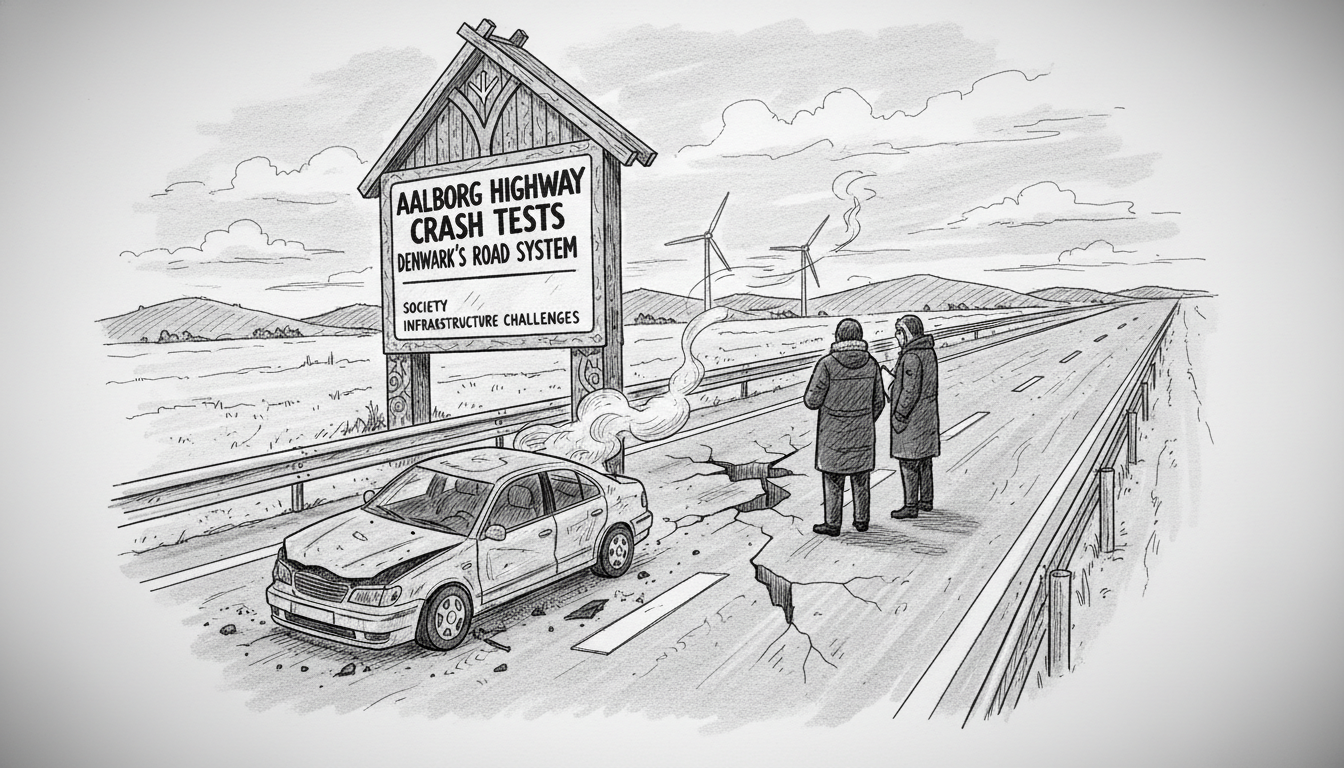
Denmark's E45 motorway near Aalborg was the scene of a disruptive traffic accident on Wednesday evening, forcing authorities to close the Humlebakken exit. The incident, reported by the Danish Road Directorate just after 7:15 PM, brought emergency services to a critical juncture of Scandinavia's main north-south artery. This disruption on the Nordjyske Motorway highlights the fragile balance of Denmark's transportation network and its wider impact on regional mobility and commerce.
Initial reports indicated a full closure of the Humlebakken exit southbound, a vital link for traffic entering and leaving Aalborg. By approximately 7:40 PM, the Road Directorate confirmed the closure. Authorities later downgraded the situation, allowing careful passage past the accident site as emergency crews worked. Police and rescue services remained on scene to manage the aftermath and clear the wreckage. For commuters and freight drivers, the event caused immediate delays and rerouting through one of Northern Denmark's busiest corridors.
The Vital Artery of the Nordics
The E45 is far more than a Danish road; it is the longest north-south motorway in Europe. Its route stretches from Karesuando in Sweden to Gela in Italy, making the Danish section a crucial segment for international transport. In Jutland, the E45 functions as the spinal column for regional logistics. An accident at a key exit like Humlebakken creates a bottleneck effect. This disrupts not just local travel but also the flow of goods between Denmark, Sweden, and Germany. The economic ripple effects, though often temporary, underscore the infrastructure's strategic importance. Every minute of closure has a calculable cost in delayed deliveries and lost productivity.
My own reporting on Danish society news often focuses on integration and social policy. From that perspective, reliable infrastructure is a silent pillar of the social contract. When major roads fail, it affects everyone equally—the native-born commuter, the international truck driver, the immigrant family on a road trip. The efficient response of authorities like the Road Directorate (Vejdirektoratet) reinforces public trust in the system. This trust is fundamental to the Danish welfare model, which depends on high-functioning public services and collective confidence in their operation.
Emergency Protocols in Action
The response to the Humlebakken accident followed established Danish emergency protocols. The Road Directorate's role is to provide real-time information to the public while coordinating with police and rescue units. Their swift public updates via traffic systems are a key component of crisis management. Denmark has invested heavily in intelligent transport systems aimed at minimizing disruption. These include variable message signs, coordinated detour routes, and close liaison with municipal traffic centers. The fact that the site moved from 'closed' to 'passable with care' within a short period suggests a controlled and effective clearance operation.
Statistics from the Danish Road Directorate show that while serious accidents on motorways are less frequent than on rural roads, their impact is magnified by the high traffic volumes. In 2022, the latest full year of published data, motorways accounted for a smaller proportion of fatal accidents but a significant share of non-fatal injury crashes due to speed and congestion. Each incident triggers a review of road design and safety features. Exits and merges, like Humlebakken, are often points of heightened risk where traffic patterns change abruptly.
A Broader View on Transportation Policy
This single accident invites a broader discussion about Denmark's transportation priorities. The country is championing a green transition, with ambitious goals to reduce carbon emissions. A reliable and safe road network is paradoxically essential to this shift. It supports the electric vehicle charging infrastructure and is critical for the buses and service vehicles that keep cities running. Congestion caused by accidents directly undermines environmental targets by increasing idling time and fuel consumption. Therefore, road safety and traffic management are not standalone issues. They are deeply intertwined with national climate policy and economic planning.
From my vantage point covering Copenhagen integration and Danish social policy, I see how transportation access influences social inclusion. A well-maintained road network ensures people can reach jobs, education, and services across regions. For new residents learning to navigate Danish society, predictable and safe infrastructure is a form of welcome. It provides a sense of order and reliability. Conversely, when the system falters, it can feed narratives of inefficiency or inequality, particularly if disruptions chronically affect certain areas. The fairness of infrastructure investment is a recurring theme in Danish political discourse.
The Human Factor in Automated Systems
Despite advanced technology, the human element remains paramount in traffic safety. Driver attention, vehicle maintenance, and adherence to speed limits are the ultimate determinants of safety on roads like the E45. Danish driver education is rigorous, and traffic laws are strictly enforced, contributing to the country's strong road safety record. However, the pressure of commercial deadlines, distraction from mobile devices, and simple human error can defeat even the best systems. The aftermath of an accident is a stark reminder that behind every traffic alert are individuals and families affected.
The Danish welfare system is designed to catch those who fall victim to such events, providing healthcare and social support. This safety net is a point of national pride. Yet, prevention is always superior. The ongoing investment in road maintenance, clear signage, and driver awareness campaigns reflects a proactive approach cherished in Danish social policy. It is a policy of preventing harm before it occurs, a principle that extends from healthcare to urban planning.
Looking Down the Road
As the cleanup at Humlebakken concluded and traffic normalized, the questions linger. Was this a preventable accident? Are there design improvements needed at that exit? How can response times be even faster? The Danish model is characterized by constant evaluation and iterative improvement. Data from this incident will be logged, analyzed, and potentially used to inform future upgrades. This commitment to data-driven refinement is what maintains public confidence.
The E45 will continue to carry the lifeblood of regional commerce and connectivity. Its reliability is not assumed but actively maintained through the work of agencies like the Road Directorate and the daily vigilance of drivers. For a nation so deeply connected to Europe, both literally and figuratively, keeping this artery flowing smoothly is a quiet but essential task. It is a testament to the often-invisible work that upholds the structure of daily life and the broader ambitions of the Danish state. The true test of any system is not that it never fails, but how quickly and effectively it recovers when it does.