
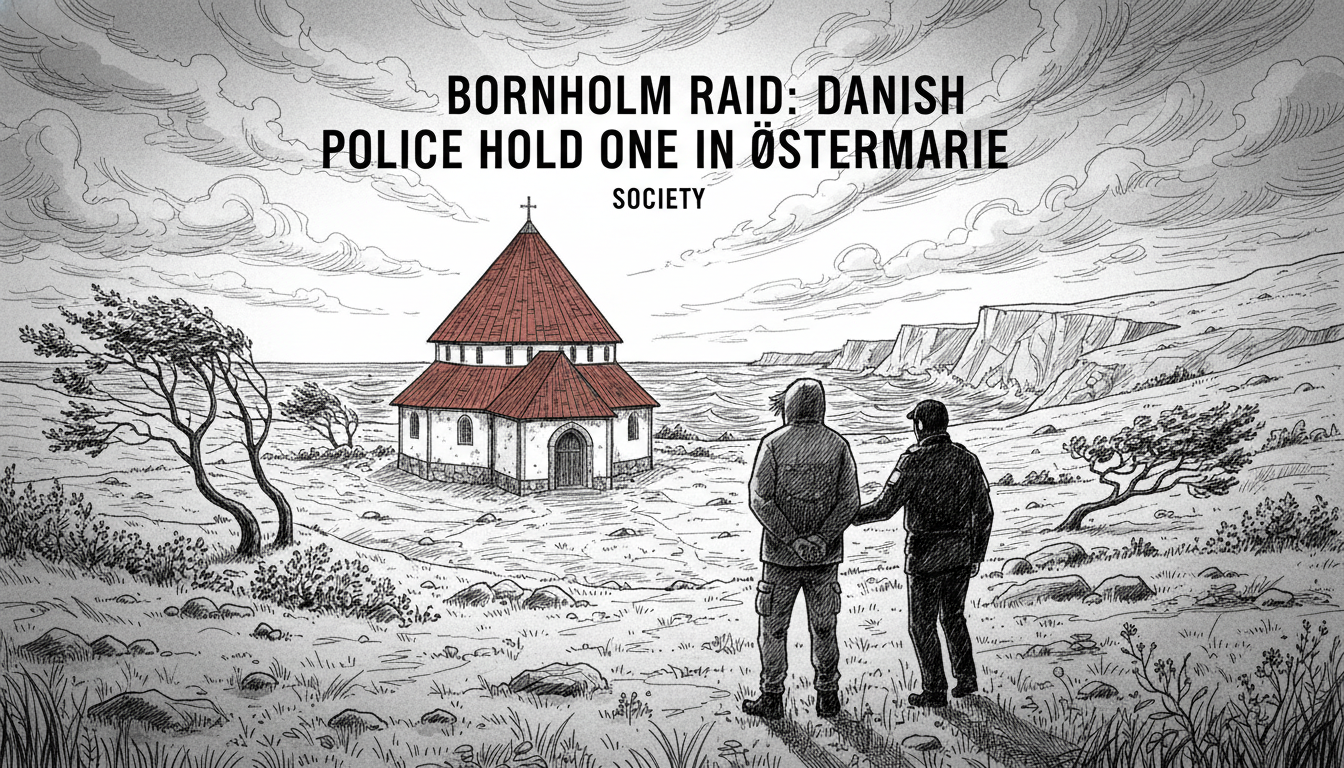
Bornholm police arrested one person and cordoned off an address in Østermarie during a large-scale special operation on Wednesday. Bornholms Politi confirmed its significant presence in the central town was connected to what it termed a 'special effort,' but provided no immediate details about the nature of the investigation. The operation sent ripples through the quiet island community, known globally for its rocky cliffs and serene beaches, highlighting the unseen challenges of policing Denmark's most geographically remote region. Vagtchefen, the duty officer for Bornholm Police, stated the force had no further information to release at this time, leaving residents to speculate about the incident that disrupted their peaceful Wednesday.
A Silent Scene in a Tourist Haven
The police action centered on Østermarie, a town of roughly 1,700 residents nestled in the heart of the Baltic Sea island. Characterized by its round church and tranquil countryside, the area is a stark contrast to the scenes of a coordinated police raid. Local reports described a talstærk, or numerically strong, police presence, indicating a operation of considerable size and potential significance. For Bornholm, an island that markets itself on tranquility and natural beauty, such a visible police action is a rare and unsettling event. The island's economy leans heavily on tourism, with visitors drawn to its unique rock formations, medieval churches, and smoked herring. An incident requiring a 'special indsats' cuts against this idyllic grain, presenting a complex narrative for a community reliant on its peaceful reputation.
The Unique Challenges of Island Policing
Bornholms Politi operates with the unique challenge of covering an island population of approximately 40,000, which swells significantly during the summer months. Unlike mainland forces that can quickly call for backup from neighboring districts, Bornholm's police are geographically isolated. This isolation necessitates a force that is highly versatile, handling everything from tourist incidents and traffic control to more serious criminal investigations. A special operation of this scale likely required careful planning and the concentration of available resources, potentially drawing officers from across the island's 588 square kilometers. Experts note that such operations in close-knit island communities are particularly sensitive; anonymity is scarce, and the social impact of police actions can resonate for years. The decision to release minimal information, while standard in active investigations, can fuel anxiety in a small community where everyone is somehow connected.
Between Secrecy and Community Trust
The police's tight-lipped approach following the operation walks a fine line between investigative necessity and public accountability. In Denmark, police generally enjoy a high level of public trust, a cornerstone of the country's societal model. However, that trust is maintained through transparency where possible. In remote areas like Bornholm, the social contract between police and the public is even more personal. Residents may understand the need for operational secrecy, but prolonged silence can lead to speculation and rumor, which can be damaging in itself. Community leaders often emphasize the importance of clear communication following such events to maintain social cohesion. The coming days will reveal whether Bornholms Politi provides more clarity, balancing the needs of their investigation with the community's right to understand significant events occurring on their doorstep.
A Strategic Location with a Quiet Present
Bornholm's history adds a layer of context to any unusual activity. Its strategic position in the Baltic Sea has made it a geopolitical point of interest for centuries, contested by Sweden and Germany before returning to Danish rule. During the Cold War, its easternmost location gave it unique significance. Today, that history is a tourist attraction, not a daily reality. The island is now administered as part of the Capital Region of Denmark, despite being far from Copenhagen. This modern-era peace is what makes a major police operation so conspicuous. It forces a momentary shift in perspective, from viewing Bornholm as a holiday retreat to recognizing it as a living, working society that faces the same complex issues as the mainland, albeit within a smaller, more transparent social framework.
The Broader Danish Policing Landscape
This operation on Bornholm occurs within a defined national framework. Bornholms Politi is part of the National Police (Rigspolitiet), and major operations, even on islands, are conducted within national guidelines and often with coordination from specialized national units if required. The term 'special indsats' is used broadly in Danish policing. It can encompass pre-planned actions like raids on suspected drug production sites, arrests in serious violent crime or organized crime cases, or the execution of high-risk warrants. Without specifics, analysts refrain from speculation but note that any operation requiring a heightened, concentrated police response is treated with utmost seriousness by Danish authorities, regardless of location.
What Comes Next for Østermarie?
The immediate aftermath in Østermarie is one of waiting. An address remains under investigation, and one individual is in custody. Danish law permits police to hold a suspect for 24 hours before they must be presented before a judge for preliminary custody hearing. This legal clock now ticks, likely determining the next phase of public information. Will the police announce formal charges? Will the investigation widen? For local residents, life will return to the island's normal rhythm, but with questions lingering. The true test for the community and its police force will be how transparency is managed once operational necessities recede. Can authorities provide satisfactory answers that reaffirm trust, or will this event become a quiet, unresolved footnote in the island's history?
Ultimately, the Bornholm operation is a reminder that no Danish community exists in a bubble. The welfare and safety model that defines Denmark is maintained by proactive policing, even in its most picturesque corners. This incident underscores that the Danish pursuit of social stability is a continuous, active effort. It requires resources, coordination, and sometimes, disruptive action in the most unexpected places. As the Baltic waves continue to crash against Bornholm's shores, the island awaits word on what exactly transpired in its peaceful heartland, and what it means for the enduring sense of security that is so central to the Danish way of life.