
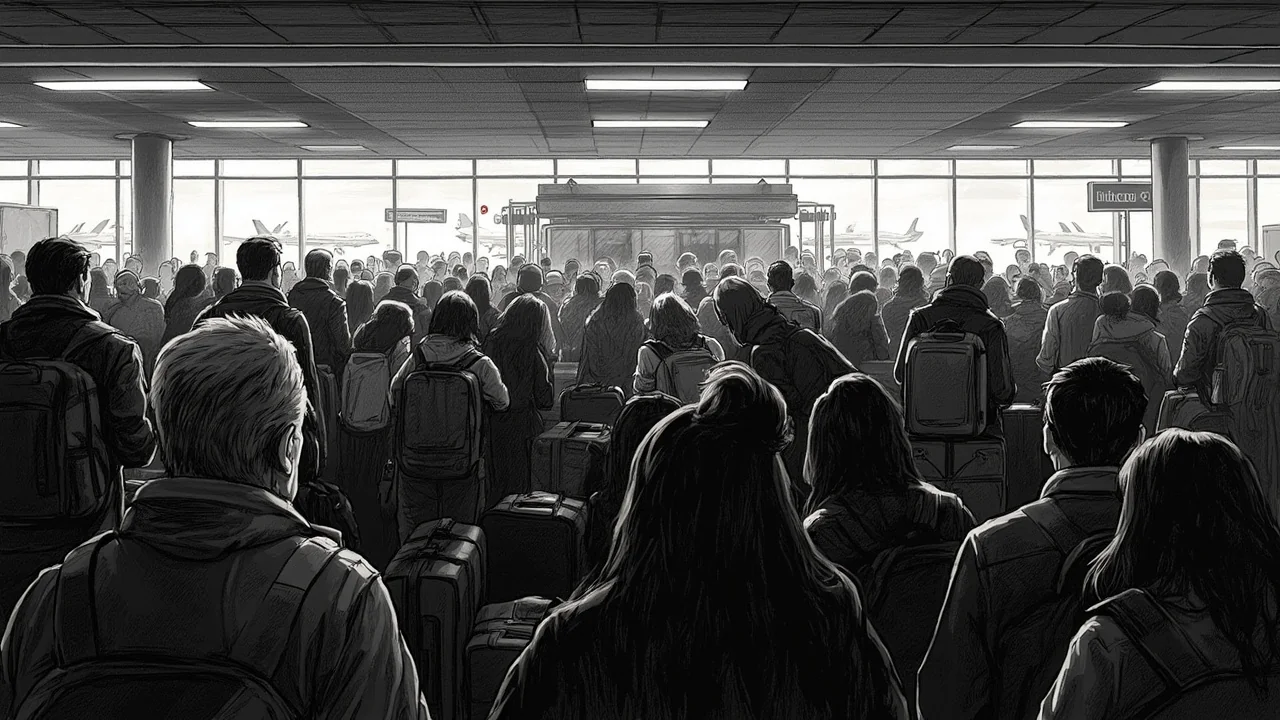
Copenhagen Airport's baggage sorting system has been offline for over 48 hours, forcing staff to manually process thousands of suitcases. The technical failure, which began on Friday, has created a logistical nightmare for departing passengers, with officials warning that checked luggage may not travel on the same flight as its owner. The airport's press office confirmed the system's supplier is working 'at full pressure' to locate and fix the fault, but no timeline for a resolution has been provided.
Travelers are facing the real possibility of arriving at their destination without their belongings. In response, airport management has issued a stark advisory on its website. "It is a good idea to pack the most necessary items—for example, medicine—in your hand luggage," the statement reads. This manual handling process is significantly slower than the automated system, leading to inevitable delays and missed connections for baggage.
A Manual Marathon for Ground Staff
The scene at the airport's baggage halls is one of intense, physical labor. Instead of whirring conveyor belts and automated scanners routing bags to their correct flights, teams of ground handlers are now sorting, lifting, and loading luggage by hand. This shift from a high-tech, computerized operation to a manual one is not just slower; it dramatically increases the risk of human error. Bags destined for Rome could easily be placed on a cart headed for Reykjavik in the confusion.
"Copenhagen Airport apologizes for the inconvenience these technical problems may cause and is working intensively to get the baggage system back in operation as soon as possible," the airport stated. This apology, while necessary, offers little comfort to passengers who have already experienced disruptions. The incident exposes a critical vulnerability in modern air travel, where a single point of technological failure can cascade into widespread chaos.
Passenger Advice and Escalating Delays
With the system down, the airport is doubling down on standard advice, emphasizing the importance of early arrival. For flights within the Schengen area, passengers are urged to arrive two hours before departure. For destinations outside Schengen, the recommendation extends to three hours. This extra time is now essential to accommodate the slower manual check-in and baggage drop process. However, even punctual arrival is no guarantee your bag will make it onto your plane.
A more critical piece of advice is the instruction to treat hand luggage as a survival kit. Passengers are being told to pack any absolute essentials—prescription medications, crucial business documents, baby supplies, a change of clothes—in the bag they keep with them. This guidance transforms hand luggage from a convenience into a primary container, reflecting the low confidence in the checked baggage system's immediate recovery.
The airport has been transparent about the consequence: "In these cases, the baggage will be sent on a later flight." This policy, known as baggage forwarding, is a standard recovery procedure but is deeply disruptive. It means travelers may be without their clothes and toiletries for a day or more, facing the hassle of filing missing baggage reports and waiting for delivery, often to a hotel in an unfamiliar city.
The Ripple Effect on Travel Confidence
This breakdown comes at a sensitive time for the travel industry, which has been working to rebuild passenger confidence after the pandemic-era disruptions. Copenhagen Airport (CPH) is a major Nordic hub, handling over 1,000 flights weekly to more than 150 destinations. A prolonged failure here doesn't just affect Danes; it impacts connecting passengers from across Scandinavia and Northern Europe.
The incident raises pertinent questions about infrastructure resilience and maintenance. How can a key piece of technology at one of the region's busiest airports fail so completely, with repair teams unable to diagnose and fix it for days? While the specific cause remains unknown, the duration of the outage suggests a complex, systemic failure rather than a simple glitch. It highlights the paradox of modern efficiency: systems designed for maximum speed and automation can become paralyzed when that automation fails.
From a Danish societal perspective, the situation is a test of the famed Nordic efficiency and problem-solving. The public expects a swift resolution, and the prolonged nature of the fault challenges that expectation. There is also a social contract element within the welfare model: travelers pay significant fees and taxes for airport services, creating an expectation of reliable, high-quality infrastructure. This failure, however temporary, breaches that contract.
Looking Beyond the Immediate Crisis
As technicians work to restore the system, the longer-term implications for Copenhagen Airport's reputation are worth considering. For business travelers and tourists alike, reliability is a key factor in choosing routes and hubs. Repeated or prolonged operational issues can influence airline scheduling decisions and passenger loyalty over time.
The airport's communication strategy during this crisis will be scrutinized. Regular, honest updates about progress—or the lack thereof—are crucial to managing passenger frustration. The current advice is practical but places the burden of adaptation entirely on the traveler. A next step could involve more active assistance, such as streamlined processes for filing delayed baggage claims or partnerships with airlines to offer essential kits to affected passengers upon arrival.
For now, the waiting game continues. The supplier's team is working 'at full pressure,' a phrase that conveys urgency but also hints at the complexity of the challenge. Every hour the system remains offline, the backlog of manually sorted bags grows, and the task of reuniting misplaced luggage with its owners becomes more daunting. The true test will be how smoothly the system reintegrates once it is rebooted, and whether it can handle the surge of pent-up baggage traffic without further hiccups.
This weekend's disruption serves as an unwelcome reminder of our dependence on unseen technology. It underscores that the seamless travel experience we've come to expect is built on a fragile digital foundation. When that foundation cracks, even temporarily, the entire edifice of schedules and connections trembles. For passengers passing through Copenhagen this weekend, the journey has become an exercise in patience and contingency planning, a sudden return to a less automated, less predictable era of travel.