
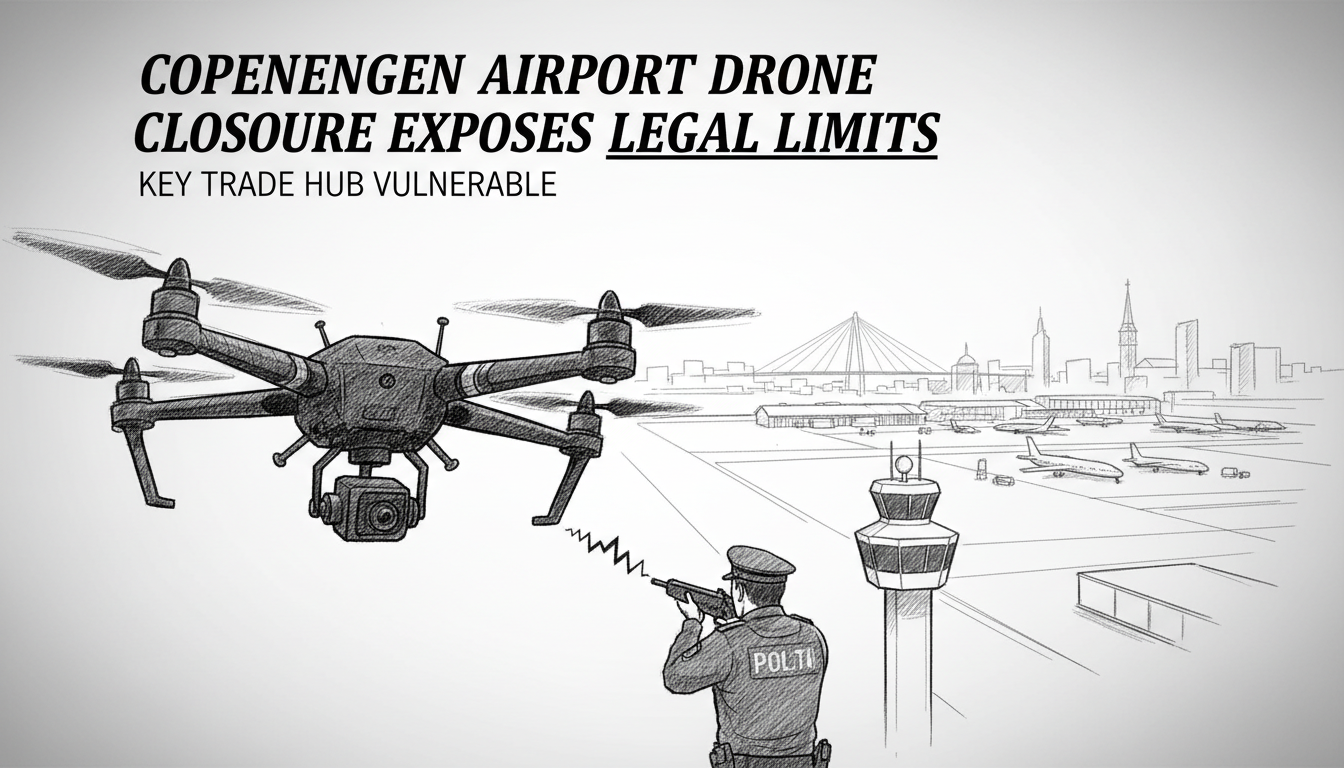
Copenhagen Airport faced a four-hour shutdown due to reported drone activity, but authorities could not legally shoot the unmanned aircraft down. This incident highlights a critical gap in Denmark's security framework that directly impacts trade and commerce. The legal reality contradicts public statements from ministers and police officials about their operational capabilities.
Legal expert Marc Schack, a lecturer in international law and national security at the University of Copenhagen, provided a clear analysis. He stated that police and military cannot legally shoot down an unknown, peaceful drone in a situation like the one reported over the airport. The rules on the use of firearms are strict and require an imminent threat to life or critical infrastructure. Schack explained that if there is no immediate danger, authorities must essentially wait for the drone to fly away on its own.
Justice Minister Peter Hummelgaard has acknowledged the operational dilemma. He said the decision not to engage was a concrete operational assessment, citing concerns that shooting it down could cause greater damage. However, this framing avoids the core legal restriction that Schack emphasizes. Authorities have not publicly detailed these legal limitations, creating a perception gap about their powers.
This legal bind has significant economic implications. Copenhagen Airport is a vital hub for Scandinavian trade, handling billions in cargo annually. Major Danish exporters like Maersk, Novo Nordisk, and Vestas rely on efficient air logistics. A prolonged or repeated closure disrupts time-sensitive shipments, affects just-in-time supply chains, and damages Denmark's reputation for reliability. The Øresund region's integrated economy, connecting Copenhagen and Malmö, is particularly vulnerable to such transport disruptions.
The government has proposed new legislation to address drone threats. The proposal would make it easier for police to neutralize drones using physical nets or electronic jamming of control signals. Crucially, it does not change the rules for using firearms to shoot drones down. The Justice Ministry confirmed the new bill does not alter the conditions for police use of weapons. The existing police law requires proportionality, and using a dangerous weapon like a firearm demands a clear, imminent threat.
This situation reveals a tension between operational security needs and legal safeguards. For the business community, the uncertainty is a concern. A drone incident during peak travel or cargo hours could cost millions in lost revenue and logistical delays. Companies operating in Copenhagen's key business districts, from Østerbro to the expanding Nordhavn area, depend on stable infrastructure. The legal analysis suggests that until the law changes, Denmark's main international gateway remains exposed to disruptive, low-tech threats that authorities cannot forcefully remove without clear and present danger. The government's current legislative path offers technical countermeasures but stops short of granting shoot-down authority, leaving a strategic vulnerability unaddressed.