
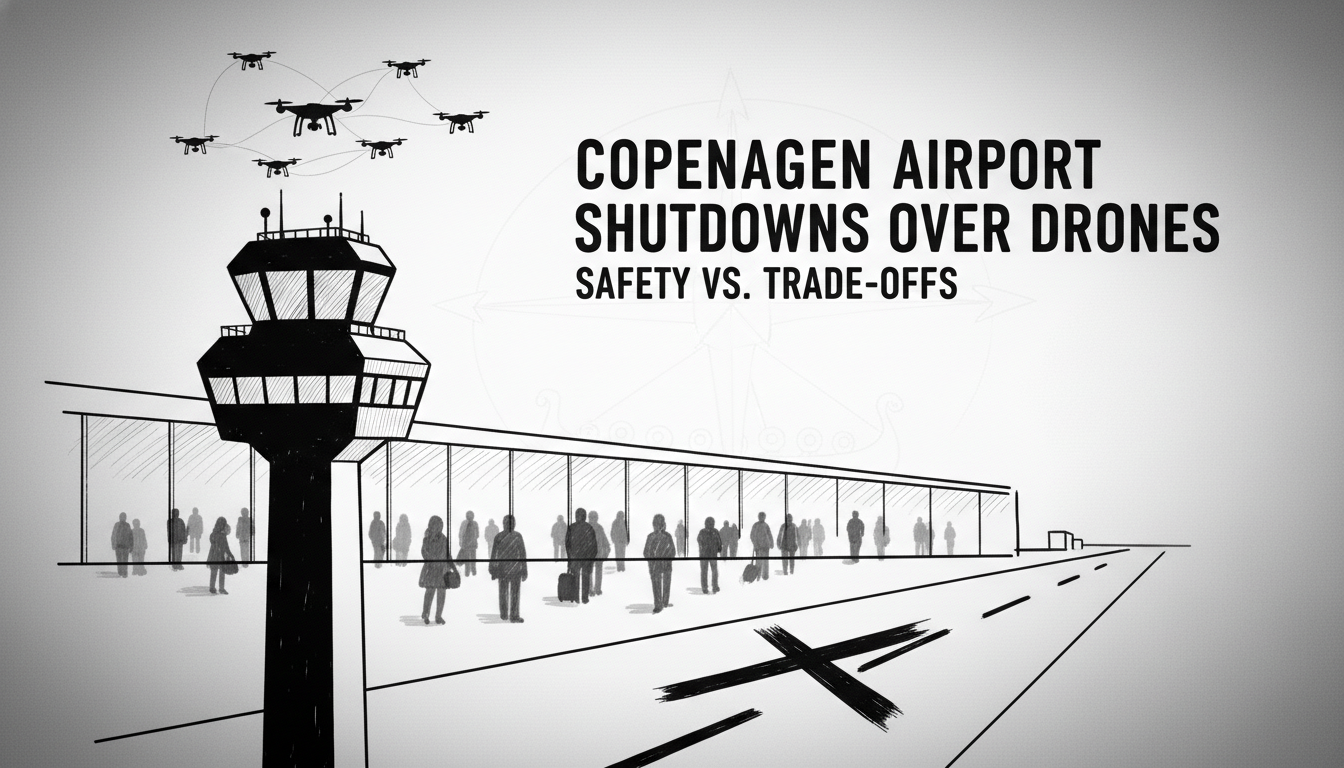
Copenhagen Airport supports a new legal stance that prevents police from shooting down illegal drones over its airspace unless they pose a direct threat. The airport's Chief Operations Officer, Kristoffer Plenge-Brandt, stated the facility would rather halt all air traffic for hours than risk the greater danger of downing a drone incorrectly.
This position aligns with a government bill presented to parliament, which maintains strict rules on police use of firearms. Legal experts confirm the rules will not change. Police may only use weapons to counter an imminent, dangerous attack on people or critical infrastructure. A peaceful drone hovering does not meet this threshold.
The economic impact of such shutdowns is substantial. Copenhagen Airport is a critical hub for Scandinavian trade and the Øresund region's economy. A four-hour closure, like the one triggered on September 22, disrupts cargo flights, delays business travel, and impacts revenues for airlines like SAS and Norwegian, along with logistics firms such as DSV and Maersk. The ripple effect touches Copenhagen's business districts and the wider Danish export economy.
Plenge-Brandt explained the airport's risk calculus. Shooting at a drone near terminals, parked aircraft, and passengers creates an unacceptable hazard. The potential for a fatal incident if a drone is shot down over a plane is a risk the airport has "absolutely no appetite for." Passenger safety is the paramount concern, even at a high operational cost.
The proposed legislation does offer alternatives. It makes it easier to neutralize drones using physical nets or radio jamming technology. It also allows critical infrastructure operators, including the airport, to acquire their own equipment and personnel to take down so-called "non-cooperative drones."
Copenhagen Airport, however, has declined this option. "We really want to leave it to the authorities who are responsible," Plenge-Brandt said. "We do not wish to be the ones who have to take drones out of the sky." This is a distinct policy from its bird control measures, where trained hunters shoot birds in specific, safe areas to prevent bird strikes—a proven and managed safety procedure.
The airport maintains that the drones observed were peaceful, though illegal. Authorities have since discredited some of the initial drone reports from the September incident, but the airport stands by its assessment. The episode highlights a growing challenge for global aviation security: balancing swift response with proportional force in an era of accessible drone technology.
For Danish business, the policy creates certainty but also vulnerability. The certainty is that police will not escalate a situation with gunfire near critical infrastructure. The vulnerability is that a single, inexpensive drone can paralyze a multi-billion kroner transport node for hours, with clear implications for trade reliability and investor confidence in Copenhagen's logistics network.