
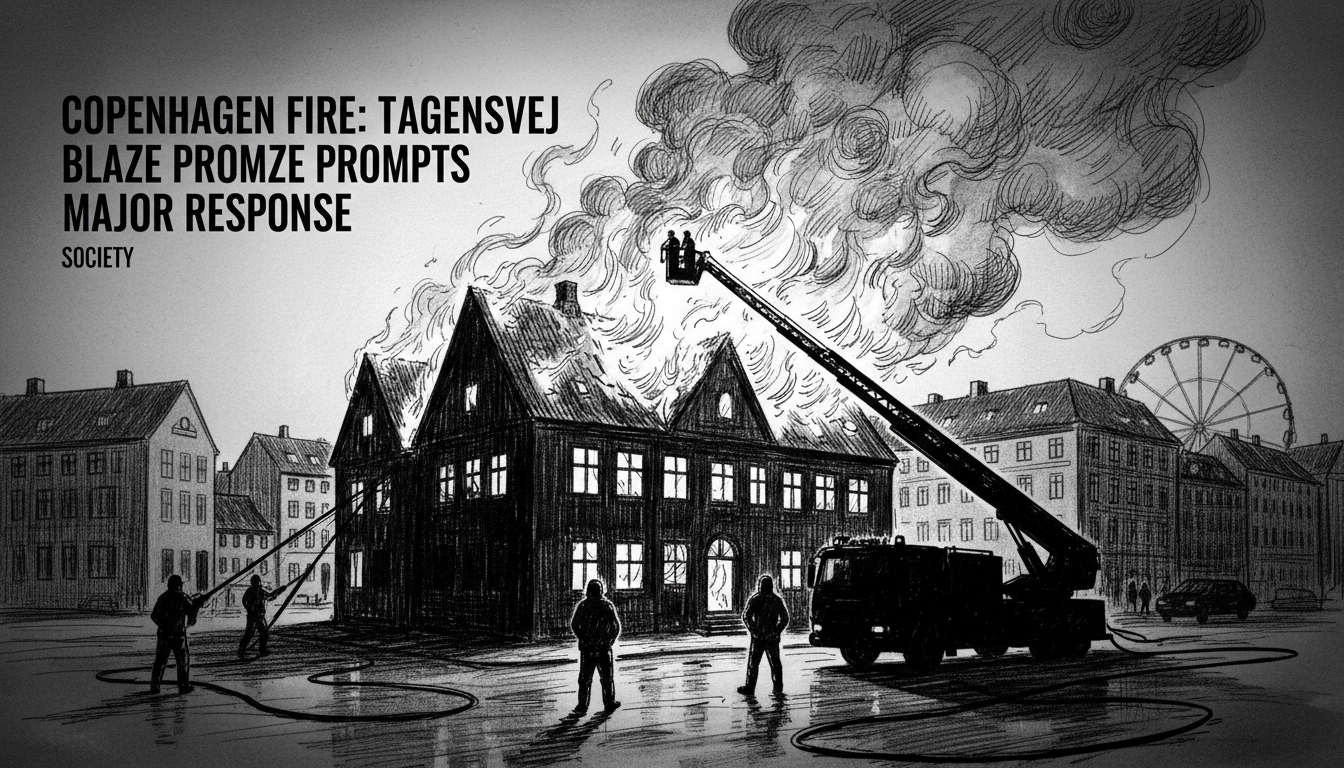
Copenhagen fire crews from Hovedstadens Beredskab responded to a significant room fire on Tagensvej after initial reports of basement smoke. A 500-meter stretch of the major road was closed as a large contingent of firefighters worked to control the blaze. The incident highlights the constant readiness required in a dense urban capital and the critical importance of public cooperation during emergencies.
A Major Response on a Major Road
Emergency services descended on Tagensvej, a key artery running through several Copenhagen neighborhoods. What was first reported as smoke from a basement was quickly upgraded to an active room fire upon arrival. This triggered a substantial deployment from Hovedstadens Beredskab, the Capital Region's fire and rescue service. Their presence was described as 'talstærkt,' meaning strong in numbers, indicating a full-scale response to contain the threat. The immediate closure of a long section of road underscores the seriousness with which crews treated the incident, ensuring safe access and operation zones.
Such responses are standard protocol for structural fires in residential areas. Older building stock, common in Copenhagen, can present unique challenges like hidden void spaces and varied construction materials. The swift escalation from a smoke report to a confirmed room fire likely dictated the scale of the response. Fire safety experts consistently stress that early, accurate reporting from the public is crucial for effective intervention. This incident shows the system working as designed, with resources mobilizing rapidly to address a developing threat.
The Critical Role of Public Cooperation
A key message from the scene was a direct appeal from emergency services. They asked the public to give them space and to respect the established cordons. This is not a mere formality but a fundamental aspect of operational safety and efficiency. Crowds of onlookers can block access routes for additional vehicles and equipment, potentially hampering firefighting efforts. In a dense city environment like Copenhagen, clear roads are vital for the logistics of a major firefighting operation.
Respecting these boundaries protects both the public and the emergency personnel. Smoke inhalation hazards, falling debris, and the risk of sudden flare-ups make the immediate area around a fire scene dangerous. The 500-meter closure on Tagensvej was implemented to create a secure perimeter. Public adherence to these instructions allows firefighters to focus entirely on suppression and rescue without managing bystander risk. This cooperation is a silent but essential partnership between Copenhagen's residents and its emergency services.
Understanding Hovedstadens Beredskab's Reach
Hovedstadens Beredskab is Denmark's largest fire department, responsible for a complex and populous region. Its jurisdiction covers Copenhagen and several surrounding municipalities, representing a significant logistical challenge. The service manages everything from apartment fires and traffic accidents to technical rescues and hazardous material incidents. Their capability to deploy a 'talstærkt' force to Tagensvej demonstrates the resource depth necessary to protect a capital region.
The department operates on a risk-based planning model, positioning resources to ensure optimal response times across its diverse territory. An incident on a main road like Tagensvej requires not only fire suppression but also traffic management and coordination with police. This integrated approach is key to managing incidents in urban environments where disruption spreads quickly. The successful containment of this fire, with no reported injuries, points to the effectiveness of this trained, coordinated response.
Urban Fire Safety in a Historic City
Copenhagen's charm is partly defined by its historic buildings, but these structures can pose specific fire safety challenges. While modern Danish building codes are stringent, older properties may have features like wooden beams, narrow staircases, and less compartmentalization. These factors can influence how a fire spreads and how firefighters approach suppression. The mention of a room fire in this incident immediately raises questions about containment within the building's structure.
Fire experts note that prevention and public awareness are as important as response. Ensuring working smoke alarms, having clear escape plans, and understanding basic fire safety are community-wide responsibilities. The Danish welfare system supports this through public safety campaigns and strict building inspections. This incident on Tagensvej serves as a real-world reminder of why these measures exist. It is a testament to the system that the situation was brought under control, but it also reinforces the need for constant vigilance in multi-occupancy buildings.
The Aftermath and Moving Forward
The fire was extinguished, but the aftermath involves investigation and recovery. Fire investigators will work to determine the precise cause of the blaze, a process vital for preventing future incidents. For residents displaced by the evacuation, municipal social services in Copenhagen often provide short-term support, a function of the Danish welfare model. The reopening of Tagensvej to traffic will follow a safety assessment to ensure no residual risks remain from the fire or the firefighting efforts.
Incidents like this, while disruptive, test and prove the mettle of a city's emergency infrastructure. The rapid, coordinated response on Tagensvej showcases a system functioning under pressure. It also quietly highlights the everyday reliance of a modern society on these essential services. As Copenhagen continues to grow and densify, the work of Hovedstadens Beredskab remains a critical, non-negotiable pillar of urban life. The real question for any city is not if emergencies will happen, but how effectively it responds when they do.