
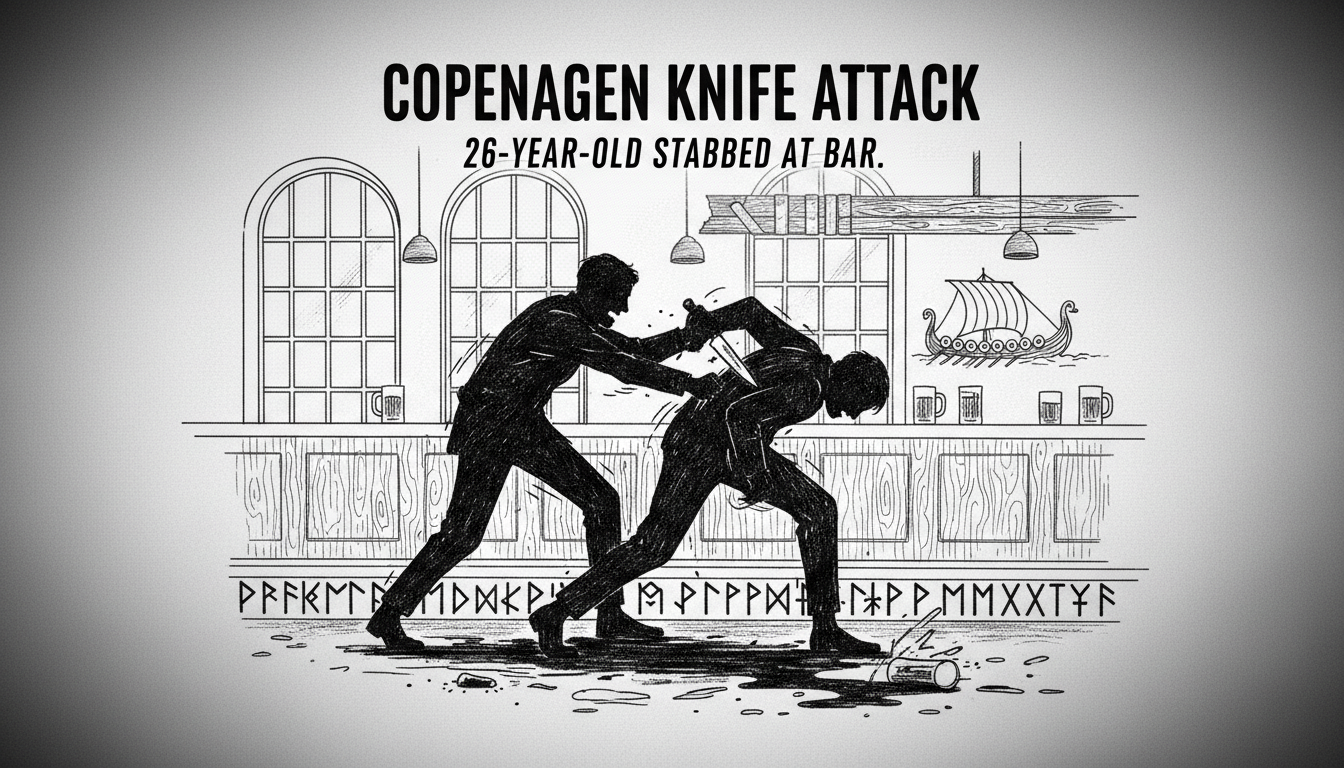
Copenhagen police are investigating a stabbing that injured a 26-year-old man at The Old Irish Pub on Vesterbrogade. The violent incident occurred around 2:20 a.m. on Sunday, sending shockwaves through the popular nightlife district. According to police, the victim was stabbed in the buttock and arm before being transported to Rigshospitalet for treatment. He was not in life-threatening condition.
Vagtchef Mads Østermark from Copenhagen Police described the event as an outbreak of tumult. No arrests have been made, and authorities are actively seeking witnesses. This attack places a renewed spotlight on safety in the city's bustling entertainment zones. It raises difficult questions about violence prevention in areas known for social mixing and, at times, conflict.
A Search for Answers in Vesterbro
Police cordoned off part of Vesterbrogade in the early hours following the attack. Investigators collected video surveillance footage and spoke to initial witnesses. Yet, the sequence of events leading to the stabbing remains unclear. Officers have since left the scene, but the investigation is ongoing.
Mads Østermark emphasized the need for public cooperation. “We have some witnesses and some video surveillance, but we would like some more witnesses,” he stated. The call for information underscores the challenges detectives face in crowded nighttime environments. Patrons' memories can be blurred, and cameras don't always capture a full picture.
Vesterbro, once a gritty industrial and red-light district, has transformed into one of Copenhagen’s most vibrant neighborhoods. Its streets are lined with cafes, restaurants, and bars like The Old Irish Pub, attracting a diverse crowd of locals and tourists. This mix is generally a source of cultural strength, but it can also lead to flashpoints when alcohol, crowded spaces, and personal disputes collide.
Knife Crime in a Low-Crime Society
Denmark consistently ranks as one of the world’s safest countries. Its homicide rate is low, and violent crime is relatively rare compared to other European capitals. However, isolated incidents of knife violence, particularly in nightlife settings, generate significant public concern. They disrupt the pervasive sense of security that defines daily life for most Danes.
Statistics from the Danish National Police show that most serious violence occurs between people who know each other. Random attacks are less common but are profoundly alarming when they happen. Experts note that police typically respond to such incidents with increased visible patrols in affected areas. This visible presence aims to reassure the public and deter further violence.
“An event like this triggers a dual response,” says Lars Holmberg, a retired police commissioner and security analyst. “First, a focused investigative effort to find the perpetrator. Second, a strategic decision about resource allocation to prevent copycat incidents or retaliation.” He explains that while Denmark's welfare model and strong social cohesion are protective factors, no urban center is immune to spontaneous violence.
The Nightlife Safety Equation
Copenhagen’s nightlife is a major part of its international appeal and local culture. The city manages thousands of licensed venues, and overall compliance with safety regulations is high. Bar staff and security personnel are trained in conflict de-escalation. Yet, managing large weekend crowds, especially in compact districts like Vesterbro, is a constant logistical challenge.
Municipal social policy often focuses on integration and prevention through community centers and youth outreach programs. These long-term strategies aim to address root causes of alienation that can contribute to violence. In the immediate term, however, safety hinges on coordinated efforts between venue operators, private security, and police patrols.
Some community leaders argue for even closer collaboration. “We need dialogue that includes everyone—residents, business owners, and social services,” says Amina Hassan, who runs a local integration NGO in Vesterbro. “Safety isn't just a police matter. It’s about creating an environment where people feel responsible for each other, even at 2 a.m.” Her perspective highlights the Danish principle of samfundssind, or community spirit, applied to urban challenges.
A Personal Reflection on Urban Tension
Reporting from Copenhagen, I see these incidents through a dual lens. As a journalist, I track the facts: the time, the location, the police response. As a citizen, I feel the communal unease. A stabbing in a familiar bar is a violation of the social contract that allows a city to function smoothly. It makes people glance over their shoulder, wondering if the strong Danish welfare system’s safety net has thin spots in the urban night.
Denmark’s approach to integration and social welfare is often studied globally. It is a system designed to foster inclusion and equal opportunity. Yet, moments of violence remind us that social harmony is a continuous project, not a finished product. They test the resilience of the community and the responsiveness of its institutions.
The victim in this case is fortunate his injuries were not life-threatening. His physical recovery at Rigshospitalet, one of the country’s leading hospitals, is assured by Denmark's healthcare system. The emotional and psychological recovery for him, and for the community’s sense of security, may take longer.
Looking Ahead: Investigation and Impact
For now, the Copenhagen Police’s investigation is the immediate priority. Anyone with information is urged to contact them directly. The outcome will influence not just one criminal case but also broader policy discussions about resources for community policing and nightlife management.
City officials will likely review protocols for weekend safety in Vesterbro. This could involve discussions about lighting, camera coverage, or the density of late-night licenses. These are complex balancing acts between maintaining vibrant city life and ensuring absolute public safety.
This stabbing on Vesterbrogade is a single, serious event in a generally safe city. But its resonance is powerful. It forces a conversation about what we tolerate, what we prevent, and how we maintain the trust that holds a diverse, modern society together after dark. The true test for Copenhagen will be how it answers these questions in the weeks to come.