
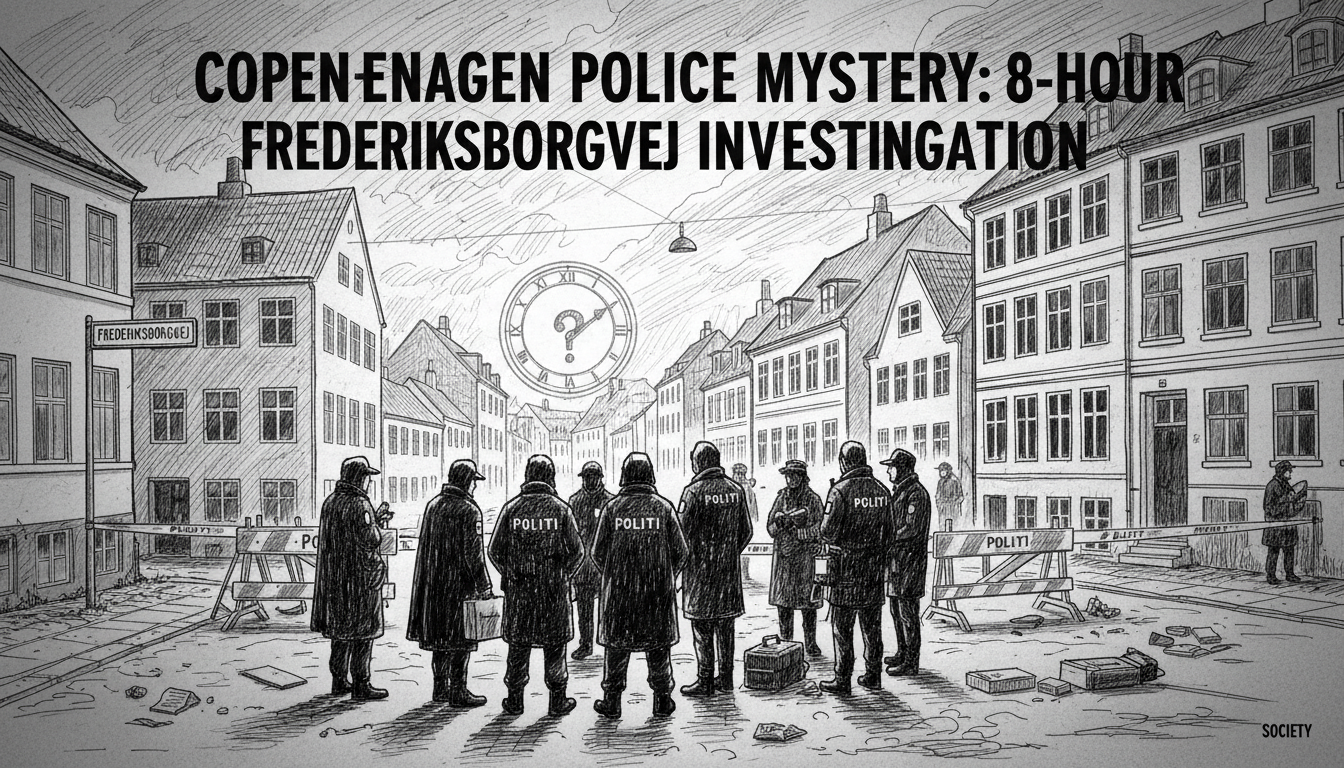
Copenhagen police concluded an eight-hour operation on Frederiksborgvej Saturday evening, leaving more questions than answers. Officers arrived at the major city thoroughfare at 9:30 AM and remained on scene, with a section cordoned off, until approximately 5:00 PM. The only official statement described the focus as a 'suspicious circumstance,' a broad term that covers everything from unattended packages to potential crime scenes. This prolonged silence from authorities is a standard but often frustrating part of police procedure, designed to protect the integrity of an active investigation.
Residents watched as a mix of investigators, patrol units, and police dogs concentrated their efforts on an apartment in one of the street's residential blocks. The presence of forensic teams and canine units typically indicates a search for specific evidence, not just a routine check. Frederiksborgvej's role as a key artery meant the cordon disrupted Saturday traffic and drew significant attention from passersby. Police have not confirmed any arrests or provided details on what prompted the large-scale response, stating they have no further information to release at this time.
The Anatomy of a 'Suspicious Circumstance'
The term 'mistænkeligt forhold' or 'suspicious circumstance' is a catch-all in Danish policing. It allows authorities to secure a scene and begin work without immediately defining the nature of the incident. This discretion is crucial. Releasing details too early can compromise evidence, alert potential suspects, or spread unnecessary alarm. A former senior investigator with the Copenhagen Police, who spoke on condition of anonymity due to ongoing contacts, explained the rationale. 'The first hours are the most fragile,' the former officer said. 'Witness memories are fresh, physical evidence is undisturbed, and the individuals involved may still be in the area. Our priority is to preserve that, not to provide a public narrative.'
This approach, while methodical, creates an information vacuum. For residents living on or near Frederiksborgvej, a Saturday transformed by police tape and forensic vans is deeply unsettling. They are left to piece together events from what they can observe from their windows. The deployment of detectives and search dogs suggests police were looking for something specific within the apartment, possibly drugs, weapons, or other physical evidence. The extended duration of the operation points to a meticulous process, likely involving detailed photography, evidence collection, and possibly interviews with neighbors.
Life on a Major Artery: Disruption and Speculation
Frederiksborgvej is not a quiet side street. It is a bustling corridor connecting central Copenhagen to northwestern districts, lined with shops, cafes, and apartment blocks housing a diverse mix of students, families, and professionals. A police cordon here does not go unnoticed. Local business owners report a drop in foot traffic, while residents describe the odd quiet that falls over a normally busy road replaced by the low murmur of police activity. 'You see the vans and the tape, and your mind immediately goes to the worst scenarios,' said Lea Hansen, who lives two buildings down from the cordoned area. 'It's the not knowing that's difficult. You just want to understand if your family is safe.'
This community reaction highlights a tension inherent in modern policing. The public's right to information, especially about events in their immediate environment, clashes with the investigative need for confidentiality. Social media often fills the void with speculation, which can range from accurate to wildly inaccurate. Copenhagen Police generally avoid engaging with speculation online, preferring to release information through official channels once it is verified and will not harm their case. The challenge is balancing public assurance with procedural integrity, a task that becomes harder the longer an operation continues.
The Protocol of Silence: Why Police Hold Back
Denmark's legal framework grants police significant latitude to withhold information during preliminary investigations. The goal is to ensure a fair process and a higher chance of successful prosecution. Revealing specific details—such as the type of suspected crime, names, or specific evidence found—could taint witness testimony or allow suspects to coordinate stories. 'Imagine if we announced we were investigating a burglary and described a stolen item,' the former investigator explained. 'If someone later tries to sell that item, they are already forewarned. Secrecy, initially, is an investigative tool.'
This protocol is common across Nordic jurisdictions, where the emphasis is often on building a court-ready case from the outset. The downside is a perceived lack of transparency, which can erode public trust, particularly in dense urban neighborhoods. Community policing advocates argue that while operational details must remain secret, a more general communication about community safety could be beneficial. A simple statement confirming there is no ongoing threat to the wider public, if accurate, can alleviate significant anxiety without compromising an investigation.
Looking Ahead: From Scene to Potential Charges
The conclusion of the physical scene work at 5:00 PM marks a transition, not an end. Forensic evidence will be sent to labs for analysis. Detectives will review any seized materials, from electronic devices to documents. Witness statements taken at the scene will be formally typed up and corroborated. This behind-the-scenes work determines whether the 'suspicious circumstance' evolves into a formal criminal case. The path forward could lead to arrests, could be reclassified as a minor incident, or could remain an open but inactive file if evidence is insufficient.
For now, the story of what happened on Frederiksborgvej resides within the Copenhagen Police district. Residents will return to their normal routines, the traffic will flow again, and the physical signs of the investigation will vanish. The psychological imprint, however, lasts longer. Incidents like these subtly shift the perception of safety in a neighborhood. They become a topic of conversation in local grocery stores and a point of reference for residents. The ultimate impact depends on what, if anything, the police eventually reveal. Will this be a footnote, or the beginning of a larger story? The answer lies in the evidence now being examined, far from public view.
The enduring lesson is one of patience in an impatient age. Major police investigations are slow, deliberate puzzles. Each piece must be carefully collected and placed. The public sees only the empty board for a long time, wondering what the final picture will show. In Copenhagen this weekend, the puzzle pieces from an apartment on Frederiksborgvej are being sorted, with the city waiting to see if they form a picture at all.