
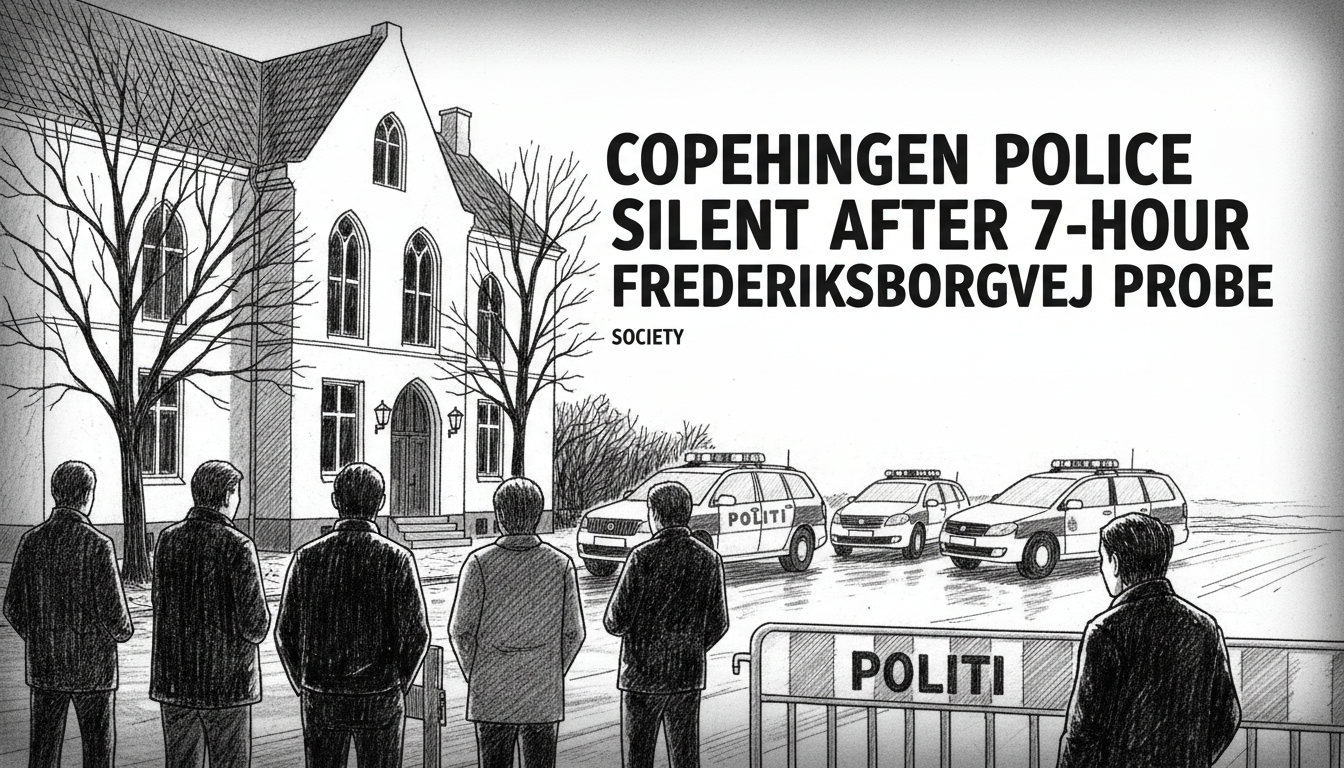
Copenhagen police have concluded a seven-hour investigation on a major city street without releasing a single detail to the public. Police cordoned off part of Frederiksborgvej on Saturday, deploying detectives, patrol units, and dogs to an apartment building, yet officials refuse to explain the 'suspicious circumstance' they were probing. This blanket silence, stretching from the 9:30 AM operation start to its conclusion around 5:00 PM, highlights a recurring tension in Danish society between official secrecy and the public's right to know.
The Scene of the Silence
For over seven hours, a section of Frederiksborgvej—a busy arterial road connecting central Copenhagen to northwestern districts—became a closed-off police zone. Residents and passersby witnessed a significant operational presence focused on one residential block. The police used the standard Danish term 'mistænkeligt forhold' or 'suspicious circumstance,' a broad classification that can cover anything from an unexplained death and a weapons cache to a chemical odor or evidence of a serious crime. The deliberate lack of elaboration is standard protocol for the Copenhagen Police during active operations, but the total blackout following the scene's closure is what fuels public curiosity and, at times, anxiety.
“Our primary focus is conducting a thorough investigation,” a police press officer typically states in such situations. “We cannot share details that could compromise that process.” This statement reflects a standard Danish law enforcement approach prioritizing investigative integrity over immediate transparency. Experts note this caution is particularly acute in densely populated urban areas like those along Frederiksborgvej, where rumors can spread quickly and potentially jeopardize witness accounts or ongoing surveillance.
A Standard Procedure or a Growing Divide?
While police reticence is normal, the context matters. This incident occurs amid ongoing national debates about crime, integration, and trust in institutions within Danish neighborhoods. Frederiksborgvej runs through diverse areas, including parts of the Northwest District, home to a mix of long-established Danish families and immigrant communities. In such settings, a large, unexplained police operation can inadvertently seed mistrust if the vacuum of information is filled with speculation. Community leaders often stress the need for clear, post-operation communication to maintain public confidence.
“Transparency is a cornerstone of the Danish social contract,” notes a Copenhagen-based social researcher who studies public institutions. “When the police, a fundamental pillar of the welfare state, are silent, it creates a space for narrative that they cannot control. A brief statement confirming the investigation's nature—once it is secure to do so—is usually in everyone's interest.” Danish police have historically enjoyed high levels of public trust, a key component of the nation's social stability. Maintaining that trust requires balancing operational secrecy with the community's need for basic reassurance.
The Anatomy of a 'Mistænkeligt Forhold'
The term used by police is intentionally non-specific. Legally, it allows officers to secure a scene and begin preliminary inquiries without immediately determining if a crime has occurred. It could stem from a neighbor's report of strange sounds or smells, the discovery of unattended luggage, or an unresponsive person at a residence. The deployment of detectives and forensic teams suggests the matter was assessed as potentially serious. The use of police dogs often indicates a search for narcotics, explosives, or a missing person.
Without an official statement, we cannot know which scenario unfolded. What we can analyze is the procedural footprint. A seven-hour timeline suggests a methodical process. It was not a fleeting check but a sustained forensic examination. The closure of a public road indicates a perceived risk or a need for a controlled perimeter. These are the tangible clues the public is left to interpret in the absence of facts.
Communication in the Digital Age
The police's silence also plays out against the backdrop of instant digital communication. Local social media groups and messaging apps often buzz with activity during such events, sharing photos and speculation in real-time. Official channels remaining quiet can create a disconnect, where the community's digital conversation races ahead of the authoritative account. This gap challenges the traditional Danish model of information flow, where citizens expect official sources to provide reliable updates.
Other Nordic countries, like Sweden and Norway, often follow similar protocols, though practices can vary by municipality and the incident's severity. The comparative balance leans toward withholding information until a clear picture emerges, rather than providing incremental updates that may change. The calculus is one of accuracy over speed, a principle deeply embedded in Scandinavian institutional culture.
Looking Beyond the Tape
The Frederiksborgvej operation may remain a minor, unexplained entry in the police log. It may also develop into a significant case. The enduring question from this Saturday is how Danish authorities navigate the modern demand for information. The social policy of integration and community cohesion relies on transparency. When people understand the actions of their institutions, they are more likely to support them. Prolonged silence, while sometimes necessary, can be misread as indifference or opacity.
For now, the tape is down, and the police have left. Life on Frederiksborgvej has returned to its normal rhythm. But the echo of their unexplained presence lingers, a reminder that in a society built on trust, what is left unsaid can sometimes resonate as loudly as what is announced. Will the Copenhagen Police eventually shed light on this seven-hour mystery, or will it dissolve into the city's countless untold stories? The answer depends on where the institution draws its line between protecting an investigation and upholding its covenant of openness with the public it serves.