
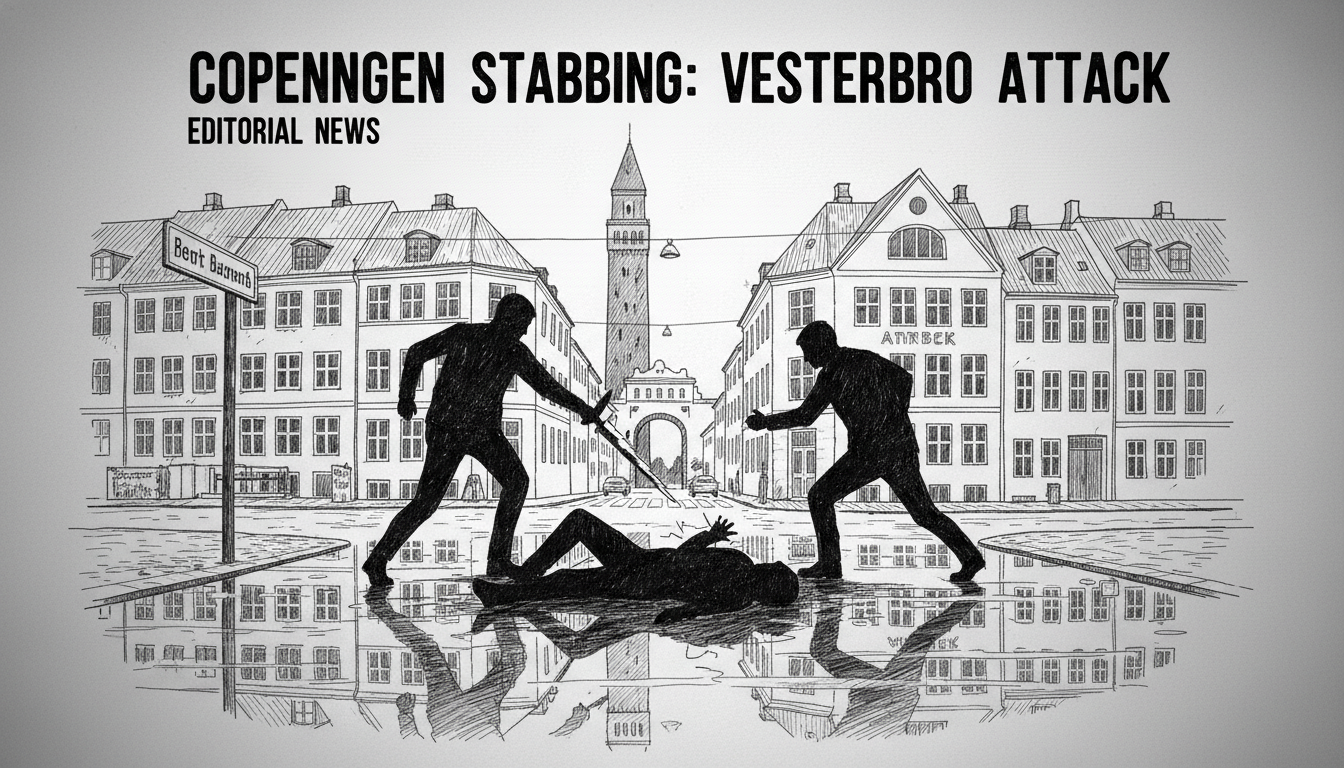
Denmark knife crime incidents, while statistically rare, send shockwaves through a society built on trust and safety. A 26-year-old man was stabbed in the buttock and arm at The Old Irish Pub on Vesterbrogade in Copenhagen early Sunday morning. The Copenhagen Police received the report at 2:20 AM and are actively seeking witnesses, with no arrests made as of Sunday morning. The victim received treatment at Rigshospitalet and was never in life-threatening condition, according to police.
For residents of Vesterbro, a district famed for its vibrant nightlife and dense mix of cultures, the news is a jarring reminder of vulnerability. The incident cuts against the grain of Copenhagen's celebrated identity. The city consistently ranks among the world's most livable, a status underpinned by low crime rates and a strong social fabric. Yet here, on a well-trodden street, a common pub altercation escalated to a blade.
"We have some witnesses and some video surveillance, but we would like some more witnesses. We are still looking for a perpetrator," said Copenhagen Police duty officer Mads Østermark in a statement. He described the event as a case of "tumult," though the precise chain of events leading to the stabbing remains unclear. The police have since left the scene, urging anyone with information to contact them directly.
The Statistical Reality of Violence
This single act of violence will dominate local news cycles, but it exists within a complex statistical landscape. According to data from Statistics Denmark, reported assaults involving knives have fluctuated but remain a small fraction of overall violent crime. The vast majority of violent incidents in Denmark do not involve weapons. The country's overall crime rate, particularly for serious violence, is low by international standards.
This context is crucial for understanding the Danish reaction. In cities with higher baseline levels of weapon crime, a non-fatal pub stabbing might not make front-page news. In Copenhagen, it is an anomaly that triggers profound public concern and intense police focus. The response is not just about solving one crime, but about reaffirming a social contract where such events are not supposed to happen.
"An incident like this feels particularly shocking in a Danish context because it violates our fundamental expectation of safety in public spaces," says Lars Holmberg, a professor of criminology at the University of Copenhagen. "The statistical probability is low, which is why each case gets amplified. The police response is typically swift and comprehensive, aiming to restore that sense of security quickly."
Nightlife and Policing in a Diverse District
Vesterbro's transformation from a working-class, sometimes gritty neighborhood to a trendy hotspot is a classic Copenhagen narrative. Its streets are lined with cafes, boutiques, and pubs like The Old Irish Pub, catering to a diverse crowd of students, young professionals, and long-term residents. This density and diversity are its strengths, but they also present unique policing challenges, especially on weekend nights when alcohol flows and crowds swell.
The Copenhagen Police maintain a visible presence in nightlife districts, with a focus on de-escalation and community engagement. The goal of Danish policing in these areas is often preventative: to maintain order so that small disputes do not spiral into violence. This stabbing suggests a moment where those preventative measures were bypassed.
Community policing strategies, where officers build relationships within neighborhoods, are a cornerstone of the Danish model. In districts like Vesterbro, this involves coordination with bar owners, social outreach workers, and municipal services. The aim is to address not just crime, but the social conditions that can lead to conflict. This integrated approach is a key reason for Denmark's generally high levels of public trust in law enforcement.
The Human Impact Beyond the Headline
While the victim's physical injuries were not life-threatening, the psychological impact of such a random, violent attack can be deep and lasting. For the individual, it shatters personal security. For the community, it seeds a whisper of doubt. Can I walk home safely? Is that argument at the next table going to turn dangerous?
This is where the Danish welfare system's broader support networks would typically engage. Following a traumatic event, victims have access to psychological counseling and support through the municipal health services. The response is systemic, treating the wound to the social body as seriously as the wound to the individual.
"We talk a lot about integration and social cohesion in Denmark," notes Aisha Mohamed, a community organizer in Copenhagen who works with youth in Vesterbro. "An event like this tests that cohesion. The immediate question from everyone is 'why?' Was it a personal feud, a random act, or something else? Until we know, people will fill in the blanks with their own fears and assumptions. The police investigation's transparency is critical."
A Look at the Broader Nordic Context
How does this incident reflect on Denmark's place in the Nordic region? Comparatively, Denmark's rates of some violent crimes are higher than those in Norway or Sweden, though direct comparisons are difficult due to differing legal definitions and reporting practices. Sweden has grappled with a significant rise in gun violence linked to organized crime in recent years, a trend less pronounced in Denmark.
Denmark's challenges have centered more on gang-related activity in specific urban areas, leading to the implementation of "ghetto list" policies and increased efforts to combat parallel societies. Isolated knife crimes in nightlife settings, however, are not typically framed as part of that gang-related pattern. They are more often linked to impulsive acts, alcohol, and personal conflicts—issues that exist in every major city worldwide.
The Nordic model, with its strong social safety net and emphasis on equality, is often credited with mitigating the root causes of crime. High levels of social trust, economic support, and accessible education are seen as long-term deterrents. When violent crimes do occur, they prompt a societal introspection: has a link in that protective chain failed?
The Path Forward for a Rattled Community
As the police investigation continues, scanning CCTV footage and interviewing witnesses, life in Vesterbro will return to its normal rhythm. Patrons will again fill the pubs and cafes. But the incident leaves a residue. It will likely be discussed in local community council meetings. Bar owners might review security protocols. Police may adjust patrol patterns.
The true test of Copenhagen's resilience is not that a crime occurred, but how the system responds. The swift, transparent communication from police aims to manage public anxiety. The comprehensive healthcare response addresses the victim's needs. The community's ability to absorb the shock without resorting to generalized fear or blame will be telling.
Denmark's high quality of life is not an accident; it is the product of continuous investment and vigilance. This stabbing is a stark data point in the annual crime statistics, a line in a police blotter. For those touched by it, it is a life-altering event. For the city, it is a reminder that safety is a dynamic condition, requiring constant care and collective effort. The search for the perpetrator continues, but so does the deeper work of maintaining a society where such a search remains an urgent exception, not a routine occurrence.