
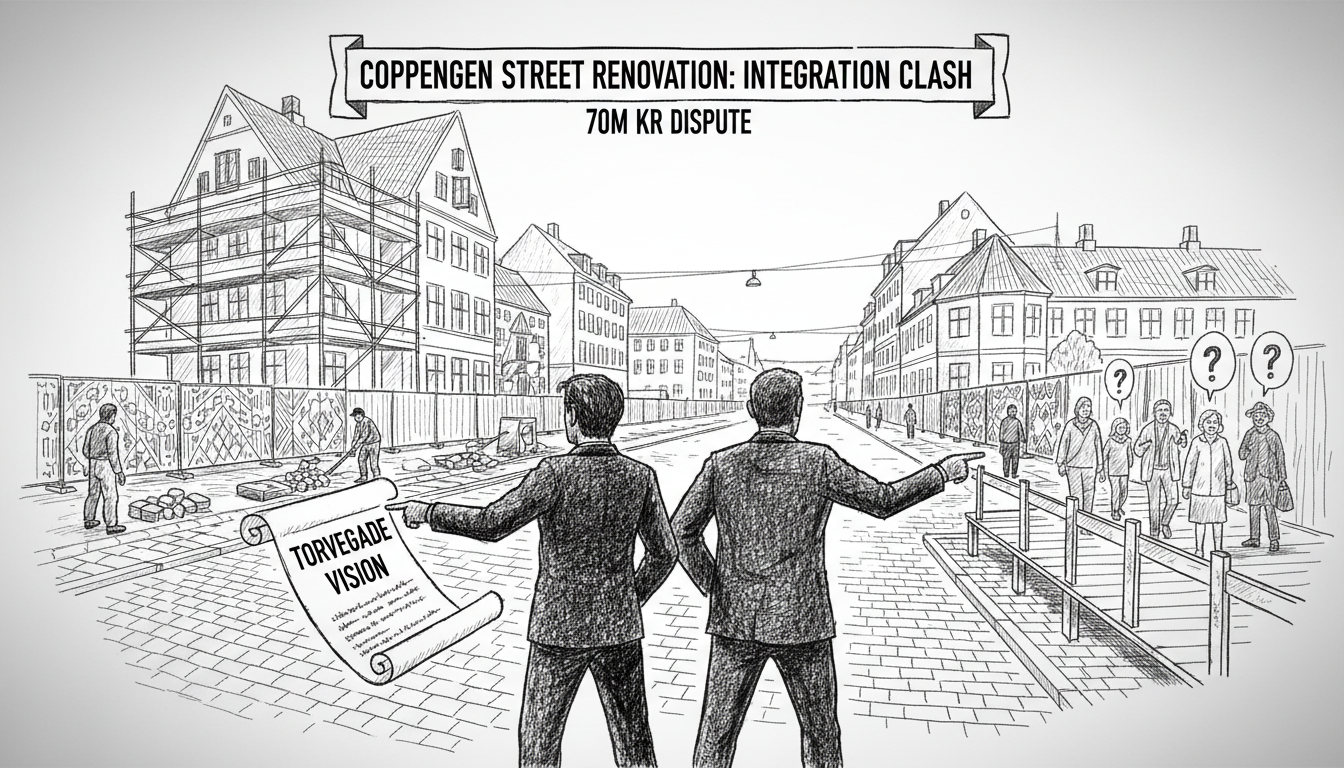
A major street renovation project in Copenhagen has ignited a public dispute between the city's current and former technical and environmental mayors. The conflict centers on the 70 million kroner redesign of Torvegade, a main traffic artery on the historic island of Christianshavn. The former mayor now criticizes the project's direction, which his successor now oversees. This debate reveals deeper tensions about urban planning, public spending, and community needs in Denmark's capital.
Torvegade serves as a critical link between Christianshavn and the rest of Copenhagen. The street cuts through a neighborhood known for its mix of historic buildings, the famous Christiania freetown, and diverse residential areas. Its redesign aims to improve traffic flow and public spaces. Yet the former mayor argues the current plan fails to meet original expectations for the area's development. He suggests the project misunderstands the street's role in the local community fabric.
This dispute is not just about asphalt and sidewalks. It touches on core questions of Danish social policy and municipal governance. Copenhagen, like many Danish cities, faces constant pressure to balance modernization with livability. Major infrastructure projects often become flashpoints for broader debates. They ask who the city is for and how public funds should serve its residents. The 70 million kroner price tag invites scrutiny, especially when compared to budgets for social services and integration programs elsewhere.
From my perspective covering Danish society, these clashes often highlight a gap between political vision and ground-level reality. Technical mayors hold significant power over Copenhagen's physical development. Their decisions shape how people move, interact, and experience the city. When a former official criticizes his own party's current project, it signals a genuine disagreement over urban strategy. It also reflects the complex challenge of governing a growing, diverse capital.
The criticism focuses on whether the renovation truly serves Christianshavn's unique community. This area has a distinct identity within Copenhagen. It is home to long-standing residents, artists, and a notable immigrant population. Effective urban design here must consider social integration as much as traffic efficiency. A poorly planned street can isolate neighborhoods. A well-designed one can connect them. The former mayor's intervention suggests he fears the current plan may fall into the first category.
What does this mean for Copenhagen's residents and international observers? It demonstrates the active, often contentious, nature of Danish local democracy. Municipal projects undergo public debate and political revision. It also shows how infrastructure spending is never neutral. Every kroner spent on a road is a kroner not spent on a school, a community center, or direct social support. In a nation proud of its welfare system, these trade-offs are always political.
The outcome of this dispute will influence more than just one street. It will set a precedent for how Copenhagen manages its historic neighborhoods amid growth. It will test the city's commitment to inclusive planning that considers all residents. And it will reveal the practical challenges of translating political promises about 'livable cities' into concrete, successful projects. The people of Christianshavn, and all Copenhageners, deserve a solution that connects their community in every sense of the word.