
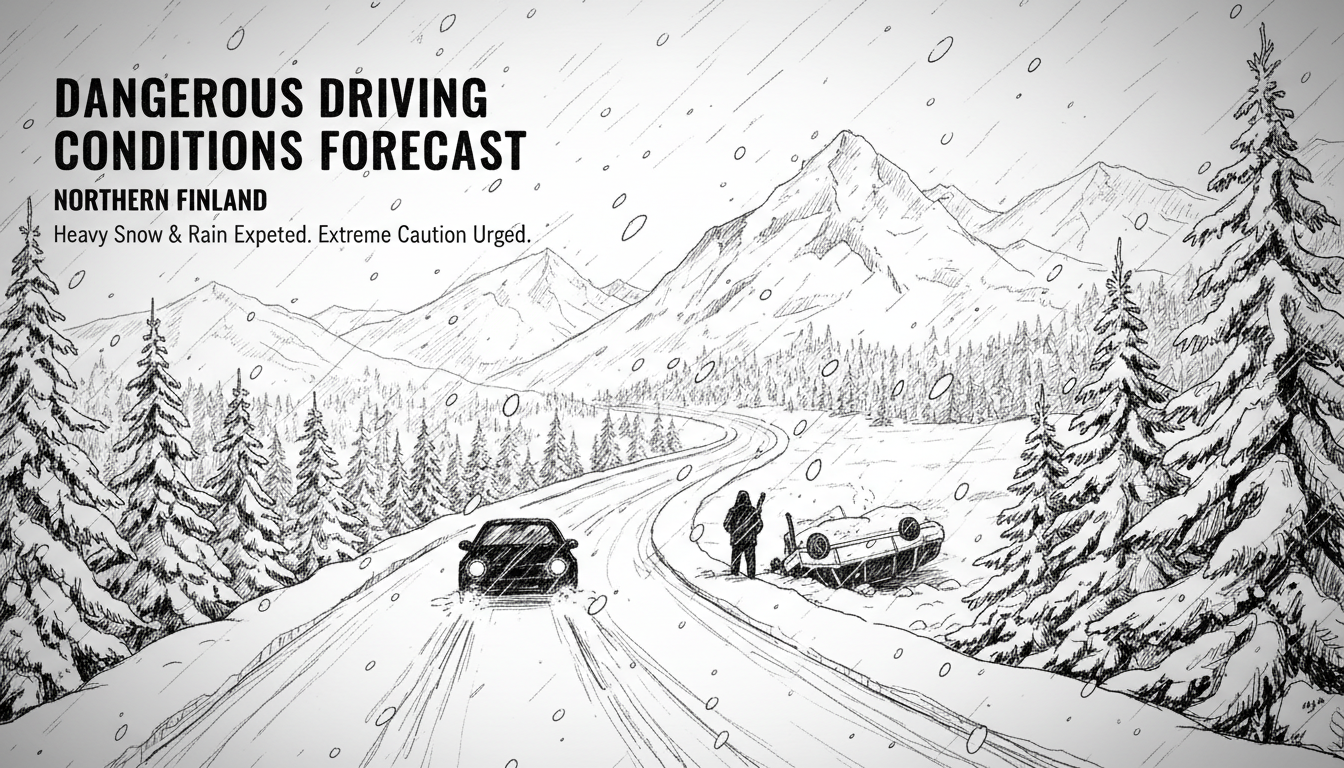
Finnish authorities have issued serious warnings for hazardous driving conditions across large portions of the country this week. The Finnish Meteorological Institute classifies driving weather as dangerous on Monday for the regions of North Ostrobothnia, Kainuu, and Koillismaa. The same warning remains in effect for Tuesday for Koillismaa and southern Lapland up to the Rovaniemi area. A significant precipitation area moving northeast across Finland is the primary cause, creating a complex and volatile situation for road safety.
Meteorologist Joonas Koskela explained the dynamics in a briefing. "In the south it is raining, but from the level of North Ostrobothnia and Kainuu northward, the precipitation is falling as snow," Koskela said. He noted that precipitation in the north is quite heavy, with snow potentially accumulating substantially throughout the day, leading directly to poor driving conditions. The initial precipitation area will move into Russia by evening, but new rainfall and snowfall is expected to arrive by Tuesday, targeting the same regions.
The situation is complicated by a fluctuating snow line. On Monday morning, this line ran approximately at the latitude of Kokkola and Kuhmo. When temperatures rise above freezing, rain turns to slush and snowy roads become wet and slippery, which also signifies poor driving conditions. Koskela pointed out that even in southern areas, driving is not necessarily straightforward. "At times the rain can come down quite heavily. If a lot falls, it accumulates on the road. Especially in the morning and evening when it is dark, heavy rain is not very pleasant on the road either," he stated.
Forecasts indicate the snow line will likely shift in the coming days. By the end of the week, it is projected to run along an axis from the Oulu region to North Karelia. Throughout the week, the zero-degree line will oscillate around the latitude of Oulu. Temperatures south of this line could reach around five degrees Celsius, while in Lapland, at its coldest, it may be a solid twenty degrees below zero. Koskela added that the snow cover in Lapland is likely not in danger of melting significantly.
This weather pattern presents a major test for Finland's winter road maintenance infrastructure, a critical component of public safety and economic continuity. The Finnish Transport Infrastructure Agency (FTIA) and local municipalities will be deploying plows and graders, but drivers are urged to exercise extreme caution. Such widespread warnings often lead to increased traffic accidents and disruptions to logistics, particularly for transport to and from the key ports of Oulu and Kemi. International readers should understand that while Finland is exceptionally adept at handling winter conditions, these forecasts represent a severe and widespread event that requires heightened public awareness. Travel plans in northern Finland, especially on highways like E75 and E8, should be reconsidered during the warning periods. The direct impact will be felt by commuters, the transport industry, and could potentially affect supply chains if conditions persist.