
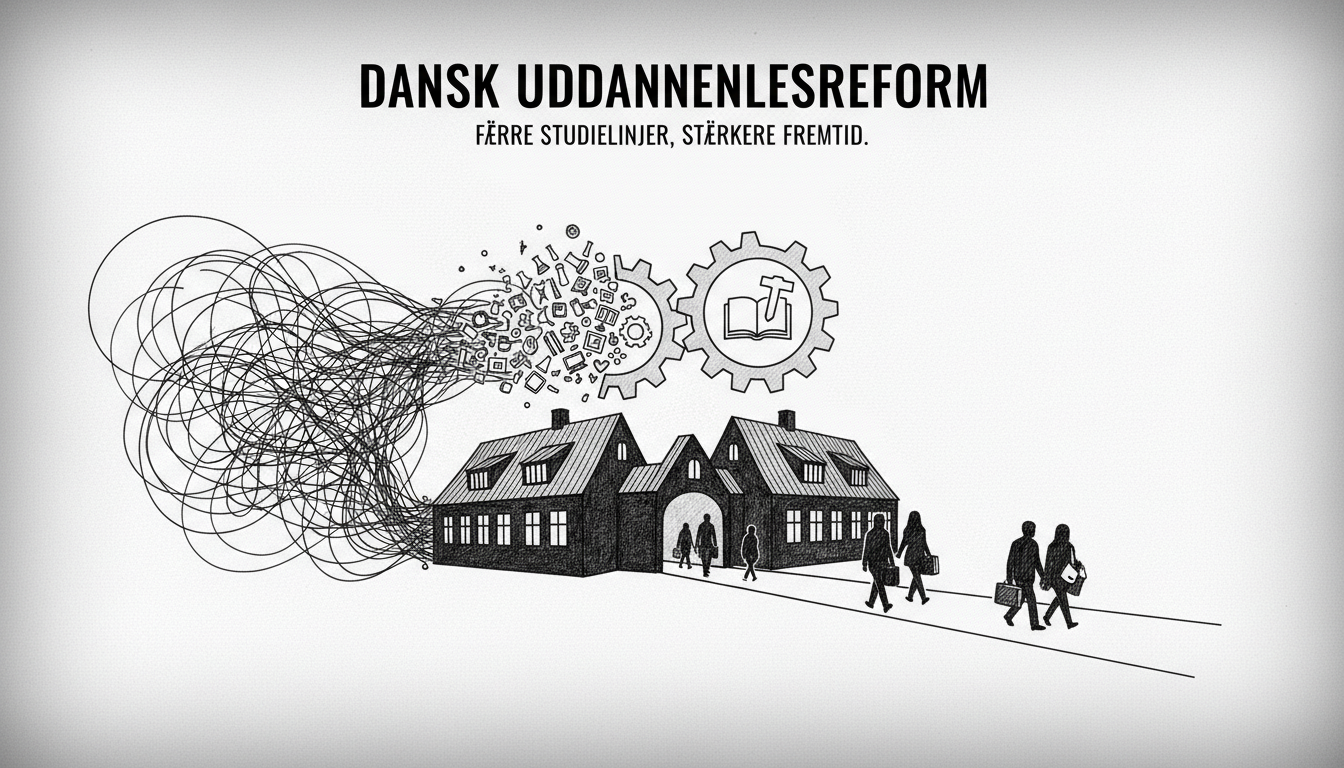
Two major Danish business and education associations are pushing for a dramatic simplification of the country's high school system. They want to return to a model with just two core study lines per program. This proposal aims to reshape the future workforce. It has direct implications for Copenhagen's business districts and the Øresund region's talent pipeline.
The Danish Gymnasiums and the Danish Business Schools and Gymnasiums associations made the recommendation. For the general upper secondary exam, known as STX, they propose 'Language and Culture' and 'Natural Science and Society'. The business-oriented HHX program would offer 'Economics and Law' and 'Culture and Market'. The technical HTX program would have 'Technology and Design' and 'Natural Science and Mathematics'.
This is a significant reduction. Students currently choose from many more specialized study lines. Maja Bødtcher-Hansen, chair of Danish Gymnasiums and principal of Frederiksberg Gymnasium, supports the change. She said the simpler structure would create more diverse classrooms. 'Too many students today choose a very specific direction to be in a class with people they know,' she explained in a statement. 'This divides the gymnasium by gender, background, and type. With two directions, we get better opportunities to mix the classes, and that provides better teaching.'
The proposal follows a political agreement in February to set new requirements for high schools. If adopted, Danish high schools would resemble their pre-2005 structure. Before that year, students graduated as either a 'language' or 'mathematics' student. The shift to more specialized 'study direction' gymnasiums began then.
This move is not just about pedagogy. It is a strategic business intervention. Danish companies, especially in renewable energy and tech, consistently report skills gaps. They need well-rounded graduates with strong foundational knowledge. The current hyper-specialization, argue business leaders, can create siloed thinking. A broader educational base could foster more adaptable employees for Copenhagen's stock exchange-listed firms and burgeoning green tech sector.
Critics argue the plan is a step backward. They say it reduces student choice and could dampen passion for highly specialized fields. The debate will center on whether a broader education truly serves a modern, complex economy. The final decision rests with the political majority that called for reform. Their verdict will shape Denmark's human capital for decades. It will directly affect export numbers and company revenues by determining the skills entering the job market. The outcome is crucial for maintaining Denmark's competitive edge in trade and renewable energy.