
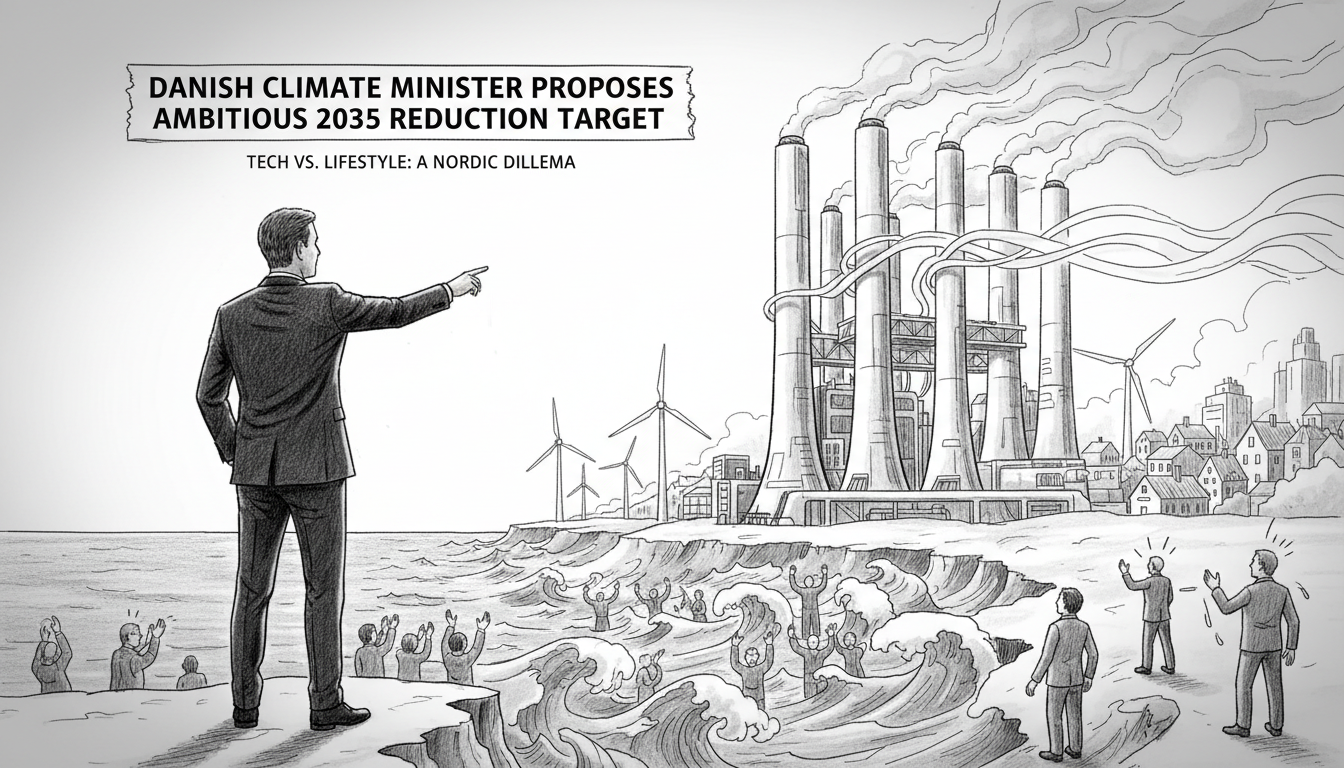
Danish Climate Minister Lars Aagaard has proposed a new national climate reduction target for 2035, aiming for an 82 to 85 percent cut in emissions. The announcement has sparked a sharp and divided response across the political spectrum and among environmental groups. Many critics have labeled the government's statement as embarrassing, while others see it as a positive, necessary step. The proposal centers on a significant financial commitment to Carbon Capture and Storage technology, known as CCS. This involves capturing carbon dioxide emissions at their source, such as power plants, and storing them deep underground. The government states it has secured funding for this initiative within the finance ministry's budgetary framework. The debate now pivots on a fundamental question for Danish society: should the primary solution to the climate crisis come from new technology or from widespread changes in public consumption and behavior?
This policy announcement arrives at a critical juncture for Denmark's green transition. The country has long positioned itself as a global leader in renewable energy, particularly wind power. Yet, meeting increasingly stringent EU climate goals requires tackling harder-to-abate sectors like agriculture and heavy industry. The minister's focus on CCS technology suggests a strategic bet on industrial innovation rather than imposing stricter limits on daily life. This approach reflects a broader tension within Danish social policy, which often seeks to balance ambitious welfare goals with economic competitiveness and individual freedom.
For the international community observing Danish climate policy, this move signals a continued commitment to technological solutions. Denmark's welfare system and high trust in public institutions often enable long-term investments in large-scale infrastructure projects that other nations might find politically difficult. The substantial funding earmarked for CCS demonstrates this capacity. However, the critical reaction from some quarters highlights a persistent concern. Critics argue that over-reliance on unproven technology at scale could delay more immediate, behavioral changes needed to reduce emissions. They question whether this is a genuine path forward or a way to avoid asking citizens and businesses to make harder choices.
From a social integration perspective, climate policy also intersects with broader questions of equity and participation in Danish society. The costs and benefits of the green transition are not felt equally. Ambitious climate targets must be implemented in a way that considers their impact on all residents, including newer communities. Will the jobs created by new green tech be accessible? How will policy ensure that the burden of change is shared fairly? These are questions that community leaders in Copenhagen and other municipalities often raise at local social centers, where the human impact of national policy becomes tangible. The success of any climate plan, technological or otherwise, may ultimately depend on its social acceptability and perceived fairness.
In practical terms, the proposed target is exceptionally ambitious. Achieving an 82-85 percent reduction in little over a decade would require unprecedented acceleration across all sectors of the Danish economy. It places immense pressure on the development and deployment of CCS, a technology that remains costly and is not yet operating at the necessary commercial scale in Denmark. The government's confidence in finding the funds is notable, but the real test will be in execution. Past Danish environmental successes, like wind energy, were built on decades of consistent subsidy and policy support. Replicating that for CCS in a much shorter timeframe presents a formidable challenge, one that will define Denmark's climate legacy for years to come.