
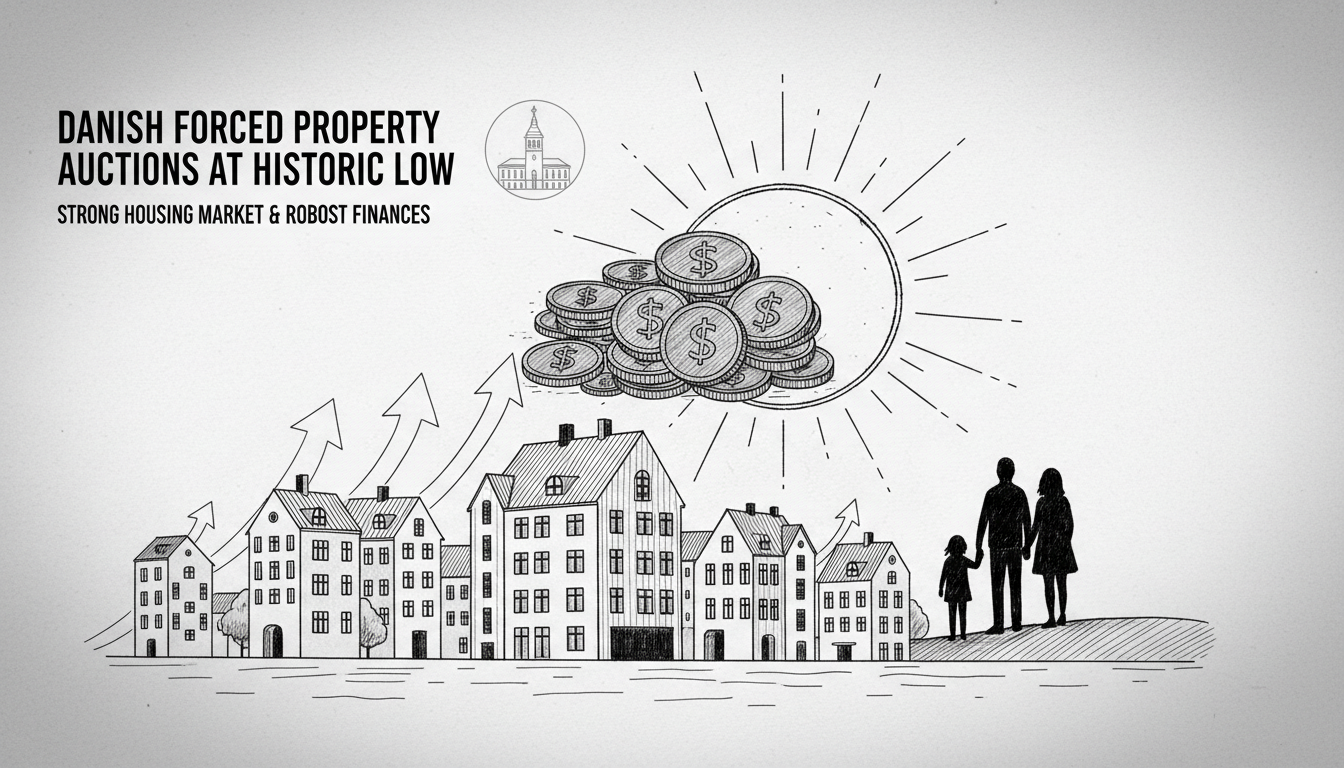
Danish homeowners and the housing market are showing remarkable strength. New data reveals a near-record low number of forced property auctions. This signals a robust economy with significant implications for trade, consumer confidence, and the financial sector in Copenhagen and across the Øresund region.
Statistics Denmark published adjusted figures for November. The seasonally corrected number of announced forced auctions stood at 97. The total for the year so far is 1,079. This figure is extraordinarily low in historical context. Records have been kept since 1993.
Brian Friis Helmer, a personal finance economist at Arbejdernes Landsbank, stated the numbers are close to setting an all-time low. If fewer than 152 auctions are announced in December, this year will become the year with the fewest forced auctions on record. The previous record low was set in 2006 with 1,231 auctions.
'The very few forced auctions are a clear result of a housing market where transactions are moving quickly and prices are rising nicely,' Helmer said in an analysis. 'Furthermore, we have homeowners who are fundamentally robust and therefore have no problems paying their installments.'
He also pointed to Denmark's strong employment situation. This helps ensure homeowner finances remain solid. The so-called arrears percentage confirms this trend. It indicates the share of outstanding mortgage loans that become delinquent. In the second quarter, it was just 0.12 percent. This is also a historic low.
A property can be forced to auction when the owner fails to pay interest and principal as agreed. If a mortgage credit institution, a bank, or another lender sees no other way to recover its claim, it can request the property be sold at a forced auction. Not all properties requested for forced auction end up changing owners. Sometimes the creditor succeeds in selling the home in a regular transaction or securing the missing funds another way.
This trend has direct consequences for Danish business news and the Copenhagen trade environment. A stable housing market underpins consumer spending. It supports the balance sheets of major Danish financial institutions like Danske Bank and Nykredit. Strong domestic consumption benefits exporters and retail sectors in key business districts like Indre By and Ørestad.
The data suggests Danish households are weathering economic pressures better than many anticipated. This resilience provides a stable foundation for the national economy. It reduces systemic risk in the financial sector. For international investors tracking the Copenhagen stock exchange, these figures are a positive indicator of underlying economic health. They point to reduced credit risk and stable demand in the construction and real estate services sectors.
However, analysts note this strength could also reflect market dynamics. High transaction volumes and rising prices may be preventing distress sales. The true test may come if interest rates see further adjustments or if employment conditions soften. For now, the record-low auction count is a clear, measurable sign of a booming Danish property market and a confident consumer base.