
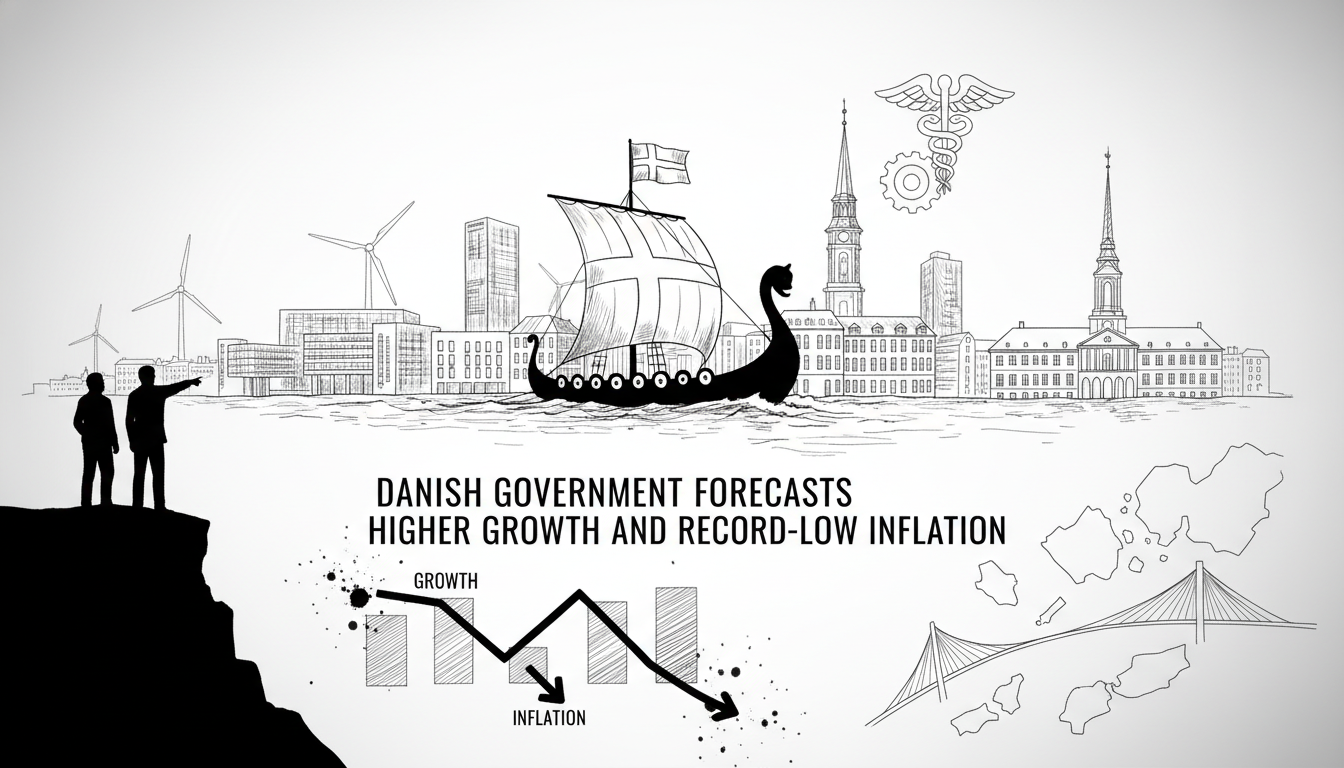
The Danish government has released its latest economic assessment, painting a notably optimistic picture for the national economy. The forecast points to higher growth and a continued decline in inflation, a combination that signals strong underlying economic health. This outlook is based on the government's official Economic Review for December. The report suggests Danish households and businesses can enter the new period with increased confidence.
For international observers, this forecast underscores Denmark's resilient economic model. The country has consistently managed to balance fiscal discipline with strong social welfare, a formula now yielding positive results. The projected low inflation is particularly crucial. It preserves consumer purchasing power and provides a stable environment for long-term business investment, especially in the capital-intensive renewable energy sector. This stability is a key competitive advantage for Denmark on the global stage.
This positive forecast has direct implications for trade and commerce in Copenhagen and the wider Øresund region. Higher domestic growth typically fuels import demand for machinery and consumer goods. More importantly, it strengthens the export potential of flagship Danish companies. Firms like Vestas, Ørsted, and Novo Nordiks rely on a stable home economy to fund their global expansion and research into sustainable technologies. A robust domestic market acts as a springboard for their international operations.
Company revenues in sectors like renewable technology and life sciences are closely tied to both domestic economic health and global trade flows. The government's forecast suggests a favorable environment for corporate earnings. This often translates into positive momentum for the Copenhagen Stock Exchange, where many of these global Danish brands are listed. Investors watch these official forecasts closely as indicators of market sentiment.
Trade figures from the past year show Denmark maintaining a strong surplus, driven by pharmaceutical and green technology exports. The new forecast implies this trend should continue. It provides the Ministry of Industry, Business, and Financial Affairs with a solid foundation for negotiating international trade agreements. A strong economy gives Denmark greater leverage in discussions with key partners in the EU and beyond.
Several CEOs in the clean-tech sector have recently echoed this sentiment in public statements. They highlight the link between national economic stability and their ability to secure large international contracts. The government's projection of record-low inflation is a critical piece of this puzzle. It reduces uncertainty in project financing and helps Danish firms present more competitive bids for global infrastructure projects.
From a political perspective, a sunny economic forecast is always welcome for the sitting government. It validates current fiscal and regulatory policies. The challenge will be managing expectations. If growth moderates or global headwinds increase, the government may need to adjust its stance. For now, the message is clear. The Danish economy is on a stable path, with Copenhagen's business districts and the nation's export engines positioned to benefit.
The real test will be in the execution. Forecasts can change with shifting global commodity prices or unexpected geopolitical events. The government's ability to maintain this positive trajectory through potential external shocks will determine the long-term outcome. For Danish business news followers, the immediate takeaway is one of cautious optimism, with a clear focus on the tangible metrics of trade, exports, and corporate performance in the quarters ahead.