
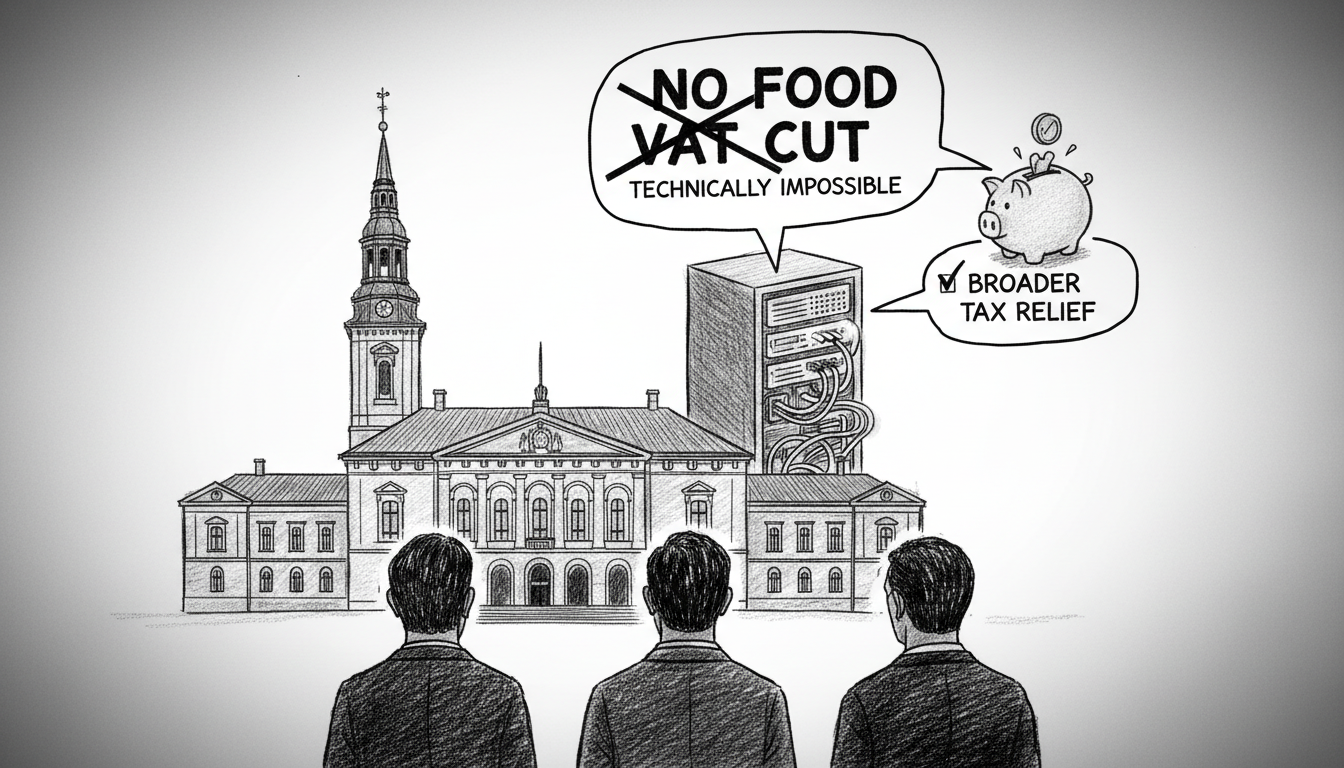
The Danish government will not reduce the value-added tax on food before the next general election. Economic Minister Stephanie Lose confirmed the decision on Thursday. She cited insurmountable technical and administrative hurdles as the primary reason. The announcement came during the presentation of the government's official economic assessment. This forecast forms the basis for Denmark's current fiscal policy.
Minister Lose stated that a direct VAT reduction is simply not feasible within the current timeframe. The next parliamentary election must be called within a year. She explained that Denmark's legacy IT systems for tax registration present a major obstacle. Implementing a differentiated VAT rate on specific goods like food could take three years or more. The country currently applies a uniform VAT rate and lacks the infrastructure for category-specific changes.
This news disappoints many Danish households grappling with high food prices. Denmark imposes the highest food tax in the European Union. The government has faced public pressure to provide relief. Prime Minister Mette Frederiksen has previously acknowledged the need for more action on consumer costs. Yet, no immediate measures are forthcoming.
Instead, the government points to broader tax relief packages already approved. These include a lower electricity tax set to take effect. Minister Lose emphasized that these pre-planned measures will increase disposable income. She projected a typical working family would gain an extra 15,000 Danish kroner by 2026. Combined with expected wage increases, this could mean 30,000 kroner more in annual purchasing power.
The economic forecast predicts wages will rise by 3.2 percent against a one percent inflation rate in 2026. This scenario suggests a significant boost to real consumer spending power. When asked if this strong outlook negates the need for a food VAT cut, Lose framed it as a political choice. She acknowledged that making essential goods cheaper remains a valid priority, regardless of the economic climate.
The administrative complexity is a genuine concern for Copenhagen's business community. Retailers and food service companies across the Øresund region would face new compliance burdens. Minister Lose illustrated the challenge with a pointed question. If a pizza has pineapple, does that topping qualify for the lower food VAT rate? Such distinctions create a compliance nightmare for small and medium-sized enterprises.
Economists often criticize targeted VAT cuts as an inefficient tool for economic stimulus. They argue broad-based income tax reductions or direct transfers are more effective. The government's stance, while pragmatic, reveals a tension between political promises and operational reality. The decision protects public finances and avoids a chaotic implementation but leaves a key consumer demand unaddressed. The government has now initiated a technical working group to explore future possibilities, effectively kicking the issue past the election cycle.
For Danish businesses, especially in the retail and grocery sectors, this provides regulatory certainty for now. Major chains like Salling Group (which owns Netto and Føtex) and Coop Danmark can continue their current pricing and accounting systems unchanged. The focus for consumer relief shifts to the upcoming electricity tax cut and wage negotiations in Copenhagen and other industrial hubs. The government's move is a clear calculation that pre-announced, broad-based relief is a safer political bet than a complex, last-minute VAT reform that might not function properly.