
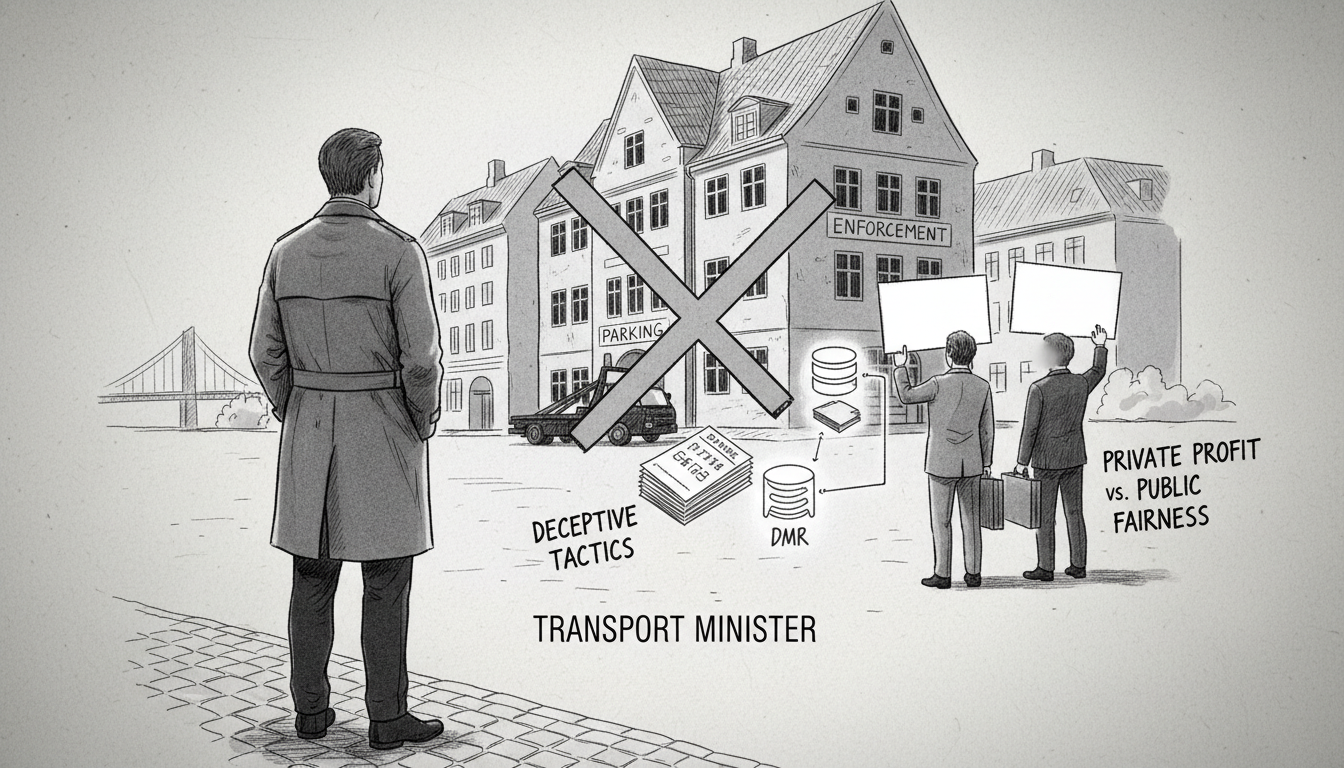
A recent change in Danish law aimed at protecting consumers from aggressive parking enforcement has backfired in a predictable way. Parking companies have simply developed new methods to issue fines, prompting a furious response from the Transport Minister. The official now plans to strip these firms of a key privilege, escalating a long-running battle over fairness and regulation in Danish public spaces. This conflict touches on core values within Danish society news, where the balance between private enterprise and public welfare is constantly negotiated.
The issue gained national attention through the experience of Birgit Mølgaard Nielsen. On a Saturday in early September, she parked her car on Damgårdstoften in Mårslet, south of Aarhus, to attend a friend's birthday. In a hurry, she parked at 12:28 PM and left just before 5:05 PM, after nearly five hours. What she missed were the signs stating the space was reserved for local residents. She received a substantial fine, feeling the system was designed to trap rather than inform. Her story is not isolated but part of a broader pattern discussed in communities across Copenhagen and other cities.
Transport Minister Thomas Danielsen has labeled these new company tactics as 'deceptive' and 'sharp practice.' He argues the firms are exploiting loopholes to maintain revenue streams after the legal change restricted their previous methods. The minister's proposed solution is drastic. He intends to revoke the parking companies' access to the national vehicle registry, a tool essential for linking a parked car to its owner's address to send the fine. Without this access, their business model for on-street enforcement would collapse. This move reflects a hardening stance within Denmark's immigration policy and broader social policy framework, where the state is increasingly willing to intervene in market operations perceived as predatory.
The debate sits at the intersection of consumer protection and municipal management. Many Danish municipalities contract private firms to manage residential parking zones, a common feature in urban areas facing integration and housing density pressures. These zones, intended to prioritize residents in crowded neighborhoods, have become a profit center. Community leaders in areas like Nørrebro and Vesterbro in Copenhagen report that confusing signage and quick enforcement create tension and a sense of unfair targeting, particularly for visitors and new residents navigating complex local rules. This friction can subtly impact social cohesion, a key metric in Copenhagen integration efforts.
The minister's threat is a significant policy escalation. It raises questions about who should control and profit from public space. Will municipalities have to bring parking enforcement entirely in-house, potentially at a higher cost to local budgets? Or will the state create a new, stricter regulatory framework for private operators? The outcome will signal how Denmark's renowned welfare system principles apply to everyday services. The system is built on trust and fairness, and many Danes perceive aggressive ticketing as a violation of that social contract. The government now appears ready to use legislative power to realign the practice with those core values. The coming months will show if this political will translates into effective law that protects citizens without creating new bureaucratic burdens for cities already managing complex challenges in social policy and urban living.