
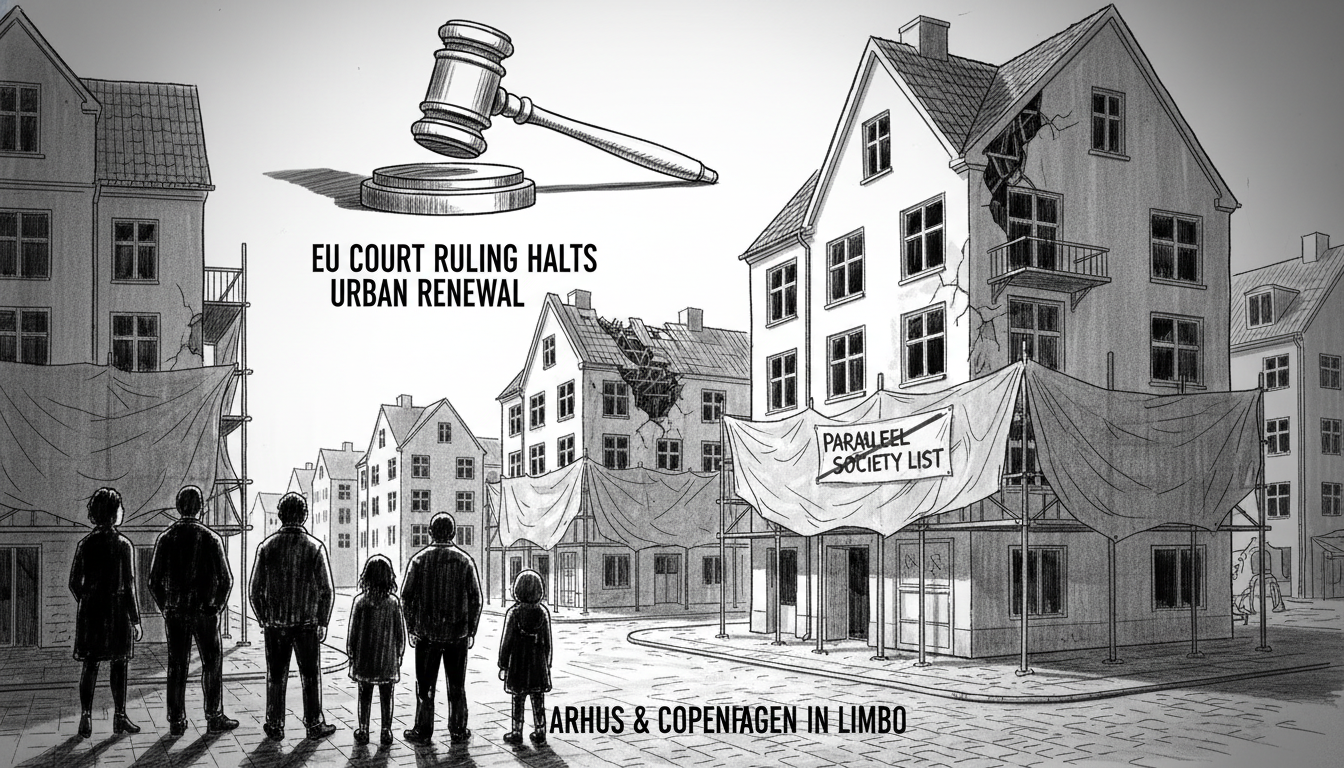
A long-awaited decision from the European Court of Justice could fundamentally reshape Denmark's controversial 'parallel society' list. The annual designation of disadvantaged residential areas, a cornerstone of Danish integration policy, is now under legal scrutiny for potential ethnic discrimination. This has brought billion-dollar urban renewal projects in cities like Aarhus and Copenhagen to a standstill, leaving thousands of residents in limbo.
Today, authorities published the latest list. The policy, originally known as the 'ghetto list', targets public housing areas with over 1,000 residents. A key entry criterion is that more than half the population must have a non-Western background. Areas must then meet at least two of four additional socio-economic criteria related to employment, crime, education, and income.
In the Gellerup area of Aarhus, resident Ezzedine Azzam has lived for 24 years. He and his family refused to relocate when their building was slated for demolition under the law. "We hope the ghetto law is abolished," Azzam said. "Then a new law should come, treating people the same way, not based on whether you are Western or non-Western." His case, and similar ones in Copenhagen's Mjølnerparken and Odense's Vollsmose, are now paused awaiting the EU court ruling.
The legal challenge questions whether using ethnic background as a primary filter violates EU equality rules. The Advocate General of the European Court has already issued a preliminary opinion calling the Danish legislation 'direct discrimination.' A final ruling is expected soon.
This legal uncertainty has frozen major construction. Kristian Würtz, managing director of Brabrand Boligforening, explained the dilemma. "We cannot move forward with the cases," Würtz said. "In both blocks, there are tenancies where residents have refused to move. Decisions await the EU Court. Only when that is clarified do we know if we can proceed with demolition and build the planned school."
Professor Claus Bech Danielsen from Aalborg University analyzes the potential outcome. "If the EU Court rules that it is discriminatory to designate these areas based on residents' ethnicity, I assume Danish politicians will try to change the criteria," Danielsen stated. He believes the ethnic criterion is the central one but doubts the list will disappear entirely. "The political climate is not for that. I think they will try to set some new criteria to capture roughly the same areas once more."
The policy's impact is measurable. Statistics show targeted areas often have over 40% of working-age residents without employment or education. Crime rates can be triple the national average. Over 60% of residents aged 30-59 may have only a primary school education. Average incomes are frequently below 55% of the regional average.
This situation highlights a core tension in Danish social policy. The welfare model traditionally emphasizes equality and universalism. Yet the parallel society list employs a form of ethnic targeting to address concentrated disadvantage. The goal is integration, but the method is now contested at the highest European legal level.
For residents like Azzam, the principle matters most. When asked why he doesn't simply move to allow redevelopment, he is clear. "It's the principle of it. We are against the entire ghetto law, and that we have to move. It's more the principle." His home represents more than affordable rent. It represents a challenge to a system he views as fundamentally unequal.
The coming weeks will determine if that challenge succeeds. The court's decision will not only affect specific buildings. It will force a national conversation about how Denmark defines integration, measures disadvantage, and balances social cohesion with individual rights. The outcome will resonate through Copenhagen integration projects and Danish social policy for years to come.