
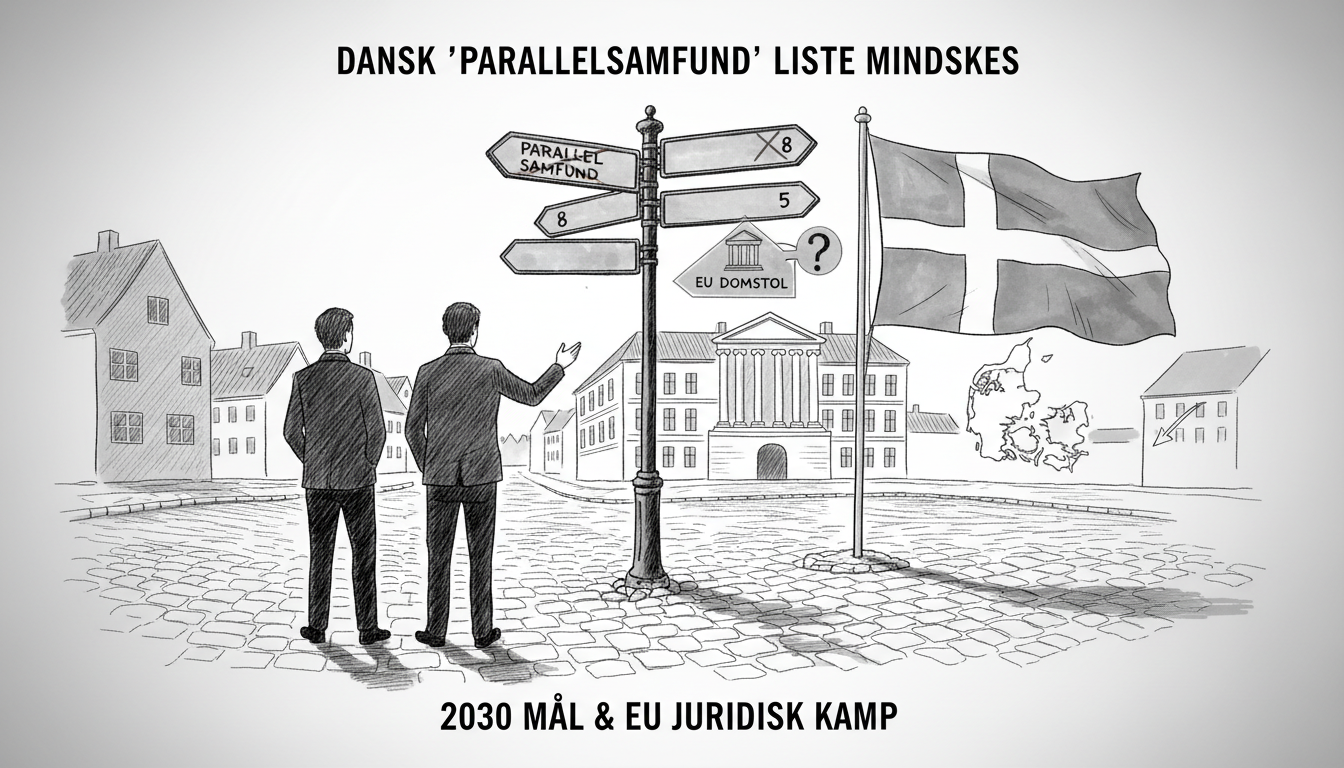
The Danish government's official list of designated 'parallel societies' has contracted from eight to five areas. This marks progress toward a stated national goal of eliminating such areas by 2030. The list, which previously carried the controversial 'ghetto list' label, identifies residential areas based on criteria including ethnicity, income, employment, education, and crime rates.
Social and Housing Minister Sophie Hæstorp Andersen attributed the decline to the 2018 Parallel Society Law. She said the legislation has driven increased investment in schools and daycare, alongside improved cooperation between municipalities and non-profit housing associations. The law mandates specific interventions in listed areas, including mandatory daycare for children over one and potential demolition or sale of public housing.
The five areas remaining on the list are Tåstrupgård in Høje-Taastrup, Sundparken in Horsens, Bispehaven in Aarhus, Gellerupparken/Toveshøj in Aarhus, and Vollsmose in Odense. Three areas—Askerød in Greve, Stengårdsvej in Esbjerg, and Skovvejen/Skovparken in Kolding—have been removed from both the parallel society and vulnerable area lists, primarily due to falling crime rates.
The policy's economic rationale is clear. The government argues that concentrated social challenges in specific postcodes hinder national productivity and create long-term welfare burdens. Integrating these areas into the mainstream labor market is seen as a fiscal imperative. The focus on non-Western immigrant demographics, a core criterion, is politically charged but reflects a longstanding Danish policy approach to integration.
Minister Andersen emphasized the goal of attracting more 'resource-strong' residents to these neighborhoods while improving opportunities for children growing up there. However, the policy faces significant legal and social headwinds. Earlier this year, an advocate general for the European Court of Justice opined that aspects of the Danish legislation constitute 'direct discrimination' on grounds of ethnicity. A final ruling is expected soon.
Residents in areas like Copenhagen's Mjølnerparken and Aarhus's Gellerupparken have criticized the law, arguing the label stigmatizes their communities and can trigger property devaluation. The minister acknowledged concern over the pending EU court decision but affirmed the government's commitment to its policy course. The underlying tension pits a Danish model of assertive social engineering against EU anti-discrimination frameworks, setting up a consequential clash. The government's strategy relies on measurable improvements in employment and education metrics to justify its continued approach, with the next annual list serving as a key performance indicator.