
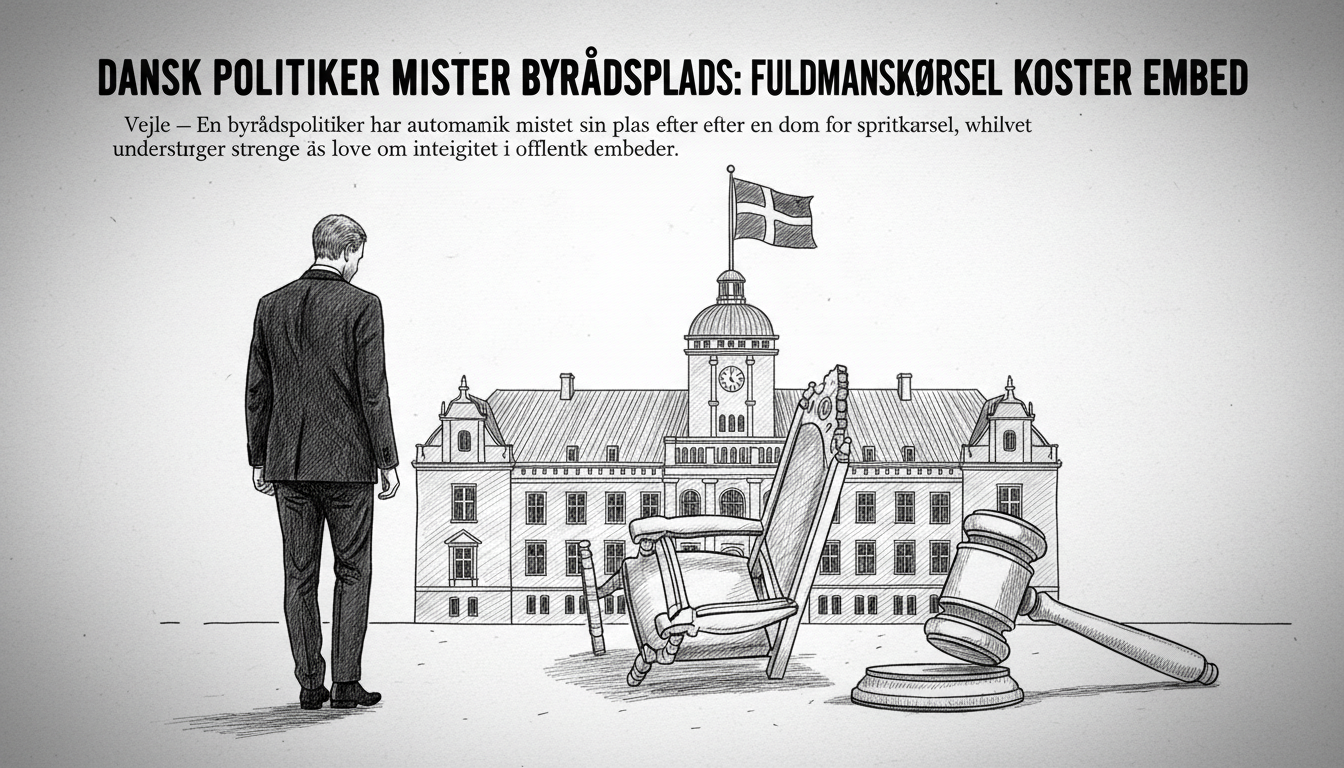
A newly elected city council member in Vejle must now relinquish his seat after a drunk driving conviction made him ineligible to serve. Kenneth Ettrup Hansen from the Liberal Alliance party received 522 personal votes but cannot convert them into political office. The case highlights strict Danish eligibility laws tied to the welfare system's integrity standards.
Hansen disclosed the situation himself in a public statement. He explained he lost his driver's license for three years this past summer after a traffic stop. His blood alcohol level exceeded legal limits, resulting in a fine of 6,500 kroner. According to Danish municipal election law, anyone unconditionally stripped of their license under specific traffic law paragraphs is barred from holding elected municipal office. The relevant statute mandates license revocation for alcohol levels above 1.2 promille.
The politician stated he attended a social event, slept, and drove the next morning feeling clear-headed. Police testing revealed the violation. He received formal notification from the Vejle municipality last Thursday declaring him ineligible. Hansen then informed the city's mayor on Friday morning. His statement did not specify the exact promille level but confirmed it was not classified as reckless driving.
This incident raises pointed questions about personal responsibility for public officials in Denmark's consensus-driven political culture. Voters entrust representatives with stewarding the social contract and welfare resources. A breach of fundamental laws like traffic safety can be seen as conflicting with that fiduciary duty. The system's automatic disqualification reflects a zero-tolerance approach where legal integrity is non-negotiable for office holders.
Hansen has resigned from the Liberal Alliance party to avoid hindering its work in Vejle. He expressed deep regret, admitted his mistake, and accepted full responsibility. Christian Fini Mosegaard from the same party will assume the council seat. The episode underscores how personal conduct has immediate professional consequences in Danish public life, where trust is a central currency in the social policy landscape.
For international observers, this demonstrates the stringent ethical frameworks within Danish local governance. The municipal and regional election law directly links the privilege of driving with the privilege of elected office. This integration of civic responsibility across different domains is a distinctive feature of Denmark's social policy model. It assumes that judgment in one area of law reflects on fitness for public trust in another.
The practical effect is a swift and automatic removal process, leaving no room for political maneuvering or appeals based on electoral mandate. The 522 personal votes become immediately void. This legal mechanic prioritizes system integrity over individual political investment, a principle deeply embedded in the Danish welfare state's operation. It shows how Copenhagen integration ideals of rule-following extend into the highest local accountability measures.
Similar eligibility clauses exist across Nordic municipal codes, designed to protect public administration's credibility. The case serves as a stark reminder to all Danish politicians and aspiring candidates. Personal legal compliance is not a private matter but a foundational requirement for participating in the collective project of Danish welfare governance. The system's design ensures such failures are self-correcting, preserving institutional legitimacy above individual political careers.