
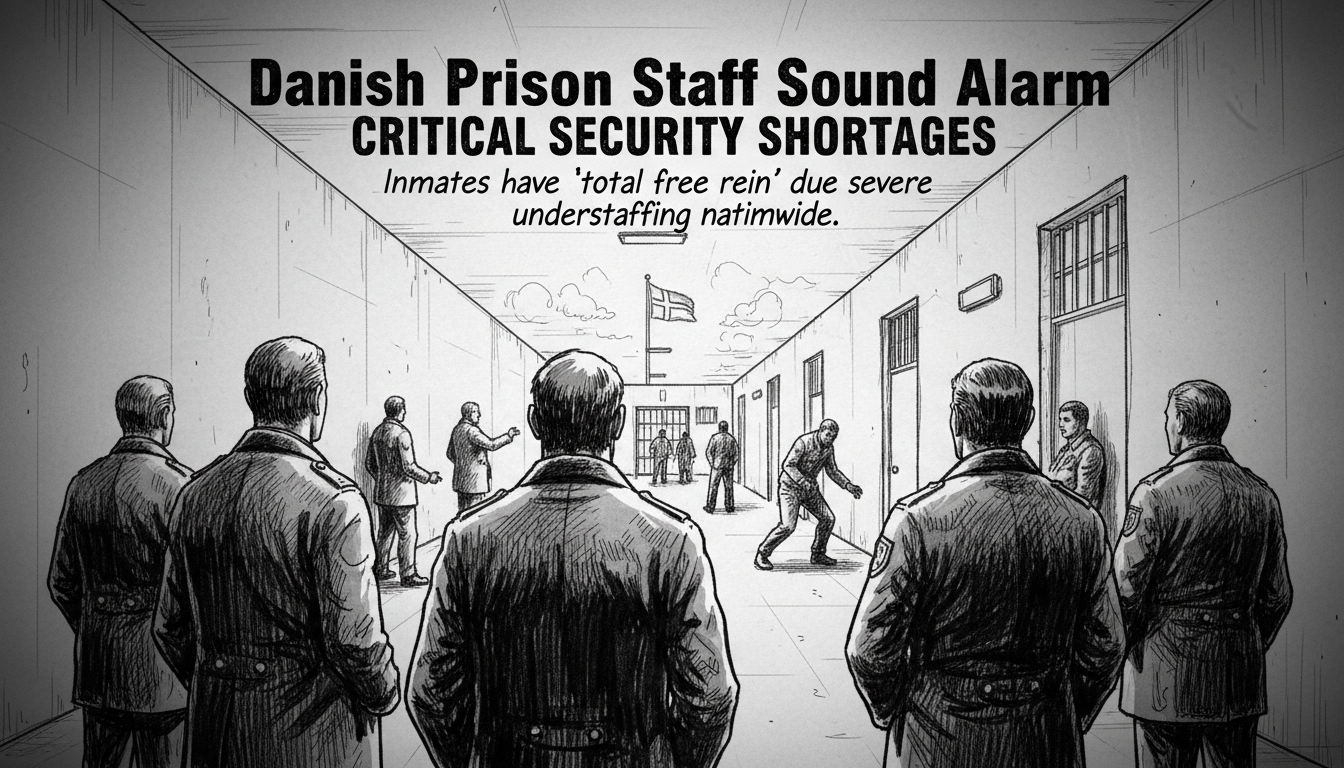
A stark warning from inside a Danish prison reveals a system under severe strain. Staff at Horserød Prison describe a critical security situation where low staffing levels have created what they call a 'free pass' for inmates. This crisis speaks to broader challenges within the Danish welfare and justice systems, where integration of new policies and retention of skilled workers are constant pressures.
Michael Thomsen, a prison officer and staff representative, paints a dire picture. He states that during evening shifts, only two or three officers are often responsible for supervising all 67 inmates. This severe understaffing forces impossible choices. Officers must abandon routine searches and patrols simply to maintain a basic presence. The safety for both staff and inmates, Thomsen says, is now 'non-existent.'
'When there are only two of us on duty, it's pointless to press the alarm. No one would come anyway,' Thomsen said in a union statement. He explains that officers avoid confronting volatile situations, knowing backup is unavailable. 'The inmates know we are not many at work. They are smart enough to figure out what it takes. They have total free rein.'
The prison's capacity was already halved after a mold discovery led to the transfer of 14 officers. Operations have struggled ever since. While prison director Tine Vigild acknowledges the difficult personnel situation, she disputes that security is compromised. She credits staff flexibility for keeping the facility running, a testament to the personal strain on employees.
This is not an isolated case in Danish society news. Staffing shortages plague prisons nationwide, a persistent flaw in the social safety net. The political response has included removing the requirement for Danish citizenship for new hires and, most recently, allocating 35 million kroner in bonuses to retain uniformed staff. These are reactive measures to a deep-rooted problem.
'We need to make it more attractive to work for us here and now,' Thomsen argues. 'A good pay raise is one thing, but we must do something else to keep and attract people.' His comment highlights a central tension in Danish social policy: the need to maintain high welfare standards while managing costs and workforce challenges. The situation at Horserød is a physical manifestation of that strain, where the theoretical safety of the system collides with the practical reality of too few people on the ground.
The implications extend beyond the prison walls. A failing correctional system impacts rehabilitation efforts, public safety perceptions, and the overall integrity of the justice system. For a country often scrutinized for its immigration policy and integration models, the state of its prisons becomes another metric of social cohesion. When basic security cannot be guaranteed in a state institution, it raises fundamental questions about resource allocation and political priority within the famed Danish welfare system. The staff's public outcry is a desperate signal that the current model is breaking under pressure.