
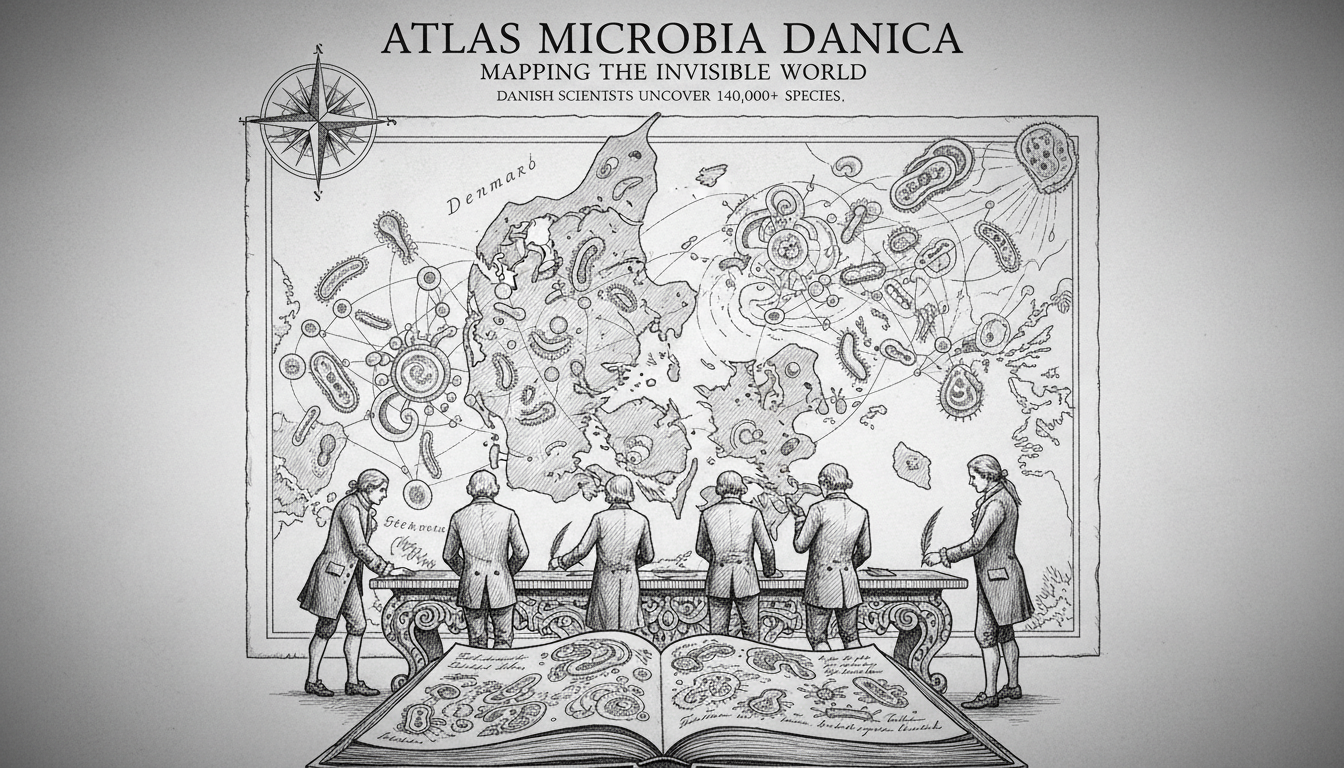
Danish researchers have completed a monumental task, creating the world's first national atlas of microorganisms. This project, called Microflora Danica, has cataloged over 140,000 different bacterial species across Denmark. The vast majority were previously unknown to science. This work sheds light on the invisible life that drives our planet's biological processes. It connects directly to our daily lives, from digestion to wastewater treatment.
Professor Mads Albertsen from Aalborg University led the research. He explains the scale of the discovery. 'We did not know most of these microorganisms beforehand,' Albertsen said. 'Eighty percent of them have never been described before.' The team analyzed 10,683 samples from fields, forests, lakes, coastal areas, and urban environments nationwide. They used advanced DNA testing to identify the species.
The project draws inspiration from a historic royal endeavor. In 1752, King Frederik V initiated Flora Danica to document all Danish plants. That project took 123 years to finish. Microflora Danica follows this tradition of national cataloging but focuses on the unseen microbial world. 'The king wanted to map the nature we lived off,' Albertsen noted. 'Microorganisms live everywhere around us today, and that is what we have mapped.'
The findings have revealed life forms so different that scientists cannot yet define their function. Researchers discovered these unique microbes in lakes across Denmark. 'It is life so different from what we know that we cannot even say what it does,' Albertsen stated. 'It is scientifically very exciting. It might tell us something about evolution and where we came from.'
The potential applications are vast and speak to core areas of Danish society and policy. Albertsen sees 'infinite potential.' New enzymes for industry could be found. Certain bacteria might influence climate accounting. Understanding these microbes could impact public health, agriculture, and environmental management. This knowledge base could inform future Danish social policy regarding public health initiatives and environmental regulations.
For a nation deeply invested in its welfare system and sustainable practices, this map provides a new foundational tool. Municipalities and social centers focused on community health and integration could eventually use insights from this microbial map. While not about immigration policy directly, a deeper understanding of public and environmental health contributes to the overall social fabric. It supports the data-driven approach characteristic of Danish governance.
The research, published in the prestigious journal Nature, marks only the beginning. The next scientific step involves investigating what these microbes can do and how we can use them. This Danish-led project sets a global precedent. It shows how a small nation can make a world-historic contribution to science by systematically understanding its own environment, seen and unseen.
This achievement reflects a broader Danish commitment to research and systematic knowledge. It is a modern continuation of a centuries-old tradition. The project provides a new lens to view Danish nature, one that reveals a hidden universe of life with profound implications for science, industry, and society.