
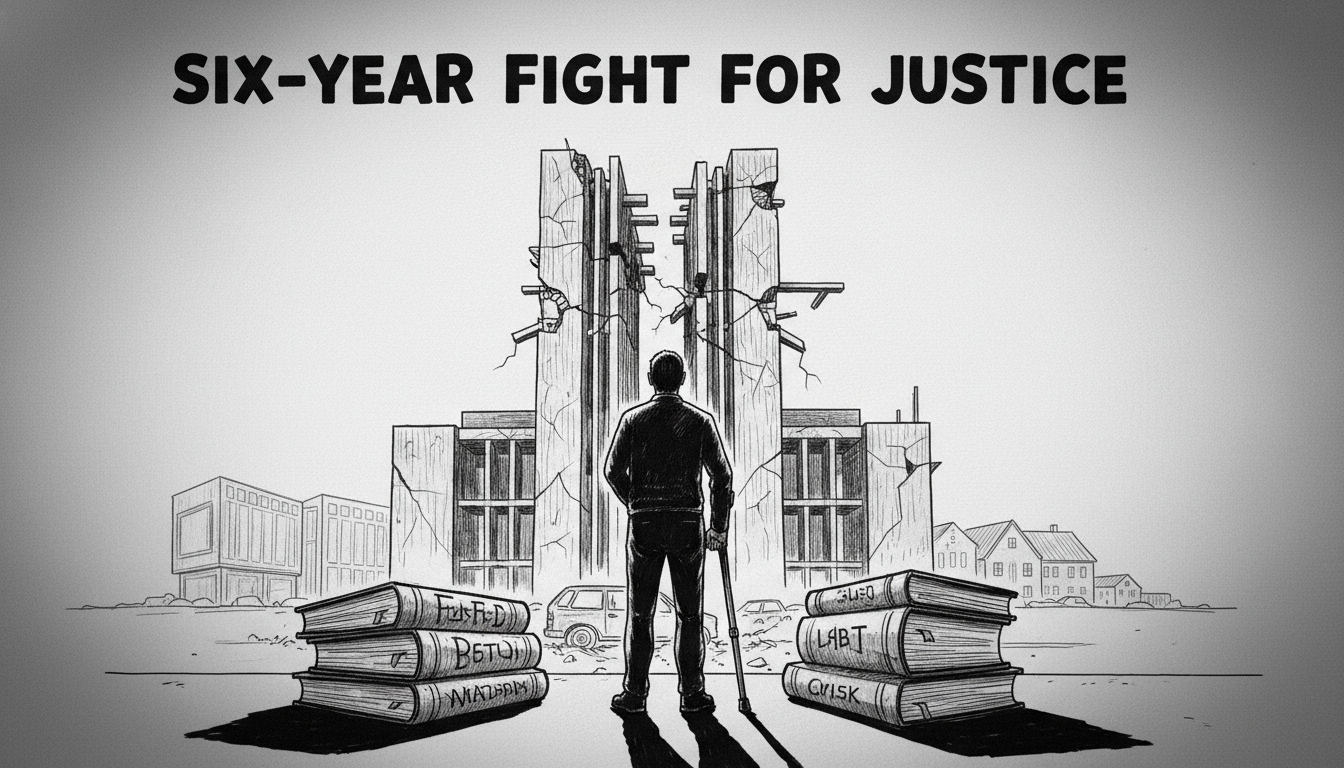
Christian B. Hansen was securing his excavator on a trailer near Copenhagen one early morning. A passing car struck him, slamming his body against the trailer and into his own vehicle. He regained consciousness on the asphalt with a concussion, whiplash, and back injuries. Nearly six years later, the system still does not officially recognize it as a workplace accident. His life is now confined by pain and a profound struggle for validation. This case exposes deep cracks in Denmark's social safety net, a system often praised internationally for its robust welfare model.
Hansen's story is a stark illustration of the human cost when bureaucratic processes fail. He followed every procedure, contacting his employer, the police, and the hospital. The police were too busy to attend the scene. The hospital recorded no serious injuries and sent him home. A critical detail later emerged: the hospital failed to log his emergency room visit that day. This missing record became a pivotal point of contention. 'The system does not trust what I am saying,' Hansen states today, his injuries preventing him from working. On his worst days, he requires a wheelchair.
His fight is with Arbejdsmarkedets Erhvervssikring (AES), the agency that assesses workplace injury claims. They repeatedly question the causal link between the accident and his chronic conditions. 'They keep saying there is no causal connection, and that it is up to me to prove it happened,' he explains. He describes facing a wall of 'mistrust, mistrust, and more mistrust' from the very system designed to support him. This experience reflects a broader issue within Danish social policy, where the burden of proof can fall heavily on the individual, challenging the core principle of the welfare state.
Now, a new law set for a final parliamentary vote threatens to make proving such injuries even harder. The legislation will relax rules on which workplace incidents must be formally reported. Lawyers specializing in compensation and insurance law, alongside labor unions, warn this will undermine employees' rights. 'There will be a lot of injured people who do not get what they are entitled to,' concludes lawyer Svend Aage Helsinghoff. Without mandatory reports, crucial evidence disappears. Hansen's case shows how difficult it already is to gather sufficient proof.
Thousands of Danes wait years for resolution in the workplace injury system. The proposed changes could push more vulnerable individuals into similar battles. For Hansen, the personal toll is immense. 'I have used an insane amount of energy to get justice, for them to acknowledge that this happened,' he says. He fears for others navigating this path. 'I am sure some people break their necks on this. I would not wish for my worst enemy to go through this. It is hard for the individual, but also for the family and social circle. Everything falls apart.'
From an integration and social policy perspective, this case touches on core tenets of the Danish welfare system: trust and collective responsibility. When citizens like Hansen, who contributed through work, encounter a labyrinth of doubt instead of support, it erodes the social contract. It raises questions about how the system treats individuals in their most vulnerable moments. The debate around the new law is not just about administrative efficiency. It is about whether Denmark's social policy will continue to prioritize citizen protection or shift the risk further onto the individual. For international observers, it is a nuanced look beyond the glossy surface of Nordic welfare, revealing the intense personal battles that can occur within its structures.