
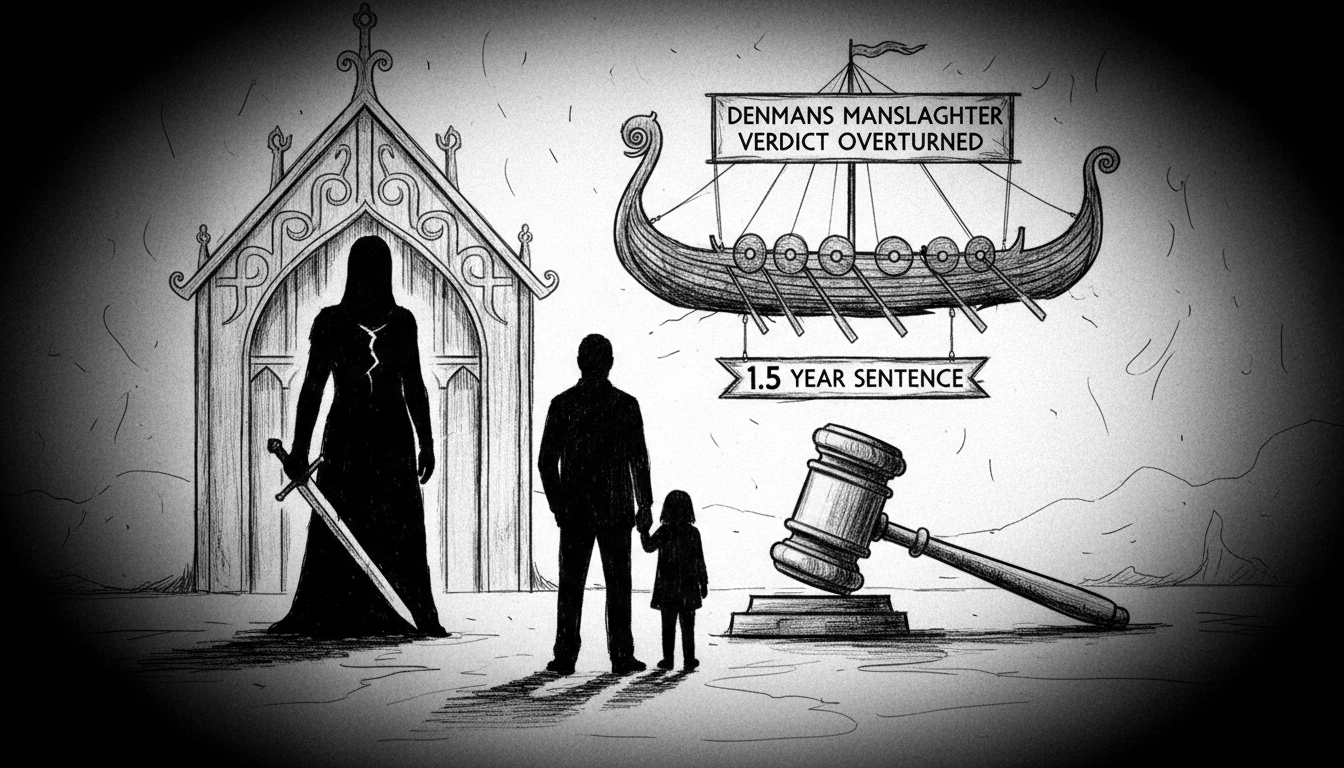
Denmark's Eastern High Court has overturned a manslaughter conviction for a Polish man, dramatically reducing his sentence and ordering his deportation. Slowomir Adrian Posniak, 30, was initially found guilty of causing his friend's death in Albertslund in June 2023 and sentenced to six years by Glostrup District Court. The high court ruled he was not responsible for the death, convicting him instead of aggravated assault and imposing an 18-month prison term followed by expulsion from Denmark with a 12-year re-entry ban.
This case highlights the complex legal challenges in determining causation in violent deaths, especially within Denmark's migrant worker communities. The two men, close friends who had lived together for years, were part of a household of foreign workers in the Copenhagen suburb. Their shared home contained a steep staircase with unusually narrow steps and metal edge profiles—a detail that became central to the appeal.
A Legal Reversal and a Tragic Friendship
The court's decision pivots on a fundamental question of legal causation. While the district court concluded Posniak's actions directly led to his friend's fatal head injuries, the high court judges found the causal link unproven. Posniak's defense lawyer, Dominika Sylwia Prokop, presented an alternative theory that the victim, who had been feeling unwell throughout the day, may have fallen down the dangerous staircase.
“It is a tragic case, and my client is very sad about it. But he is relieved because he now has proof that he was not guilty of his friend's death,” Prokop said. Several individuals had independently considered calling an ambulance for the man earlier on the day he died, indicating his poor health prior to the alleged assault. This context introduced reasonable doubt about the sole cause of his fatal injuries.
The Burden of Proof in Danish Homicide Cases
Danish legal experts note that overturning a district court's manslaughter verdict on appeal is significant but not unprecedented. It underscores the high burden of proof required, particularly for the 'with death as a consequence' element. The prosecution must demonstrate beyond reasonable doubt that the defendant's violent act was the direct and necessary cause of death, excluding other plausible explanations.
“The differing verdicts between the district and high courts show how finely balanced these cases can be,” said a Copenhagen-based criminal law professor who asked not to be named while the case could potentially proceed. “When another credible explanation for the fatal injury exists—like a dangerous domestic environment combined with prior illness—the chain of causation can break. The high court clearly found that break.”
This legal principle protects individuals from being held criminally liable for consequences they did not directly cause, even when they have committed a serious crime like aggravated assault. The reduction from a six-year sentence for manslaughter to 18 months for assault reflects the substantial difference in how Danish law penalizes these offenses.
Deportation as a Standard Consequence
The court's order to deport Posniak after his sentence is a standard judicial consequence for non-citizens convicted of serious crimes in Denmark. The 12-year re-entry ban is also typical for such convictions. Danish immigration policy allows for the expulsion of foreign nationals sentenced to prison terms, with the length of the entry ban often correlating to the severity of the crime.
This aspect of the verdict places the tragedy within broader discussions on Denmark's integration and justice policies. Foreign workers, particularly those from other EU countries like Poland, form a significant part of the labor force in the Copenhagen region. Their living conditions and access to support systems occasionally come under scrutiny, especially following incidents of violence or accidental death in shared housing.
A Suburban Household and a Dangerous Staircase
The Albertslund residence, home to several migrant workers, contained the steep staircase cited by the defense. Descriptions of “unusually narrow steps” with “metal edge profiles” suggest a potential household hazard. While not directly exonerating the defendant of violence, this environmental factor provided the high court with an alternative, accidental explanation for the victim's head trauma that the prosecution could not definitively disprove.
Such shared housing is common for single migrant workers seeking affordable accommodation in the Greater Copenhagen area. Municipalities occasionally conduct inspections, but safety standards in private rentals can vary. This case may prompt local authorities in Albertslund to review awareness of housing safety regulations among landlords renting to multiple tenants.
The Human Cost Beyond the Courtroom
Beyond the legal technicalities lies a profound human tragedy. Two friends, bound by years of shared living in a foreign country, were torn apart by an incident ending in death, imprisonment, and expulsion. The survivor, while legally cleared of causing the death, must serve a prison sentence and then face permanent separation from his life in Denmark.
The victim's family, whether in Poland or elsewhere, is left without the full closure of a definitive legal finding on what exactly caused his death. The high court's verdict means the official record states he died from injuries, but the court did not affirmatively find what caused those injuries—only that Posniak's assault was not the proven cause.
A Reflection on Justice and Certainty
This case ultimately reflects the justice system's struggle with uncertainty. When evidence allows for multiple narratives, courts must err on the side of the defendant. The high court's ruling demonstrates this principle in action, choosing a conviction for the proven crime of violence while refusing to assign responsibility for an unproven consequence.
It also shows the appellate system's role as a crucial check on lower court judgments. The high court judges, likely with access to the full trial record and fresh arguments from the defense, reached a different conclusion based on the same set of facts. This process is designed to minimize judicial error in serious cases carrying severe penalties.
For the community of foreign workers in Denmark, the case is a sobering reminder of how quickly a personal conflict can escalate with irreversible consequences, intersecting with strict legal and immigration policies. It underscores the importance of conflict resolution and support networks within transient communities living under significant pressure.
The finality of the high court's decision is likely, though a further appeal to the Supreme Court on legal principle remains a remote possibility. For now, the case closes with a man sentenced for violence but not for death, destined to leave the country, while the precise circumstances of his friend's final hours remain, in the eyes of the law, officially uncertain.