
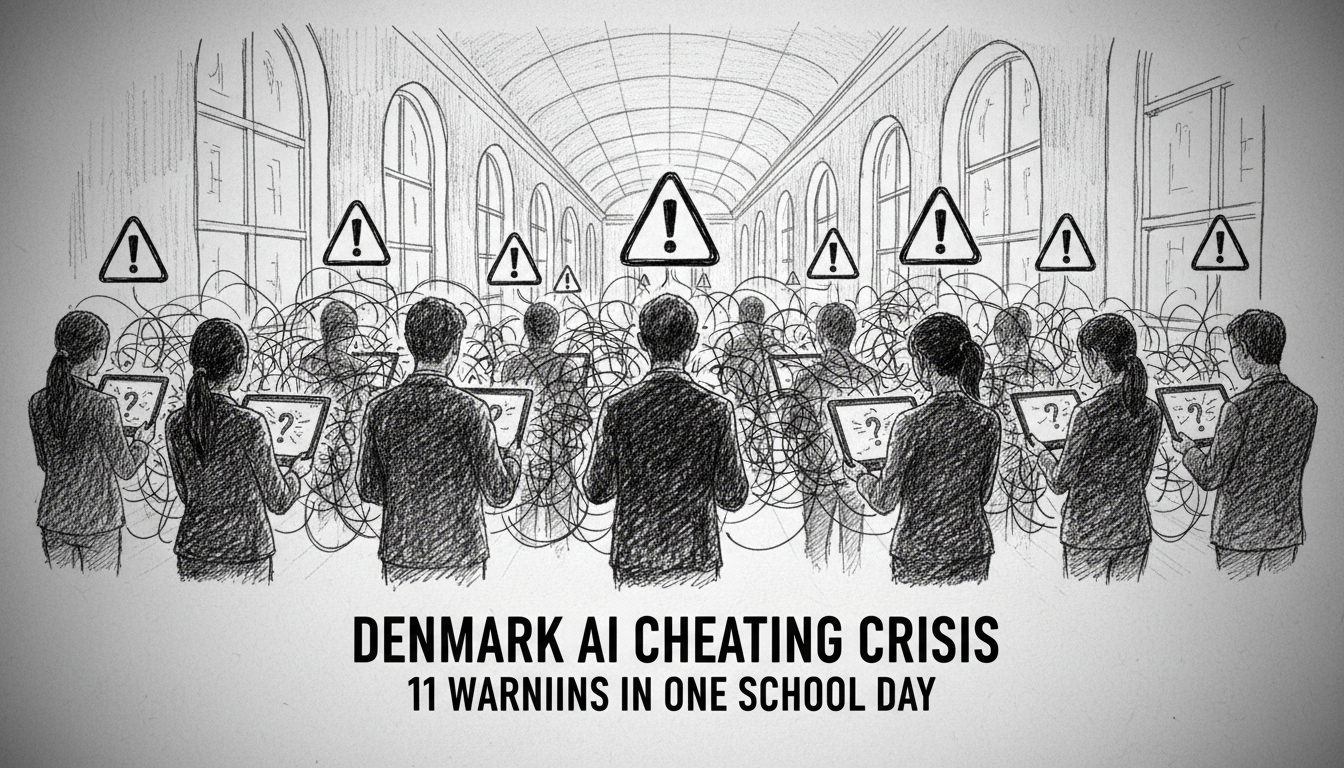
Denmark's education system is confronting a new reality after a single high school headmaster issued 11 formal warnings for suspected AI cheating in just one day. The incident at a Holbæk gymnasium highlights a growing national challenge as tools like ChatGPT blur the lines between assistance and academic dishonesty. Schools across the country are now scrambling to adapt their policies and teaching methods to an era where advanced artificial intelligence is just a click away.
Headmaster Michael Brodersen's experience is not isolated. Teachers nationwide report a sharp increase in assignments bearing the hallmarks of AI generation—fluent but generic text, a lack of personal voice, and incorrect references. "We caught 11 cases in 24 hours, and that's just the ones we could prove," Brodersen stated, emphasizing the scale of the problem. This single event has become a catalyst for a broader call to action, pushing the issue of AI plagiarism to the top of the educational agenda.
The situation reveals a significant gap between technological advancement and institutional response. Danish secondary schools operate under the Ministry of Children and Education's guidelines, which are now being tested. Current academic integrity rules, designed for traditional plagiarism, often lack clear protocols for detecting or penalizing AI-generated content. This legal and ethical gray area leaves both educators and students navigating uncharted territory.
A System Under Pressure
The Danish folkeskole and gymnasium systems pride themselves on fostering critical thinking and independent learning. The proliferation of generative AI directly challenges these core principles. A 2023 study by Charles University found that 57% of students use AI tools for learning, a statistic that likely mirrors Danish classroom trends. The key question for educators is determining where legitimate use ends and cheating begins.
"We need to distinguish between using AI as a tool for understanding and using it to replace the learning process," says Karen Jensen, an educational policy consultant in Copenhagen. She argues that the current wave of warnings is a symptom of a system in transition. Without updated national guidelines, individual schools and teachers are left to set their own boundaries, leading to inconsistencies and confusion.
The Holbæk case underscores the practical difficulties of enforcement. Detecting AI-generated text requires more than standard plagiarism software. Teachers must rely on their familiarity with a student's usual work, stylistic analysis, and sometimes a student's own admission during disciplinary meetings. This process is time-consuming and fraught with subjectivity, placing an additional burden on educators already facing heavy workloads.
Rethinking Assessment in the AI Age
Experts argue that punitive measures alone are an insufficient solution. The focus is increasingly shifting toward redesigning how students are assessed. Oral examinations, in-class written assignments, and projects that emphasize process and reflection are gaining renewed importance. These methods assess skills that AI cannot easily replicate, such as live reasoning, personal synthesis, and defense of one's ideas.
"The answer isn't just to police harder. It's to teach smarter," states Professor Lars Bo Hansen from the Danish School of Education. He advocates for integrating AI literacy directly into the curriculum. This approach would involve teaching students how to use AI tools ethically, critically evaluate their outputs, and transparently cite AI assistance. By demystifying the technology, educators hope to reduce both fear and misuse.
Several Copenhagen municipalities are piloting programs where students openly use AI for initial research or drafting, but must then analyze and personalize the output. This model treats AI as a collaborative tool rather than a forbidden shortcut. It aligns with a broader Danish societal value of adapting to technological change while maintaining trust and integrity.
The Call for Political Action
The headmaster in Holbæk has explicitly called for political intervention to create a unified national framework. This call is echoed by teacher unions and school leadership associations. They seek clear definitions of AI-assisted plagiarism, standardized detection resources for schools, and updated disciplinary procedures. The goal is to ensure fairness and consistency for all 98 Danish municipalities and the students they serve.
The Ministry of Children and Education has acknowledged the challenge. A working group is currently analyzing the impact of generative AI on teaching and evaluation. Their recommendations, expected later this year, will likely shape policy for the foreseeable future. The debate balances concerns about cheating with the potential for AI to personalize learning and support students with different needs.
Student perspectives are crucial in this discussion. Some feel the pressure to use AI to keep up with peers, while others see it as a valuable aid for non-native speakers or those struggling with writer's block. The ethical dilemma is personal. "It's so easy to use, and the line feels unclear," notes one Copenhagen gymnasium student. "We need clearer rules from the adults in charge."
Building a Culture of Academic Honesty
Ultimately, the fight against AI cheating is part of a larger effort to nurture academic integrity. Danish schools have long promoted values of mutual trust and responsibility. This foundation is now being tested by a technology that offers easy solutions with hard-to-detect consequences. Social centers and youth counselors are noting increased anxiety among students about keeping up academically, which may drive some toward misuse.
The path forward requires a multi-faceted strategy. It combines updated policy, teacher training, assessment innovation, and student dialogue. Denmark's welfare model is built on high levels of trust and equal opportunity. Ensuring the education system upholds these principles in the digital age is paramount. The 11 warnings in Holbæk are not just a disciplinary statistic; they are a wake-up call for a society learning to coexist with powerful new technology.
The coming school year will be a critical test. Will Danish educators successfully integrate AI as a constructive learning tool, or will classrooms become battlegrounds of detection and deceit? The answer will define not just academic integrity, but how Denmark prepares its next generation for a world where AI is ubiquitous. The lesson plan for this new subject is still being written, one challenging case at a time.