
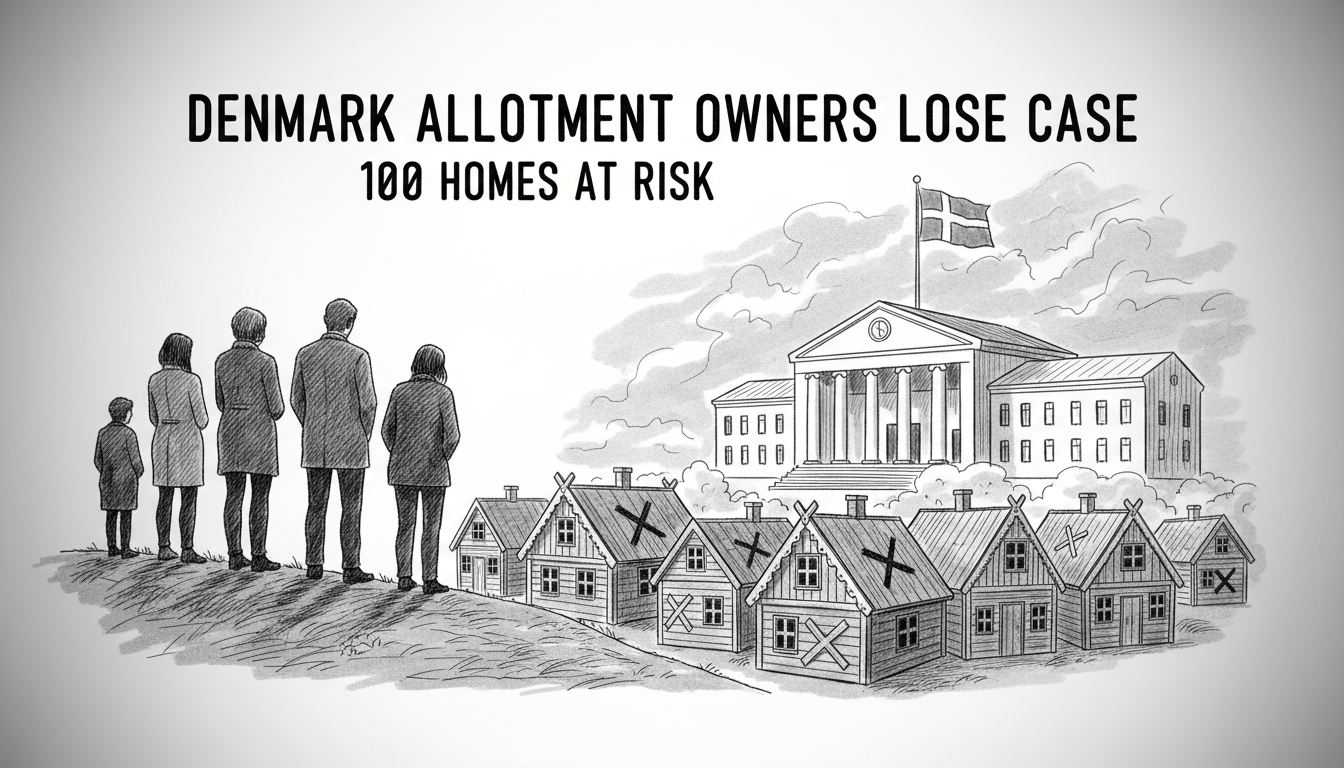
Denmark allotment garden owners in Vejle face demolishing parts of their homes after a court upheld local building size regulations. For Brian Westergaard, a resident of the Borchsminde garden association, the ruling means potentially tearing down sections of his cabin. This decision affects over 100 kolonihave plots in western Vejle, highlighting a persistent clash between community desires and municipal planning. As a reporter focused on Danish integration, I see this conflict reflecting broader tensions in welfare societies between individual adaptation and collective rules.
A Community Confronts Compliance
On a recent Monday, the Court in Kolding ruled in favor of Vejle Municipality, dismissing the lawsuit filed by the Kolonisternes Haveforening. The court confirmed that local plans 1387 and 1389, which limit building sizes, are legally binding. These plans stipulate that on plots of at least 300 square meters, total built area cannot exceed 80 square meters, with the house itself capped at 50 square meters. Erik Junge Madsen, project leader for allotment gardens in Vejle Municipality's Technical & Environment Department, said the municipality expected this outcome. 'We anticipated a clearance for the municipality, without speaking too boldly,' Madsen told local media. The association must now pay 50,000 DKK in legal costs, and many owners must reduce their structures.
The Human Cost of Oversized Cabins
Brian Westergaard's frustration is palpable. 'The municipality has slept for 80 years down here,' he said. 'They need to wake up and see what they've slept through and make a local plan with us, so we can agree.' His sentiment echoes among owners who invested in their gardens as retreats, only to face retroactive enforcement. Vejle Municipality estimates that approximately half of its 974 kolonihaver have buildings that violate size rules in some way. Some cabins reportedly span up to 176 square meters, far beyond the limits. This isn't just about square meters; it's about homes filled with memories and community ties. The kolonihave tradition, dating back over a century, provides vital green space and social cohesion in urban areas.
| Regulation Aspect | Limit Under Local Plans |
|---|---|
| Total Building Area Per Plot | 80 square meters |
| Maximum House Size | 50 square meters |
| Minimum Plot Size | 300 square meters |
Municipal Balancing Act in Danish Planning
Vejle Municipality initiated a process in February to legalize several hundred non-compliant kolonihaver, acknowledging the scale of the issue. This move reveals the delicate balance Danish municipalities must strike. They enforce building codes to preserve urban planning integrity and fair resource use, yet they also respond to community needs. From my perspective in social policy, this mirrors integration challenges where rules must adapt to lived realities. Danish welfare relies on clear regulations, but flexibility is key to inclusion. Kolonihaver are microcosms of this dynamic, blending private ownership with communal values. The municipality's delayed enforcement, cited by owners, complicates trust in public institutions.
Legal Precedents and Social Implications
The court's decision sets a precedent for similar disputes across Denmark, where kolonihave rules vary by municipality. Experts in urban planning often note the tension between preserving these spaces for recreational gardening and their evolution into secondary residences. Larger structures can alter the character of allotment areas, potentially excluding those seeking modest plots. However, harsh enforcement risks destabilizing communities that contribute to mental well-being and urban biodiversity. Statistics on integration show that shared green spaces foster social bonds, a principle embedded in Danish welfare. This case underscores how policy enforcement impacts daily life, requiring nuanced approaches that consider historical context and future needs.
Personal Insight: Integration Through Shared Spaces
As someone who reports on Danish society, I see kolonihaver as unsung engines of integration. They are places where diverse residents garden side-by-side, transcending backgrounds. Strict size limits aim to prevent inequality and overdevelopment, ensuring access for all. Yet, when rules are enforced inconsistently, it creates confusion and conflict. Vejle's situation illustrates a common theme in Danish social policy: the need for proactive communication between authorities and citizens. The association plans to appeal the ruling, as Westergaard confirmed: 'We will appeal it, of course we will.' This ongoing legal battle may reshape how municipalities nationwide manage these cherished plots.
Looking Ahead: Dialogue or Demolition?
The path forward hinges on whether Vejle Municipality's legalization process can offer a compromise. Will demolition orders be enforced, or can retroactive approvals find a middle ground? Danish society often prides itself on consensus, but this case tests that ideal. For kolonihave owners, the stakes are personal—their sanctuaries hang in the balance. For policymakers, it's a lesson in timely governance and community engagement. As Denmark navigates urban density and green preservation, the outcome here could influence allotment gardens from Copenhagen to Aarhus. Ultimately, this isn't just about property law; it's about how a society values the spaces where people grow together, both plants and connections.