
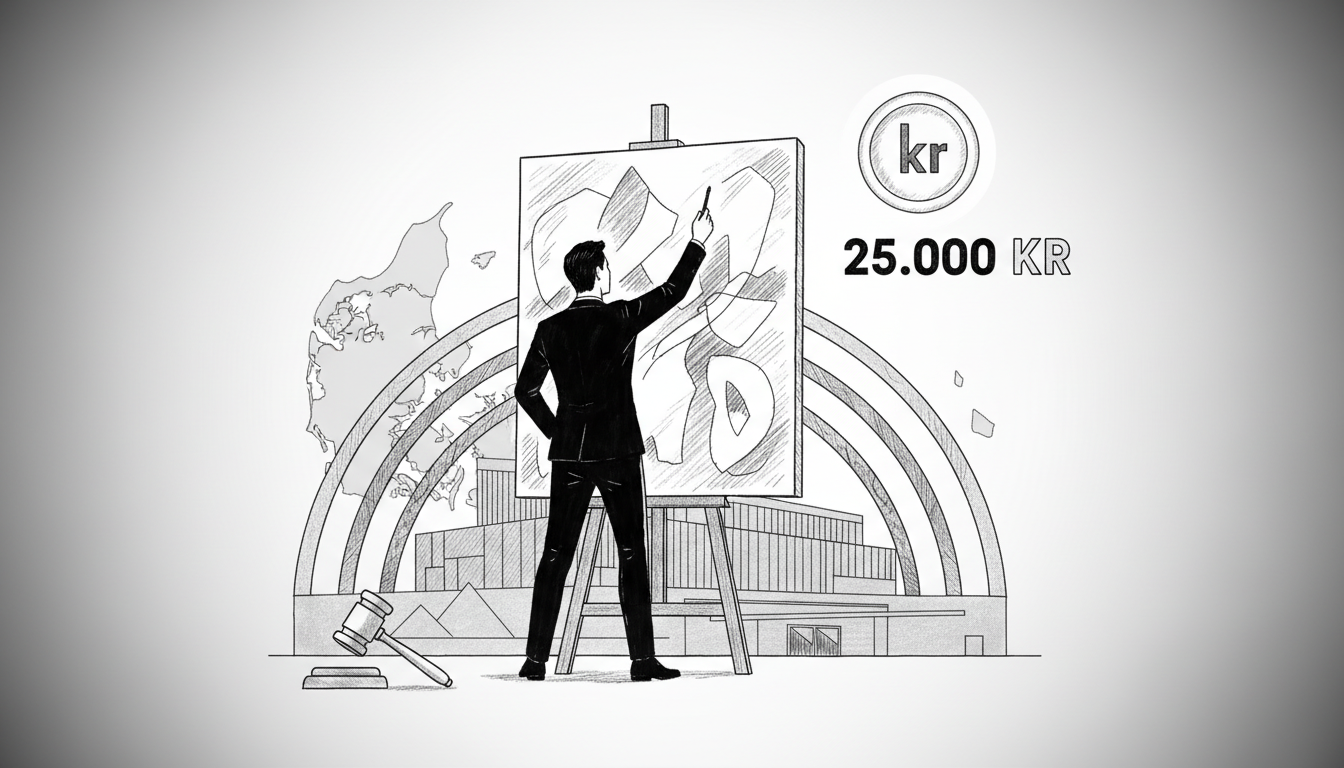
Denmark copyright law was tested in a Copenhagen courtroom this week as conceptual artist Jens Haaning accepted a 25,000 kroner ($3,600) settlement, a fraction of his original claim, in a case against news agency Ritzau Scanpix. The court found the agency infringed his copyright by selling images of his controversial artwork ‘Take the Money and Run’. Haaning, represented by the Danish Visual Artists Association (Billedkunstnernes Forbund), had sought 861,000 kroner. Despite the modest sum, the artist declared the ruling a victory for principle over profit.
‘I think it's fantastic. We have won our point,’ Haaning said. ‘It's about the principle. Can you steal something and sell it? The court says you cannot.’ The case centers on whether a news agency can commercially license photographs of an artwork without the creator's consent, a question with significant implications for media and artists in the digital age. Ritzau Scanpix has removed the contested images from its database, preventing media outlets from purchasing them for stories, including coverage of this verdict.
A Victory Measured in Principle, Not Kroner
The Copenhagen City Court's decision hinged on a key assessment: the 25,000 kroner award approximates the licensing fee Haaning would have received had a proper agreement been in place. For Jacob Kwon, Director of Ritzau Scanpix, the ruling was a partial vindication. ‘We note the compensation is much less than what the artist demanded,’ Kwon stated, adding the agency had hoped for a full acquittal. He confirmed the agency is reviewing the ruling with legal counsel to decide on a potential appeal. Haaning and his association are conducting a similar review.
The financial disparity highlights the complex valuation of artistic copyright. Legal battles often involve high claims to cover legal fees and establish precedent, but actual damages can be harder to quantify. Stina Teilmann-Lock, a researcher in design and copyright management at Copenhagen Business School, noted the court's rejection of Ritzau Scanpix's attempt to use copyright exception rules was crucial. ‘This reinforces that commercial exploitation, even of news images, typically requires permission,’ she explained. ‘The court drew a clear line between reporting on art and selling the art's image.’
The Artwork That Started It All
To understand the case's significance, one must revisit the source. ‘Take the Money and Run’ is a 2021 conceptual work by Haaning for the Kunsten Museum of Modern Art in Aalborg. The museum provided 534,000 kroner in banknotes for Haaning to recreate two earlier pieces featuring framed cash. Instead, he submitted two blank canvases, kept the money, and renamed the work. The museum sued for repayment. In a subsequent ruling that echoed this week's focus on principle, a court ordered Haaning only to return the exact physical banknotes, not their monetary value, acknowledging the completed work's conceptual nature.
This background makes the copyright case particularly layered. Ritzau Scanpix was selling images of an artwork that was itself the subject of legal debate about value, ownership, and artistic integrity. The agency argued its actions fell under standard news reporting practices. The court disagreed, finding the act of licensing the images for a fee crossed into commercial use. This distinction is vital for Denmark's creative economy, where artists rely on copyright to monetize their work in an era of easy digital reproduction.
Implications for Media and Artistic Copyright
The ruling sends a clear message to media bureaus and publishers across the Nordics. While news reporting often enjoys certain copyright exceptions, systematically licensing images of copyrighted artworks for profit is a protected right of the creator. ‘It clarifies the boundaries,’ said a legal advisor familiar with Danish intellectual property law, who spoke on condition of anonymity. ‘A news photo of a painting in a public square for an article is one thing. Adding that photo to a commercial database for repeated sale is another. The latter requires clearance.’
For artists, the decision is a defensive win. The Danish Visual Artists Association, which supported Haaning's case, views it as strengthening the enforcement tools available to its members. In a landscape where images circulate endlessly online, proving infringement and securing compensation remains challenging. A court-established precedent, even with a relatively small award, provides a stronger foundation for future claims and negotiations. It affirms that the market value of a license, not just abstract artistic value, is the relevant metric for damages.
The Road Ahead and Broader Impact
Whether either side appeals will determine the case's final impact. An appeal could lead to a higher court refining the rules on copyright exceptions for media. For now, the immediate effect is practical: Ritzau Scanpix has removed the images. This creates the paradoxical situation where one of Denmark's most discussed contemporary artworks cannot be legally illustrated by major media through standard agency channels, a testament to the power of copyright enforcement.
The case also intersects with ongoing European debates about the Digital Single Market and copyright directives. Denmark has consistently implemented strong protections for creators, and this ruling aligns with that trajectory. It underscores that the economic rights of artists persist even when their work becomes newsworthy. The value of art, this case suggests, is not only in its physical form or conceptual shock but also in the control over its reproduction—a control the Copenhagen court has priced at approximately 25,000 kroner in this instance.
Ultimately, Jens Haaning's satisfaction with the outcome underscores a reality in many intellectual property disputes: the legal principle established can be more valuable than the immediate financial compensation. In securing a ruling that confirms his exclusive right to license images of his work, he has fortified a position for all visual artists in Denmark. The message to media distributors is to scrutinize their licensing practices. The message to artists is that their copyright, much like the blank canvases in ‘Take the Money and Run’, holds a value defined not just by what is present, but by the rights and principles it represents.