
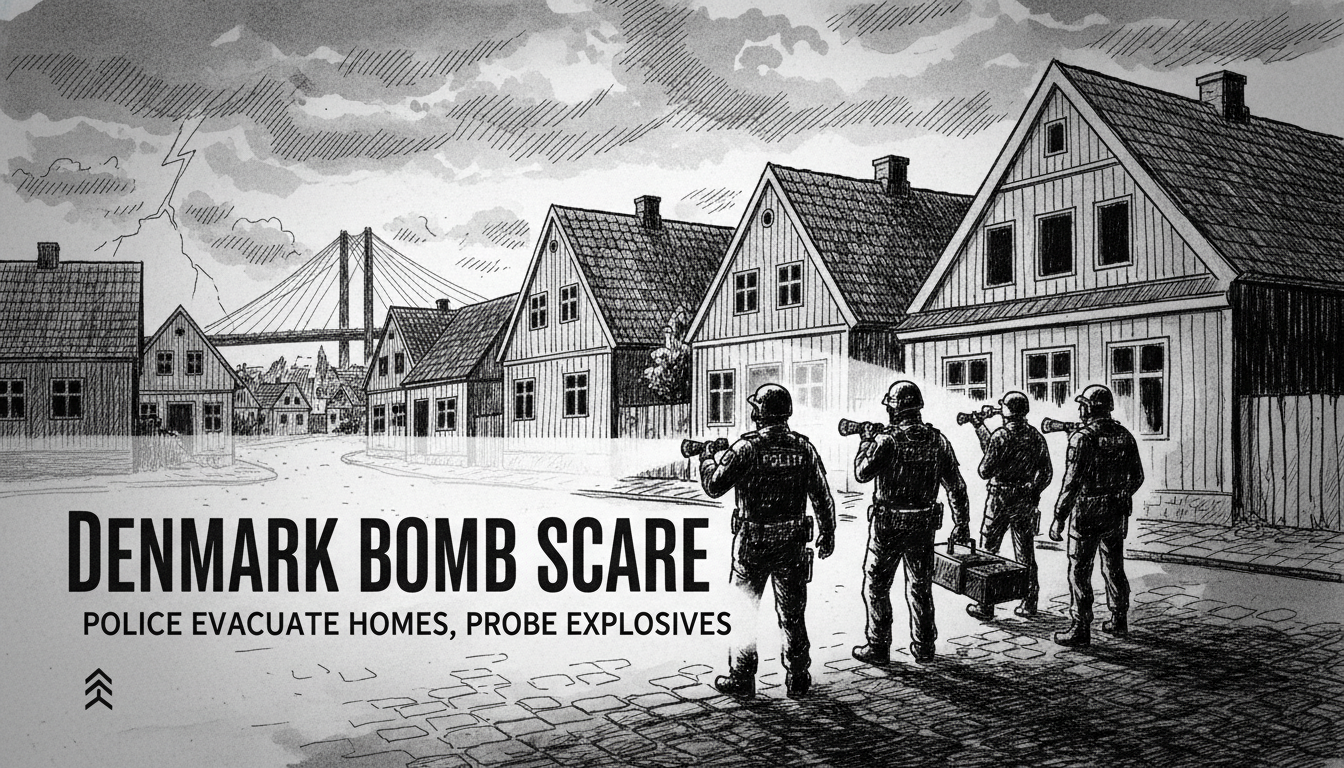
Denmark police evacuated residents from a residential address in Southern Jutland on Tuesday while investigating potential explosives. Syd- og Sønderjyllands Politi confirmed no one was injured during the operation. Authorities stated there was no danger to the wider public as long as official instructions were followed, a standard reassurance in such high-alert situations. The incident underscores the meticulous and precautionary nature of Danish law enforcement when faced with potential threats to public safety.
A Tense Afternoon in a Quiet Community
Residents in the affected area received direct instructions from officers to leave their homes temporarily. The police cordoned off the vicinity, a visible sign of the serious threat assessment. While the specific location was not disclosed to protect the ongoing investigation, such operations typically involve close coordination with the national bomb disposal unit, EOD. This unit is trained to handle and neutralize unstable or suspicious devices. The evacuation, while disruptive, is a non-negotiable first step in the Danish protocol for bomb scares, prioritizing human life above all else.
“The safety of citizens is our absolute highest priority in these situations,” a police spokesperson said in a statement. “We ask for the public’s understanding and patience while our experts work.” This communication style is typical of Danish authorities, who aim to inform without causing unnecessary panic. The incident, though alarming, was managed within the framework of Denmark's well-rehearsed emergency response plans, which are regularly tested across municipalities.
The Standard Protocol for an Unstandard Threat
When a report of potential explosives is received, Danish police follow a strict escalation procedure. The initial response involves securing a large perimeter around the suspect location. Trained negotiators and bomb technicians are then deployed to assess the situation remotely where possible. Evacuation orders are issued based on the estimated blast radius of a potential device. These procedures are rooted in both national security guidelines and lessons learned from international incidents.
“Every bomb threat is treated as credible until proven otherwise,” explains Lars Bjerregaard, a former police commissioner and now a security consultant. “The financial and social cost of an evacuation is insignificant compared to the potential cost of inaction. The Danish system is built on a precautionary principle.” This approach reflects the broader Danish societal contract, where trust in state institutions to manage risk is high. Citizens generally comply with police directives, understanding them as necessary for collective security.
The Human Impact Behind the Headlines
For the evacuated families, the experience is far from routine. Being suddenly removed from your home, often with little time to gather belongings, creates significant anxiety and logistical headaches. Local municipalities and the Red Cross are typically placed on standby during such events to provide immediate support if needed. This can include offering temporary shelter, food, and psychological first aid to those affected, especially the elderly or vulnerable.
The incident also disrupts the daily rhythm of the entire neighborhood. Schools or daycare centers near the perimeter may be locked down, public transport rerouted, and local businesses lose foot traffic. The social fabric of a community is momentarily strained, though it often rebounds quickly once the all-clear is given. This communal resilience is a noted feature of Danish society, where a shared sense of order and safety helps communities weather such shocks.
From Suspicion to Resolution: The Investigation Phase
Once the area is secure, the technical investigation begins. This involves forensic officers and EOD specialists working to determine the nature of the reported threat. They may use robots to inspect packages or vehicles before any human approach is made. The goal is to ascertain whether the threat is real, a hoax, or a case of mistaken identity—such as someone finding old fireworks or inert military memorabilia.
The police will also launch a parallel investigation into the origin of the threat. Who reported it and why? Was there a specific tip-off, or did officers discover something during a separate operation? In Denmark, making a false bomb threat is a serious criminal offense that can result in a substantial prison sentence. This legal deterrent is part of the strategy to prevent the waste of emergency resources and public alarm.
A Broader View of Security in Modern Denmark
While isolated bomb scares occur, Denmark’s overall security threat level is managed by the Danish Security and Intelligence Service (PET). PET continuously assesses risks from terrorism and extremist violence. Their public threat level communicates the general climate to the population. Most local police responses to potential explosives, like this one in Southern Jutland, are handled as serious criminal matters rather than explicit terrorism cases unless evidence suggests otherwise.
This incident serves as a live exercise for the integrated Danish emergency response system. It tests coordination between local police, national specialist units, and municipal crisis services. Each event provides data that can refine future responses. The calm, methodical public messaging is designed to maintain trust, a cornerstone of the Danish model. It informs citizens without sensationalism, aiming to prevent the spread of misinformation that could amplify fear.
The Quiet Return to Normalcy
As the investigation concludes, the most critical phase for the community begins: the return. Police will systematically clear the area, allowing residents back into their homes. Officers and municipal workers may be present to answer questions and provide support. For the families involved, the relief of returning is often mixed with residual unease. The reason for the scare may remain unclear for days or weeks as the police investigation continues privately.
The lasting impact of such an event is often psychological. A sense of security in one's own neighborhood can be temporarily shaken. Danish society's strong local networks, however, often facilitate recovery. Neighbors check on each other, and local community councils might discuss the event in future meetings to ensure everyone feels supported. This social cohesion is an informal but vital part of Denmark's resilience strategy.
A Reflection on Safety and Disruption
Tuesday's evacuation in Southern Jutland ended without explosion or injury, a successful outcome measured in safety. It highlights the silent, efficient machinery of Danish public safety that operates in the background. Society accepts temporary disruption as the price for a system that errs decisively on the side of caution. The police work within a framework of immense responsibility, where their decisions directly safeguard lives.
The story will fade from national news quickly, replaced by other events. But for the residents who packed a bag not knowing what they would return to, it was a profound reminder of the fragility of daily peace. It also demonstrated the society they live in: one that mobilizes extensive resources to protect them, asks for their compliance, and expects their trust in return. The ultimate question after any such scare is whether that vital, mutual trust is strengthened or strained by the experience.