
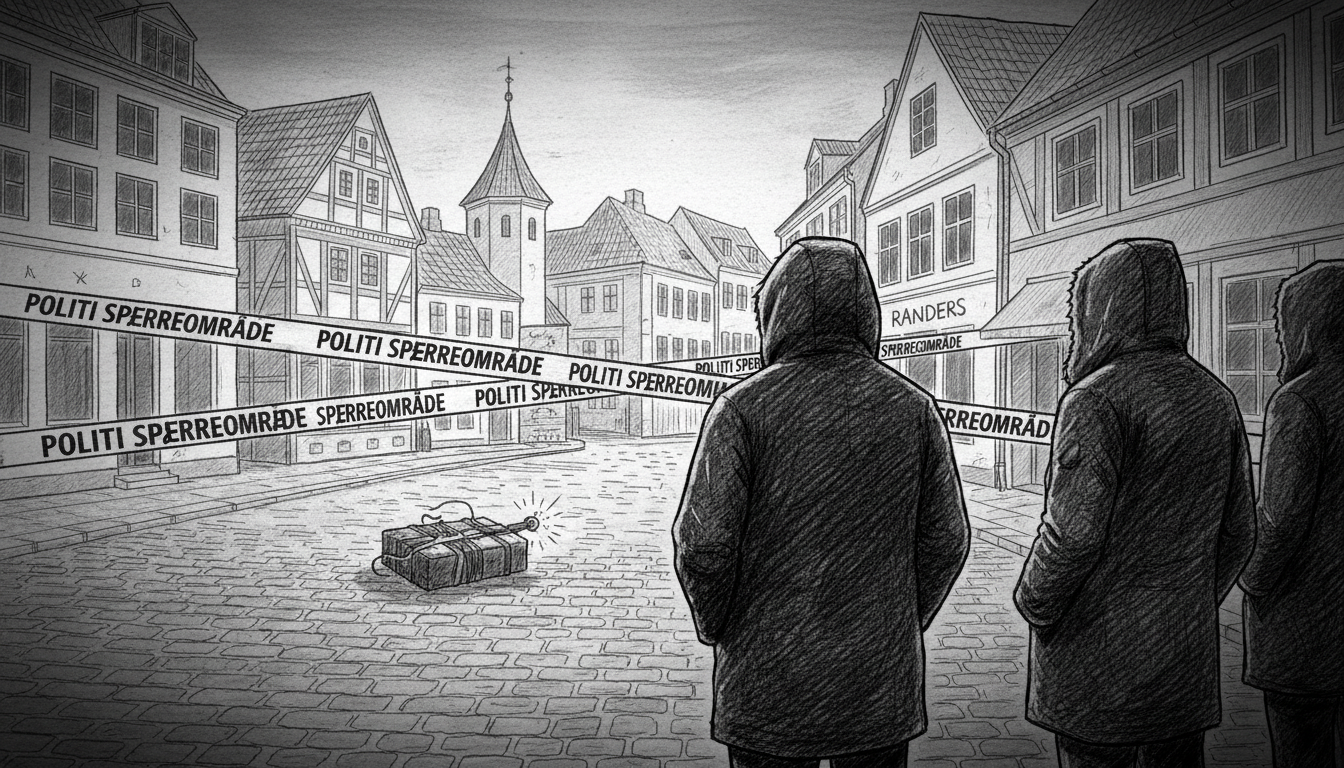
Denmark police are investigating a suspicious incident in a residential area of Randers, prompting a large-scale emergency response. The East Jutland Police confirmed their presence on Skovlund road in the Vorup district Monday, cordoning off an area near a railway bridge. Unconfirmed reports from the scene suggest the investigation involves a grenade, though authorities have not commented on the specific nature of the threat. Multiple civilian police vehicles, ambulances, and fire trucks were deployed to the location as a precaution.
Residents watched from a distance as officers established a wide security perimeter. Police used social media to warn the public to respect the cordon and avoid the area entirely. The operation reflects standard protocol for potential explosive threats, where isolating the scene is the first priority to ensure public safety. Such incidents, while alarming, are handled with extreme caution by Danish bomb disposal units.
A Tense Afternoon in Vorup
The sudden arrival of emergency vehicles transformed the quiet neighborhood into a focal point of police activity. Vorup, a district in southeastern Randers, is typically known for its residential streets rather than high-alert security operations. The presence of unmarked police cars indicated the involvement of specialized units, likely from the national police's task force or the bomb squad. This level of response suggests authorities were treating the report with utmost seriousness.
Local journalists on the scene reported that unnamed individuals linked the police activity to a grenade. Police spokespersons have maintained a policy of not speculating during active operations. "We are investigating a suspicious circumstance," a police statement read, offering no further details. This restraint is common in Denmark during unfolding incidents, where authorities prioritize operational security over immediate public updates.
The Protocol for Potential Explosives
When a potential explosive device is reported, Danish police follow a strict and measured procedure. The primary goal is always to protect human life. Officers first secure a large perimeter, often much larger than the public might expect, to mitigate risk from blast fragmentation. Access points are controlled, and residents or bystanders within the cordon may be evacuated. Specialized technicians, often from the National Police's Center for Terror Analysis or the Armed Forces' EOD (Explosive Ordnance Disposal) team, are then called to assess the situation.
These experts use remote-controlled robots and protective gear to examine suspicious objects. Their job is to determine if the device is real, inert, or a hoax. If a viable explosive is confirmed, they perform a controlled detonation on-site. This process can take several hours, explaining the prolonged police presence in Randers. The investigation afterward focuses on forensic evidence to trace the origin of the device.
Randers in a National Context
Randers is Denmark's sixth-largest city, a community where most news revolves around industry, culture, and local politics. A bomb scare here resonates differently than in Copenhagen. It disrupts the sense of security in a region less accustomed to such threats. While Denmark's overall crime rate is low, police and security services consistently warn that the threat from organized crime and isolated extremist acts persists across the country.
Incidents involving explosives or weapons, while rare, often have links to gang conflicts. Denmark's police have intensified efforts against organized crime networks in recent years, seizing weapons and making high-profile arrests. Any discovery of a grenade would immediately trigger investigations into possible gang activity or arms trafficking. The social fabric of Danish society, built on trust and a strong welfare state, is deeply unsettled by the intrusion of such violent tools.
Community Impact and Social Cohesion
Events like the one in Vorup send ripples through a community. They create immediate fear and long-term questions about safety. For the residents living near Skovlund road, Monday was a day of disrupted normalcy, marked by flashing lights and uncertainty. Such incidents test the relationship between the public and the police, relying on trust that authorities can manage the threat effectively.
From my perspective covering Danish society, the response also highlights the strength of municipal and regional safety networks. The coordination between police, fire, and medical services is a practiced element of Denmark's emergency preparedness. The system is designed for a swift, integrated response to protect citizens, a cornerstone of the social contract here. The real measure of success is not just the resolution of the incident, but how quickly the community's sense of security is restored.
The Investigation Ahead
The police work in Randers is far from over. Once the immediate threat is neutralized, detectives will begin the meticulous process of investigation. They will canvass for witnesses, review any available surveillance footage from the area, and conduct forensic analysis. If a device is recovered, its provenance becomes a key clue. Are its markings traceable to a specific source or previous crime? The answers could point to local criminal activity or something more broadly concerning.
Authorities will also examine the possibility of a hoax. False reports involving explosives, while wasteful of resources, are themselves serious crimes. The motivation behind such an act—whether intended to cause disruption, fear, or as a misguided prank—carries significant legal consequences. The police silence on details will likely continue until they have concrete evidence to present, ensuring the integrity of their case.
A Reflection on Safety and Society
As the situation in Randers develops, it serves as a stark reminder. No community is entirely insulated from threats that dominate headlines elsewhere. Denmark's high levels of social trust and effective policing are powerful deterrents, but they are not absolute shields. The response in Vorup demonstrates the infrastructure that exists to manage crises, a system built on professionalism and public cooperation.
The coming days will reveal whether this was a genuine threat, a false alarm, or something in between. For now, the people of Randers are left with the unsettling images of their cordoned-off street, waiting for answers. The ultimate test for any society is not avoiding incidents, but handling them with competence and transparency. How authorities communicate their findings to the residents of Vorup will be just as important as how they secured the scene.