
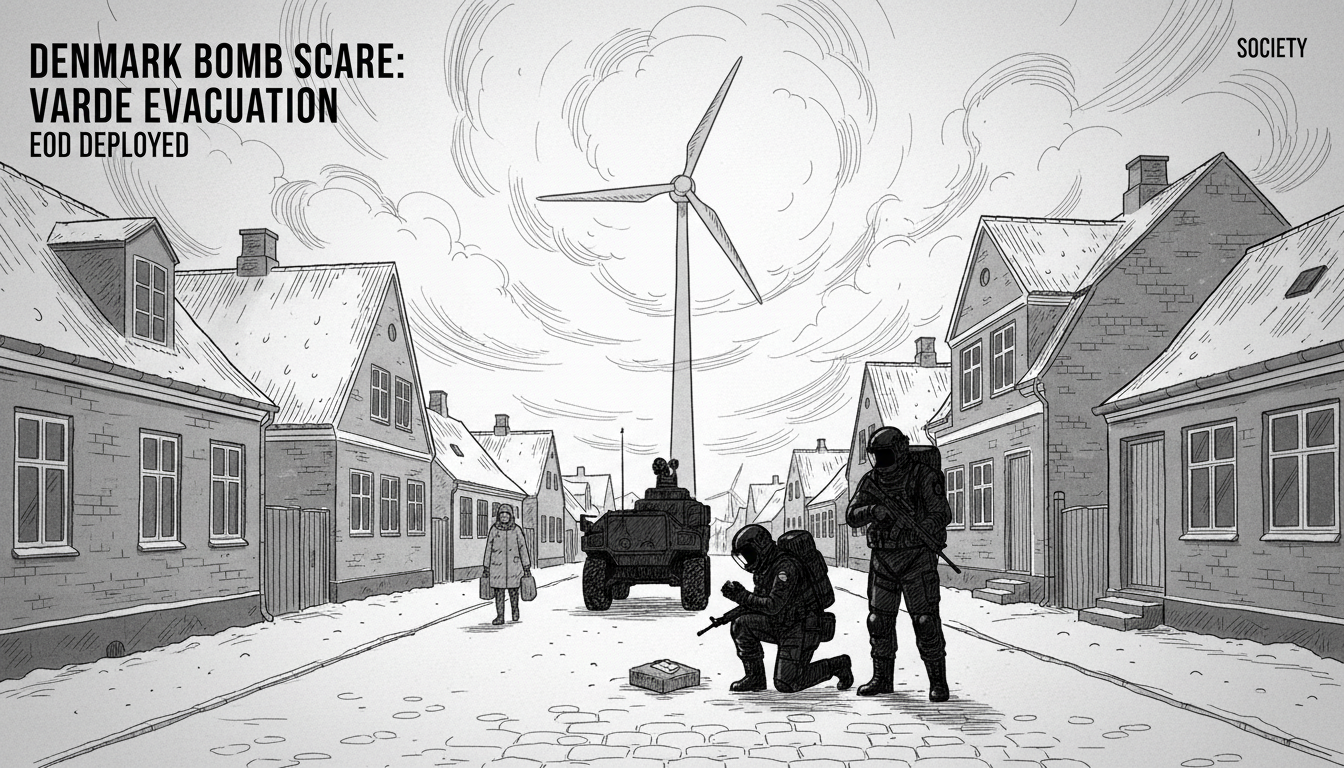
Denmark's South and Southern Jutland Police are evacuating residents and halting transport in Varde following a report of possible explosives. Authorities responded Tuesday afternoon to an address on Torvegade in the southwestern Danish town, launching an investigation and calling in the military's bomb disposal experts. The immediate evacuation of specific apartment buildings and a shelter for displaced residents underscores the serious but controlled police response to such threats in Danish communities.
A Tense Afternoon in a Quiet Town
Residents in central Varde received abrupt instructions to stay indoors as police cordoned off the area. Bus and train services through the town were suspended, creating an unusual stillness in the typically calm municipality of around 14,000 people. The police operation focused on a single address, with officers moving door-to-door to clear specific buildings as a precaution. 'We are in the process of evacuating individual stairwells - other residents in the area must stay indoors and follow the police's instructions,' the police stated in a social media update. This targeted approach aimed to minimize disruption while prioritizing safety, a hallmark of Danish crisis management protocols.
No injuries have been reported, and police emphasized there is no danger to citizens who follow official guidance. For those required to leave their homes, the municipality opened Lerpøthallen on Lerpøtvej as a temporary shelter. The local rescue service arranged transportation for residents needing assistance, demonstrating the coordinated response between police, municipal services, and emergency personnel. This infrastructure for citizen support during crises is a standard part of Denmark's welfare safety net, activated even in small towns like Varde.
The Specialists Take Over
The situation escalated from a police matter to a military one with the arrival of Forsvarets EOD, the Defence's Explosive Ordnance Disposal unit. Their involvement signals that the report warranted the highest level of technical expertise available in Denmark. EOD teams are trained to handle, disarm, and dispose of explosive devices, from historical wartime munitions to modern illicit materials. Their deployment to a residential street transforms the scene from a local police incident into a national security operation, albeit on a small scale.
Experts note that such call-outs, while alarming for communities, follow strict and rehearsed procedures. 'The protocol is clear: secure the area, evacuate based on risk assessment, and let the specialists conduct the safe examination,' says a former security advisor familiar with Danish EOD operations. 'The fact that transport is shut down shows they are taking a very cautious perimeter, which is standard for an unknown potential threat.' The presence of possible explosives in a civilian apartment is exceptionally rare in Denmark, making the EOD's role critical for definitive answers.
Life on Pause in Varde
The disruption, while temporary, reveals how quickly normalcy can dissolve. Local businesses near Torvegade faced an unexpected halt in activity, and commuters found their routes blocked. The incident places Varde, a town not often in national headlines, at the center of a security alert. For the evacuated residents, the afternoon involved an abrupt departure from home, uncertainty about their belongings, and reliance on municipal support at the local hall. This human impact, the waiting and worry, is the immediate cost of such a scare, even if no physical harm occurs.
Danish society places high trust in authorities during crises, a factor that likely aided compliance with police orders. The clear, repeated communication from police via social media and on the ground aimed to prevent panic. Instructions to stay indoors or report to a specific shelter create a framework of control amidst uncertainty. This relationship between the public and authorities is a key component of managing incidents without additional chaos, a social contract tested in real-time on a Tuesday afternoon in Varde.
The Broader Context of Threats in Denmark
While the discovery of explosives is uncommon, Denmark is not immune to bomb scares or the possession of illicit materials. Past incidents have ranged from forgotten historical ammunition to more serious threats. Each triggers a significant response, reflecting a policy of extreme caution. The Danish security and intelligence services periodically warn of a general threat level, but localized incidents like the one in Varde are typically treated as isolated police matters until proven otherwise.
The integration of military EOD into a domestic police operation highlights the interconnected Danish response system. It is a resource available to all municipalities, ensuring even smaller towns have access to top-tier technical capabilities. This model reflects the decentralized yet unified nature of Danish crisis management, where local police lead but can instantly draw on national assets. The outcome of the EOD's examination will determine the next steps, which could range from a simple all-clear to a complex criminal investigation.
Awaiting the All-Clear
As the EOD team works, the town remains in a state of suspended animation. The resolution hinges on what, if anything, is found inside the apartment. A false alarm would mean a collective sigh of relief and a return to routine, albeit with a memorable story for the community. The discovery of actual explosives would shift the focus to a criminal probe, with questions about origin, intent, and ownership taking center stage. The police have not speculated on the source of the report or the nature of the potential threat, rightly waiting for factual evidence from the scene.
For now, the priority is the safe conclusion of the technical operation. The shelter at Lerpøthallen stands ready, and emergency services remain mobilized. The incident, regardless of its final outcome, serves as a live exercise for Varde's emergency response framework and a reminder of the protocols that exist beneath the surface of daily Danish life. It tests the system's capacity to protect citizens and maintain order with a measured, professional response.
A Community in Waiting
Final word will come from the police, likely in a brief statement confirming the findings and announcing the lifting of restrictions. Life in Torvegade will resume, buses will run, and residents will return home. Yet, the afternoon's events leave a mark, a ripple of anxiety that highlights a community's vulnerability. It also showcases the structured Danish approach to potential danger, where procedure and precaution are deployed to ensure that even the suspicion of a threat is met with a full and serious response. The true measure of this system is not just in preventing disaster, but in managing fear and uncertainty with competence and care, allowing a small town to cautiously catch its breath and move forward.