
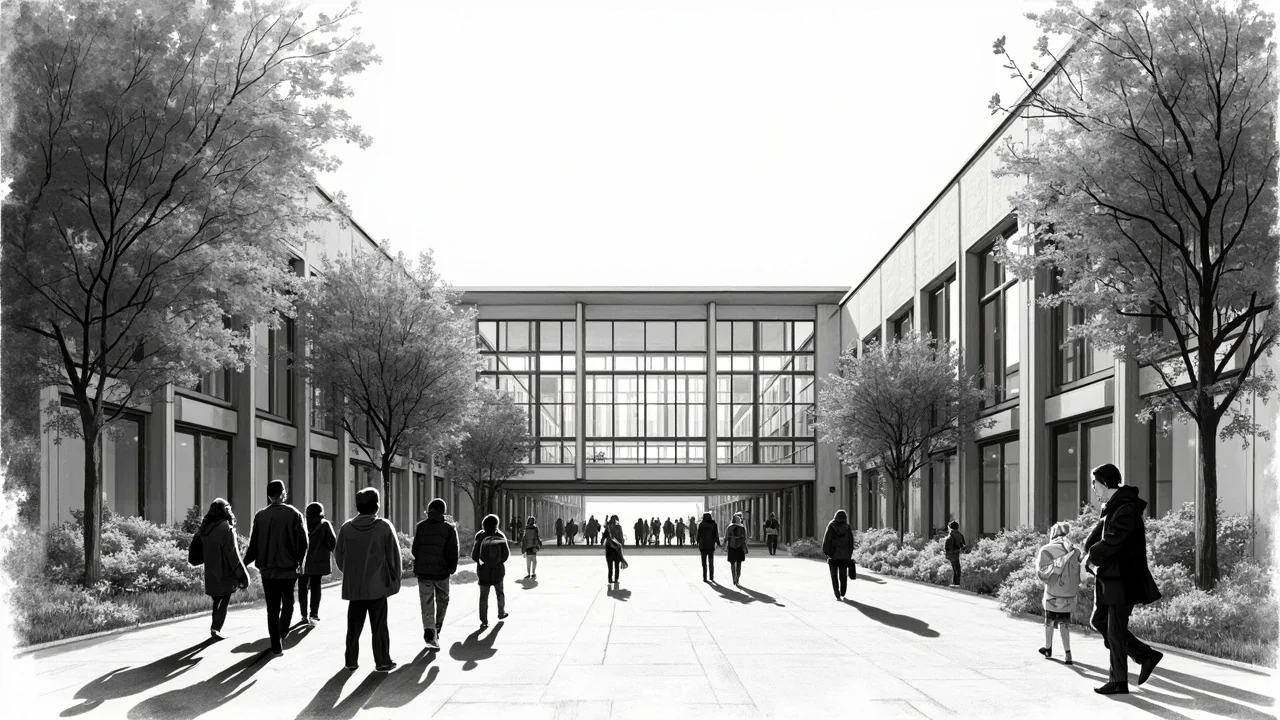
Denmark's newest primary school now serves 1,176 children in a location once declared unsafe for them. At the edge of Copenhagen’s busiest traffic corridor, where S-trains, long-distance rail, a massive bike path, and a bus terminal converge, the Carlsberg City District School stands as a deliberate urban statement. It accommodates 840 students and 336 children in municipal after-school care, transforming a forbidden zone into a community hub.
From Concrete Jungle to Classroom
Just a few years ago, this area was considered unsuitable for children. Locals and city planners viewed the nexus near Dybbølsbro, Kalvebod Brygge, and the Fisketorvet shopping center as purely infrastructural. The site contained a gritty mix of traffic, commerce, and industrial buildings. Today, architects from BBP and NORD have created a building that acts as both a protective bastion and an open invitation. Its design consciously screens the playgrounds and lower floors from the visual and auditory chaos outside. This thoughtful design provides a sanctuary for learning amid the urban roar.
The project represents a significant shift in Copenhagen's approach to urban space. It prioritizes child-friendly development in densely populated, mixed-use areas. "We are reclaiming the city for its youngest citizens," said a project lead from the City of Copenhagen, who requested anonymity as they were not authorized to speak publicly. "This is about more than a school. It's a signal that every part of our city must be habitable for all generations." The investment challenges the notion that certain urban zones are solely for transit or commerce.
A Test Case for Social Policy
This school’s location is a practical test of Denmark's integration and welfare policies. By placing a major educational institution in a highly diverse, transit-rich area, the municipality ensures accessibility for families from varied socioeconomic backgrounds. Copenhagen has faced ongoing challenges integrating children from immigrant backgrounds into the education system. Statistics from the Danish Ministry of Education show that children from non-Western backgrounds still have lower average exam scores in public schools. Placing a well-resourced school in a central, accessible location is a direct strategy to promote equality.
The school’s integrated after-school care program is a key component of the Danish welfare model. It supports dual-income families and aims to provide consistent, quality supervision. This reduces the so-called 'activity gap' between children from different home environments. "The fritidsordning (after-school club) is where much informal learning and social integration happens," explains Karen Toft, a social policy analyst I spoke with. "By making it a seamless part of the school day in such a central location, you normalize diversity and provide stable frameworks for every child."
Architecture as Social Infrastructure
The building’s design directly addresses its challenging context. It does not hide from the surrounding bustle but engages with it through strategic positioning and materials. Classrooms are oriented away from the noisiest corridors, while common areas offer controlled views of the city's energy. This approach teaches children to engage with their metropolis, not fear it. The architecture physically embodies the Danish principle of 'tryghed'—a sense of security and comfort—which is foundational to child development here.
Community leaders in the adjacent Vesterbro and Sydhavn districts have watched the project closely. Many see it as a corrective to past planning mistakes that isolated functions. "For decades, we built roads and railways that cut communities apart," said Bjørn Mikkelsen, a local council member. "Now, we are building institutions that stitch them back together. This school connects neighborhoods that were previously divided by this very traffic." The school acts as a bridge, both literally and socially, in a fragmented urban landscape.
The Metrics of Urban Livability
Copenhagen Municipality measures the success of such projects through livability indexes and enrollment diversity. Early indicators show strong enrollment from the surrounding apartments and new housing developments. The critical test will be its long-term ability to attract a mixed socioeconomic student body. Denmark's education policy often grapples with residential segregation, which can lead to 'parallel societies' and schools with homogenous student populations. A centrally located, attractive school can be a powerful tool to combat this trend.
The project also reflects a national focus on 'the whole child' within the welfare system. Education, leisure, and social care are viewed as interconnected. The school's co-location with after-school care ensures continuity. Children are not shuttled between disparate locations, reducing stress and increasing the time available for play and relationship-building. This integrated approach is a hallmark of Scandinavian social planning, though its execution in such a complex site is new.
Looking Beyond the School Gates
The Carlsberg City District School’s ultimate impact will be judged by its students' outcomes over the next decade. However, its immediate success is already visible. It has turned a non-place—a space defined only by movement and transit—into a destination with life and purpose. The sounds of children now mix with the sounds of trains and traffic, creating a richer, more human urban soundtrack.
This project raises a pertinent question for cities worldwide. As urban density increases and available land disappears, where do we place our essential community institutions? Denmark’s answer, demonstrated here, is to boldly integrate them into the most challenging fabrics of the city. It refuses to relegate schools, and by extension children, to the quiet margins. Instead, it places them at the heart of the action, arguing that a healthy city must make room for childhood everywhere. Can the relentless energy of a modern metropolis coexist with the quiet needs of a child? Copenhagen is betting 1,176 young lives that it can.