
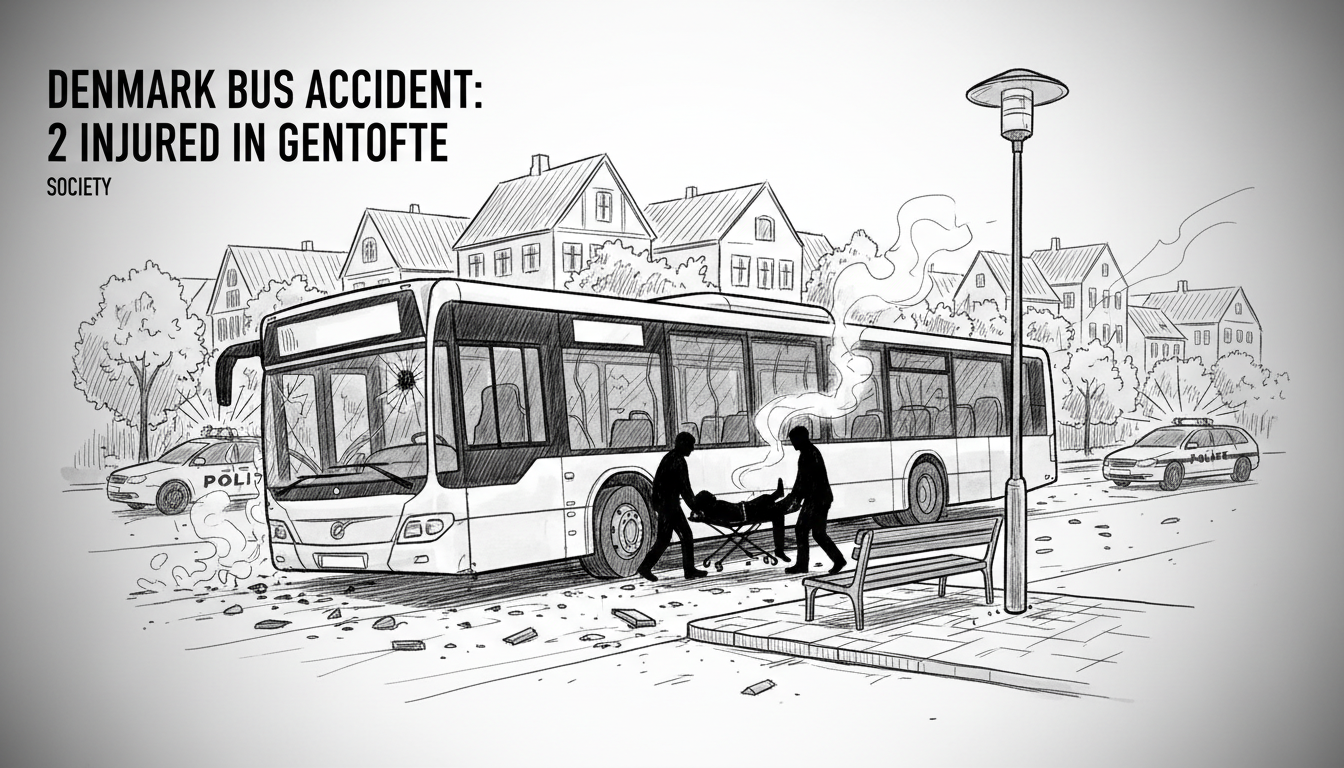
Two people were hospitalized after being struck by a bus in an affluent Copenhagen suburb Thursday evening, raising immediate questions about pedestrian safety and infrastructure. The accident occurred at the intersection of Maltegårdvej and L. E. Bruunsvej in Gentofte, a municipality known for its quiet, tree-lined streets. Eyewitnesses described a harrowing scene, with one person reportedly trapped beneath the vehicle as emergency services scrambled to respond.
A Quiet Suburb's Sudden Chaos
Gentofte is typically a picture of suburban calm, with some of Denmark's highest income levels and well-maintained public spaces. This incident shattered that tranquility just after dusk. North Zealand Police confirmed the collision and the transport of both victims to a trauma center. "The person was not run over by the tires," said duty officer Thomas Ratzlaff, clarifying a critical detail from the chaotic scene. This distinction can often mean the difference between life-threatening and severe injuries in traffic medicine.
The response was swift and substantial. Multiple ambulances and fire trucks converged on the intersection, their flashing lights illuminating the otherwise dark residential corner. Police cordoned off the area to begin their technical investigation, a standard but meticulous process in Danish traffic accidents. The condition of the two individuals remains unknown, leaving families and the community in anxious limbo.
The Mechanics of Danish Emergency Response
When serious accidents occur in Denmark, a well-oiled machine activates. The integrated response involves police, emergency medical services, and often the fire brigade for extraction and technical support. Denmark's emergency response protocols prioritize both immediate lifesaving care and preserving evidence for a thorough investigation. Every fatal or serious traffic accident triggers a detailed reconstruction effort.
Police investigators will now examine a precise sequence of factors. They will look at the bus driver's actions and condition, the mechanical state of the vehicle, the lighting and signage at the intersection, and the movements of the pedestrians. In Danish society, where trust in public systems is high, such investigations are expected to be transparent and conclusive. The findings can influence future traffic planning in the municipality.
This process reflects the Danish welfare system's preventive approach. The goal is not just to assign blame but to understand systemic failures. Could better lighting, clearer crosswalks, or altered speed limits prevent a repeat? Municipalities like Gentofte have significant autonomy in local road planning, often balancing resident desires for calm streets with the need for safe transit corridors.
Pedestrian Safety in a Cycling Nation's Capital
The accident spotlights an ongoing conversation in the Capital Region about shared space. Denmark is famously a nation of cyclists, and Copenhagen's infrastructure prioritizes bikes. Yet pedestrians, especially in suburban areas, can sometimes feel like an afterthought. Intersections designed for smooth vehicle flow may not always align with safe walking paths.
Gentofte, while wealthy, is not immune to these challenges. Its roads see a mix of local car traffic, commuter buses, cyclists, and people walking. As evening falls early in the Nordic autumn, visibility becomes a paramount concern. Danish social policy often focuses on creating environments for "everyday security," a concept that extends to safe passage on public streets. This incident tests that ideal.
Data from the Danish Road Directorate shows that while overall traffic fatalities have fallen dramatically over decades, vulnerable road users—pedestrians and cyclists—still face significant risks. Each incident prompts local reviews. A community meeting or a council debate on traffic calming measures often follows such serious events in Danish municipalities.
The Human Impact Beyond the Statistics
Behind the police report and the technical analysis are two individuals whose lives were abruptly altered. They were conscious when transported, a positive sign, but the road to recovery from serious trauma can be long. The Danish welfare system, including its healthcare and social support networks, will now envelop them. Their experience will become a data point in safety statistics, but first it is a personal tragedy.
For the bus driver and passengers, the psychological impact is also considerable. Danish public transport drivers undergo rigorous training, and such events are deeply traumatic. Support systems within companies like Movia (which operates buses in the region) are typically activated following critical incidents. The community of Gentofte, too, will process the shock of violence in a familiar place.
This is where the human element of Danish social policy meets cold, hard infrastructure. The social centers and community networks in towns like Gentofte provide the soft support, while municipal engineers and police provide the hard solutions. Both are necessary for healing and prevention.
A Look Forward: From Response to Prevention
The investigation in Gentofte will conclude with a report. It may recommend specific changes to that intersection. It might highlight a need for broader pedestrian safety campaigns as the dark winter months approach. In Copenhagen's integration and urban planning circles, there is constant discussion about designing inclusive, safe public spaces. This accident serves as a grim reminder of what is at stake.
Does the design of our suburbs prioritize convenience over safety for all users? How do we ensure that quieter, wealthy neighborhoods maintain the same rigorous safety standards as bustling city centers? These are the questions local politicians will now face. The answers will involve traffic engineers, community input, and budget allocations.
For now, the focus is on the wellbeing of the two injured individuals. The efficient, comprehensive Danish response system has done its initial job. The next phase—understanding why it happened and how to stop it happening again—is just as critical. In a society built on a foundation of security and trust, every accident is both a failure and a catalyst for improvement. The true test for Gentofte and similar municipalities is what they build from this moment of fracture.