
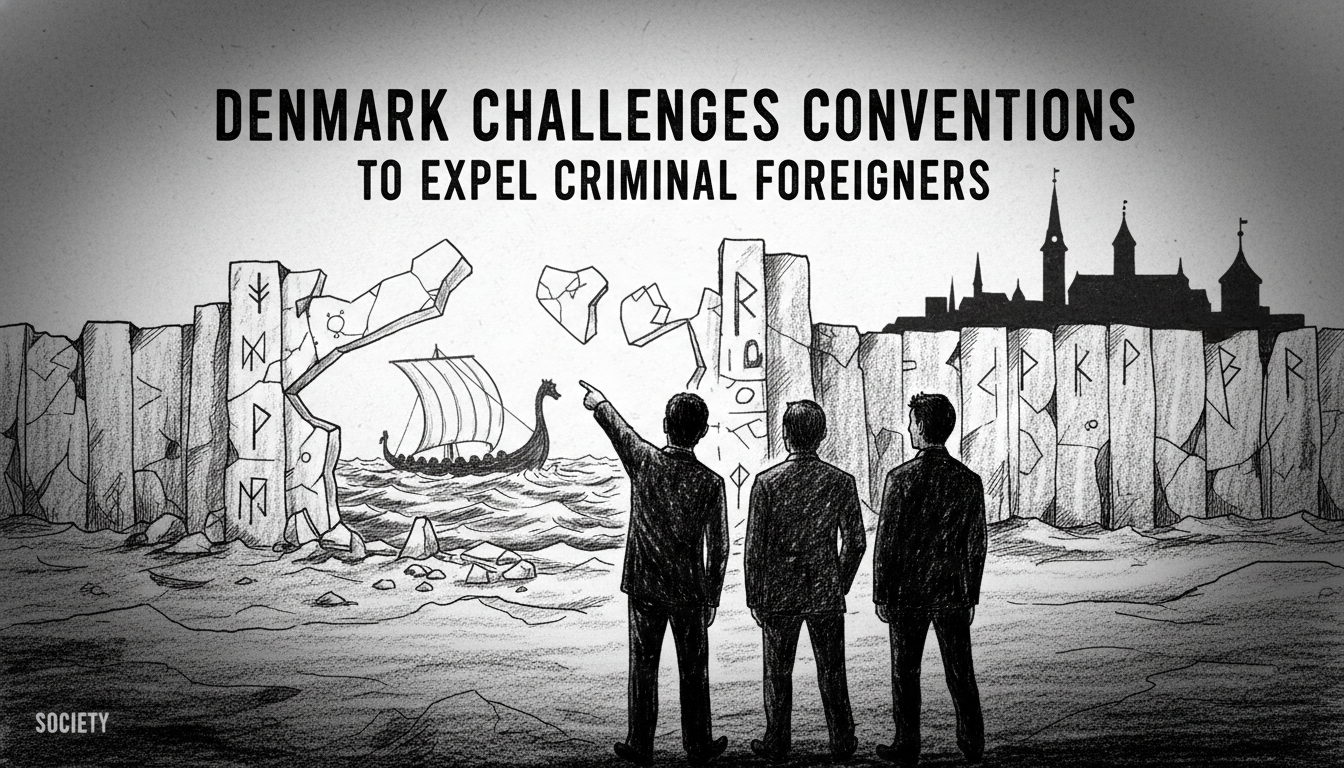
Denmark's government is preparing to confront international human rights conventions to expand the deportation of foreign nationals convicted of crimes. Immigration and Integration Minister Rasmus Stoklund stated his intention this week, acknowledging legal risks but expressing confidence the European Court of Human Rights would listen. This marks a significant escalation in Denmark's long-standing political struggle to balance its international obligations with domestic demands for stricter immigration controls.
For Ahmed, a social worker in Copenhagen's Nørrebro district, the policy debate is not abstract. He sees its potential human consequences daily at the local community center. "We work with young men who made mistakes, served their time, and are trying to rebuild," he says, asking that his full name not be used to protect his clients. "A deportation order shatters that rebuilding. It sends them to a country they may not remember, cutting them off from any positive network they have here." He describes cases where individuals face removal for crimes committed years ago, after periods of stable employment and family life. The threat of expulsion, he argues, can hinder the very rehabilitation the justice system intends to promote.
A Minister's Calculated Risk
Minister Stoklund's declaration is a direct challenge to legal boundaries that have long constrained Danish deportation policy. "We are ready to take on the conventions to get more criminal foreigners expelled," Stoklund stated. He specifically pointed to Article 8 of the European Convention on Human Rights, which protects the right to family life, as a recurring legal hurdle. The Minister conceded Denmark faces a "process risk" of losing cases in Strasbourg but believes the court will be receptive to arguments emphasizing public safety and the severity of crimes. This stance follows a political agreement in late 2023 where a majority in parliament, including the Social Democrats, Liberals, and the Danish People's Party, pledged to explore the limits of existing conventions. The goal is to lower the threshold for expelling foreign nationals convicted of serious offenses like violence, sexual abuse, and drug trafficking.
Legal experts are deeply skeptical. "The government is navigating a narrow path between political ambition and international law," says Karen Jensen, a professor of international law at the University of Copenhagen. "The European Court of Human Rights has a consistent practice. Expulsion to a country where an individual faces a real risk of inhuman treatment is absolutely prohibited under Article 3. Weakening protection against separation from family under Article 8 would require a fundamental shift in the court's jurisprudence, which is unlikely." She notes that Danish courts are already obligated to consider the severity of the crime, the individual's ties to Denmark, and their connections to their country of origin. Pushing further, she warns, could lead to Denmark being found in violation of its treaty obligations.
The Numbers Behind the Push
The political drive stems from a potent mix of public opinion and specific statistics. According to the Danish Immigration Service, 344 foreign nationals were expelled due to criminal activity in 2022. This number fluctuates yearly based on court rulings and the nature of convictions. However, polling consistently shows strong public support for stricter measures. A 2021 study by the polling institute Voxmeter, commissioned by a national newspaper, indicated that 68% of Danes supported tougher deportation rules, even if it meant challenging international conventions. This sentiment provides a powerful mandate for the government's current course. It reflects a broader Nordic trend where welfare state sustainability is often linked to strict immigration control, a connection frequently debated in integration policy circles.
At the municipal level, the practical implications are complex. Social services in cities like Aarhus and Odense are tasked with both implementing integration policies and dealing with the fallout of deportations. "Our job is integration," says a municipal social coordinator from Frederiksberg who wished to remain anonymous due to the sensitivity of the topic. "When a person who has lived here most of their life, with a Danish partner and children in Danish schools, is suddenly deported, we are left to support a fractured family. The children are Danish. Their trauma and need for support don't vanish with their parent's expulsion." This local-level perspective highlights a frequent tension between national political rhetoric and municipal social practice within the Danish welfare system.
Between Sovereignty and Shared Rules
The debate touches the core of national sovereignty in a globalized legal landscape. Proponents of the government's stance argue that democratically elected Danish authorities should have the final say on who resides in the country, especially concerning criminal justice. Opponents counter that international conventions represent a shared commitment to fundamental rights that protect everyone, including Danish citizens abroad. "Denmark has historically been a strong supporter of the international human rights system," Professor Jensen notes. "Selectively challenging aspects you find inconvenient undermines that system's credibility and could encourage other states to ignore rulings they dislike."
The government's strategy appears to involve carefully selecting test cases to bring before the Strasbourg court, hoping to gradually shift its interpretation. This is a long-term and uncertain legal gambit. In the interim, the government has also moved to tighten domestic rules, such as expanding the list of crimes that can trigger automatic expulsion proceedings and reducing the weight given to an individual's length of stay in Denmark. These incremental changes can have immediate effects while the larger constitutional battle plays out internationally.
For communities in Denmark, the outcome will shape lives and social cohesion. Ahmed, the social worker, worries about the message it sends. "It creates a two-tier system of justice," he argues. "The principle is that you serve your sentence and pay your debt to society. But for some, an additional, permanent punishment is added based on their origin. That undermines the trust we need for successful integration." As Minister Stoklund prepares his government's legal arguments for Strasbourg, this tension between the desire for security and the principles of rehabilitation and non-discrimination will remain at the heart of Danish society's ongoing conversation about itself. The world will be watching to see if Denmark can bend the conventions, or if the conventions will ultimately define the limits of Danish policy.