
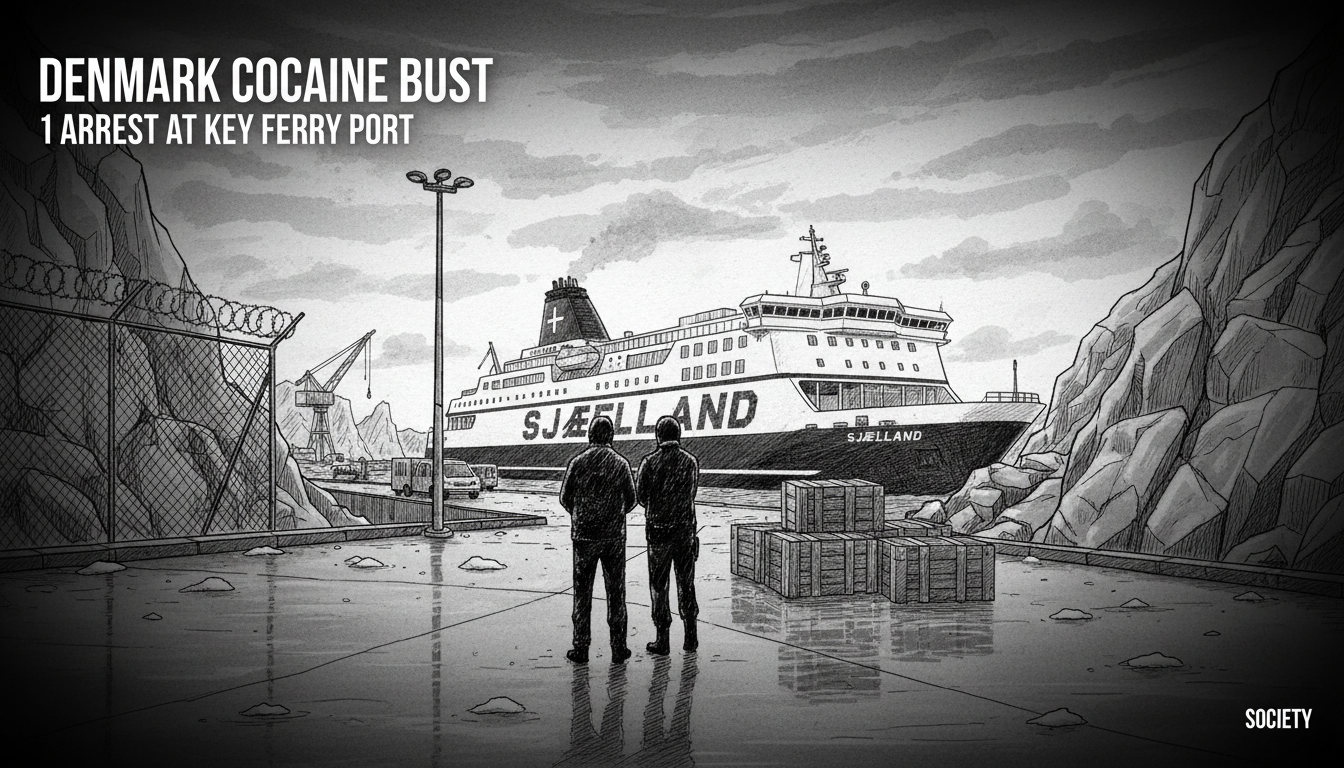
Danish police have arrested a man at the Hirtshals ferry terminal, charging him with smuggling cocaine for the purpose of sale. The arrest, which occurred on Sunday, led to a custody hearing at the Hjørring Court on Monday where the man was remanded for four weeks. He faces charges under the stringent Section 191 of the Danish Penal Code, which is applied specifically in drug trafficking cases where prosecutors believe the intent was resale. This single arrest at a major Nordic transport hub highlights the ongoing challenge of intercepting narcotics before they enter the Scandinavian market.
Prosecutor Morten Sønderby of North Jutland Police confirmed the arrest and the charges. The suspect admits to possessing the drugs but denies any intention to sell them, a common defense strategy in such cases. The court hearing was conducted behind closed doors, a standard procedure when an investigation is active and police are pursuing further leads. This suggests authorities may be investigating potential connections to broader distribution networks.
A Strategic Port in the Smuggling Chain
Hirtshals is not just a quiet fishing town; it is a critical maritime nexus. The port functions as a primary gateway for ferry traffic between Denmark and Norway, Iceland, and the Faroe Islands. Thousands of passengers and commercial vehicles pass through its terminals weekly, moving within the Schengen Area with minimal border checks. This fluidity, essential for trade and tourism, also presents a significant vulnerability that organized crime seeks to exploit. Smugglers often attempt to blend illicit cargo with legitimate goods or use complex concealment methods in vehicles and freight.
“Ports like Hirtshals are front-line territory in the fight against drug trafficking,” says a security analyst familiar with Nordic logistics, who spoke on condition of anonymity. “The volume of traffic is immense, and the resources required to screen everything effectively are substantial. An arrest like this indicates both the persistent threat and the focused efforts of border and police units.” The analyst notes that cocaine typically enters Europe through major continental ports before being distributed northward, making secondary hubs like Hirtshals key chokepoints for interception.
The Weight of the Law: Paragraph 191
The decision to charge the suspect under Paragraph 191 is legally significant. This section of the penal code is reserved for serious drug crimes involving possession, production, or sale of substances on a scale that indicates commercial intent. It carries heavier penalties than simple possession. The application of this charge hinges on the quantity of cocaine seized, though the exact amount has not been publicly disclosed by police during this initial phase. Prosecutors must prove the intent to sell, which often relies on circumstantial evidence like the drug's purity, packaging, value, and the suspect's communications or equipment.
Danish drug policy has grown stricter in recent years, particularly toward hard drugs and organized distribution. Convictions under Paragraph 191 can result in lengthy prison sentences. The suspect’s denial of intent to sell sets up a core challenge for the prosecution, requiring them to build a case that the amount and circumstances unequivocally point toward trafficking. His decision not to appeal the remand suggests his legal team may be focusing on a later trial strategy.
The Nordic Drug Market: Demand and Supply
While Denmark is often praised for its progressive social policies, it faces the same pressures of the international narcotics trade as its European neighbors. Cocaine remains a high-value commodity in the region. According to the latest annual report from the Danish National Police, drug seizures have remained at persistently high levels, with cocaine and cannabis being the most frequently intercepted substances. The street value of cocaine in Denmark is considerable, providing a powerful profit motive for criminal networks.
These networks are increasingly interconnected across borders. An arrest in Hirtshals likely connects to supply chains originating far beyond Denmark. The case underscores a broader social policy dilemma: how to balance open borders within the EU and Nordic region with effective control against cross-border crime. Investment in scanning technology, canine units, and intelligence-sharing between national police and customs authorities are part of the ongoing response.
Community Impact and Policy Reflections
From my perspective covering Danish society, each seizure tells two stories. The first is one of law enforcement success, a potentially dangerous consignment stopped. The second is a story of persistent demand that fuels this supply. It raises uncomfortable questions about the effectiveness of purely punitive approaches and the need for complementary harm-reduction and addiction treatment services within the Danish welfare model. Major ports are economic lifelines for communities like Hirtshals. Drug trafficking investigations must be handled with precision to secure convictions without unnecessarily disrupting legitimate commerce and travel.
The coming weeks will reveal more as the investigation proceeds. Will this arrest lead to further detentions, unravelling a local distribution cell? Or will it remain an isolated incident, a single courier caught in a vast network? The closed-door hearing implies the police are working on answers. For now, the message from authorities is clear: even at the northern edge of Jutland, the pathways into Denmark are being watched. The real test is whether policing can keep pace with the adaptability and resources of the criminal organizations that constantly seek new routes and methods.