
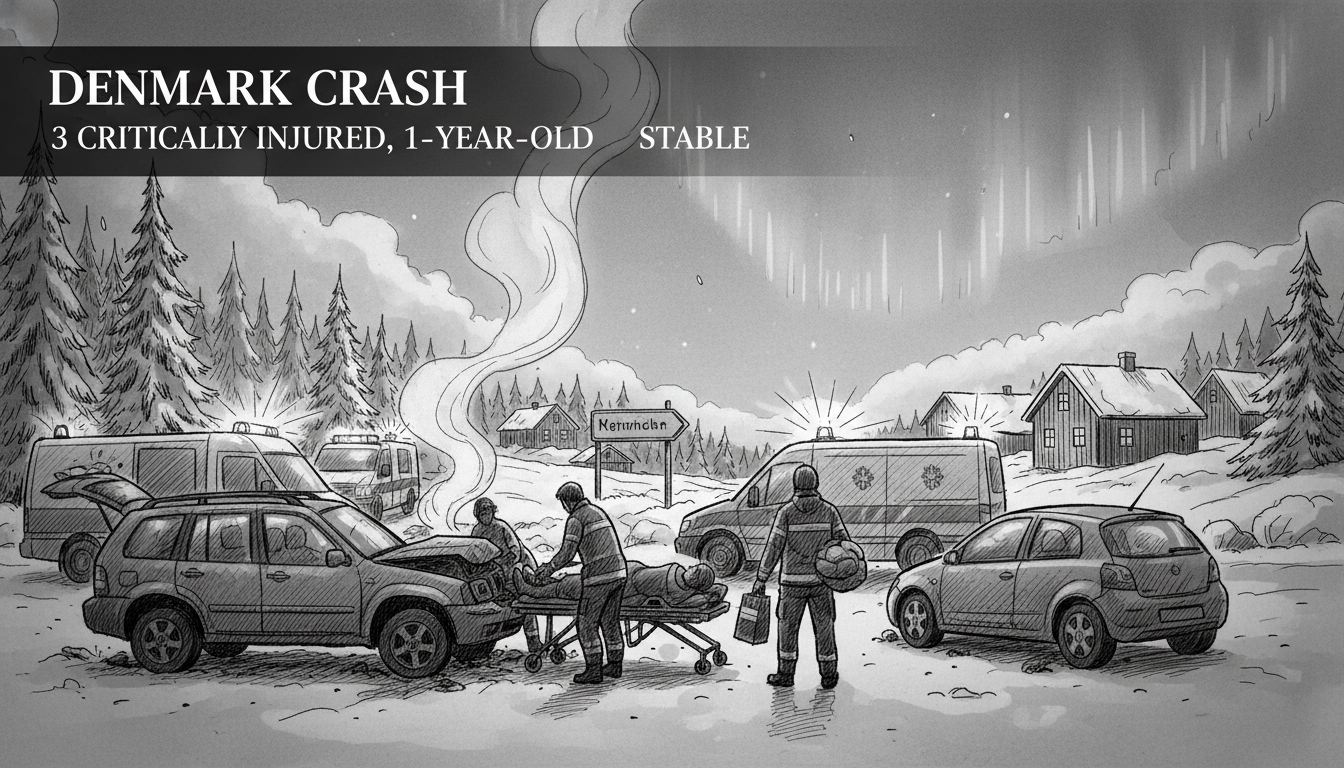
Danish police are investigating a severe head-on collision that left a 30-year-old man fighting for his life and three others, including a one-year-old boy, seriously injured. The crash occurred Tuesday afternoon on Ribe Landevej, a major rural road in Southwest Jutland. Emergency services responded to the scene shortly before 4 p.m., working for nearly four hours to extricate the injured and clear the wreckage.
The accident involved two cars, each carrying three people. In the first vehicle, a 30-year-old man is reported to be in critical condition. He was driving with a 30-year-old woman and their one-year-old son. The child, according to initial police information, is in stable condition despite suffering serious injuries. The second car was driven by a 44-year-old man, accompanied by a 43-year-old woman and a 12-year-old boy. The conditions of these three individuals have not been disclosed, but they were transported to hospital.
For the young family at the heart of this crash, a routine drive turned into catastrophe. The image of a one-year-old child, now in a hospital crib, encapsulates the profound fragility exposed on Denmark's roads. While official investigations are just beginning, the human devastation is immediate and absolute. This single impact has altered at least six lives irrevocably, a stark reminder that behind every traffic statistic lies a web of personal tragedy.
A Road Known for Speed and Risk
Ribe Landevej is a significant connective route in the region, often characterized by long, straight stretches that can encourage higher speeds outside urban areas. While Denmark boasts one of the world's lowest rates of road fatalities per capita, serious accidents on rural roads like this one remain a persistent challenge. National data provides sobering context: preliminary figures for 2022 show 167 people died on Danish roads, with another 1,643 seriously injured. Each number represents a story of sudden loss and lasting consequence.
“Every serious accident is a tragedy, but when very young children are involved, it hits everyone especially hard,” said Lars Jensen, a veteran traffic safety consultant and former senior analyst with the Danish Road Directorate. “The immediate focus is on the victims and their families. Subsequently, a technical investigation will work meticulously to understand the sequence of events. Was it a distraction, a split-second misjudgment, a vehicle fault, or the road environment itself? We must wait for the facts.”
Jensen emphasized that while Denmark's infrastructure is generally safe, the human factor is often paramount. “Our roads are designed to high standards, and vehicle safety improves every year. Yet the final variable is always the person behind the wheel. Speed is a force multiplier in crashes; it drastically reduces reaction time and increases impact energy exponentially.”
The Long Recovery Ahead
The physical recovery for the critically injured man will be a marathon, not a sprint. Traumatic injuries from high-speed collisions often require multiple surgeries, prolonged hospitalization, and extensive rehabilitation. For the one-year-old boy reported as stable, the long-term developmental impacts of a serious physical trauma are a concern pediatric specialists will monitor closely. The psychological recovery for all involved, including the 12-year-old from the second car and the emergency responders, can be an even longer journey, often involving treatment for post-traumatic stress.
This incident immediately triggers a multi-pronged response from Danish authorities. The police's accident investigation unit will examine skid marks, vehicle positions, and debris patterns. They will seize the vehicles' electronic control units, which can record data like speed and braking in the seconds before a crash. Traffic cameras or dashcam footage from other motorists will be sought. The process is thorough and can take months to conclude, with the ultimate goal of determining cause and potentially preventing future tragedies.
Local municipal authorities, responsible for road maintenance and local safety initiatives, will also review this stretch of Ribe Landevej. They will assess if any immediate engineering measures—like improved signage, rumble strips, or speed indicator displays—could be warranted. In Denmark, such reviews are standard procedure following a serious collision, part of a systemic commitment to continuous safety improvement known as 'Vision Zero,' which aims to eliminate fatal and serious injuries on the roads.
The Human Cost Behind the Statistics
The national figures of 167 fatalities and 1,643 seriously injured in 2022 are not abstract. They are composed of individual stories like the one unfolding at a hospital near Ribe Landevej. They represent parents, children, siblings, and friends. For every fatality, experts estimate dozens more—family members, colleagues, and first responders—are left to cope with the emotional and psychological aftermath. The societal cost, in terms of healthcare expenses, lost productivity, and human suffering, is immense.
Community response in such situations often reveals the strength of local social bonds. It is common for neighbors, schools, and local social centers to mobilize support networks for affected families, providing practical help with meals, childcare, and emotional solidarity. This communal safety net is a cornerstone of the Danish welfare model, extending beyond state services to informal community care.
As the investigation continues, questions will linger for the families and the community. The why behind the crash is a burden that survivors often carry heavily. Finding answers is crucial not just for legal or insurance purposes, but for personal closure and the prevention of similar pain for others. The Danish police typically release their final report publicly, contributing to the collective knowledge used to shape safer driving campaigns and infrastructure investments.
A Sobering Reminder for All Road Users
This crash serves as a grim reminder during a season when many Danes are traveling to visit family for Christmas holidays. Safety campaigns consistently highlight the dangers of fatigue, distraction, and inappropriate speed, especially on familiar local roads where complacency can set in. Ensuring children are correctly secured in age-appropriate car seats is a legal and moral imperative that experts say dramatically improves survival odds, as it may have for the one-year-old in this case.
The story on Ribe Landevej is not just a brief news item about a car accident in Denmark. It is a sudden rupture in the lives of ordinary people. It is a call for vigilance to every driver. And it is a test for the systems Denmark has built—from emergency medical response and trauma care to psychological support and thorough accident investigation—to cope with the devastating moments when those systems are needed most. The true measure of safety is not found in annual reports, but in preventing empty seats at family dinner tables.