
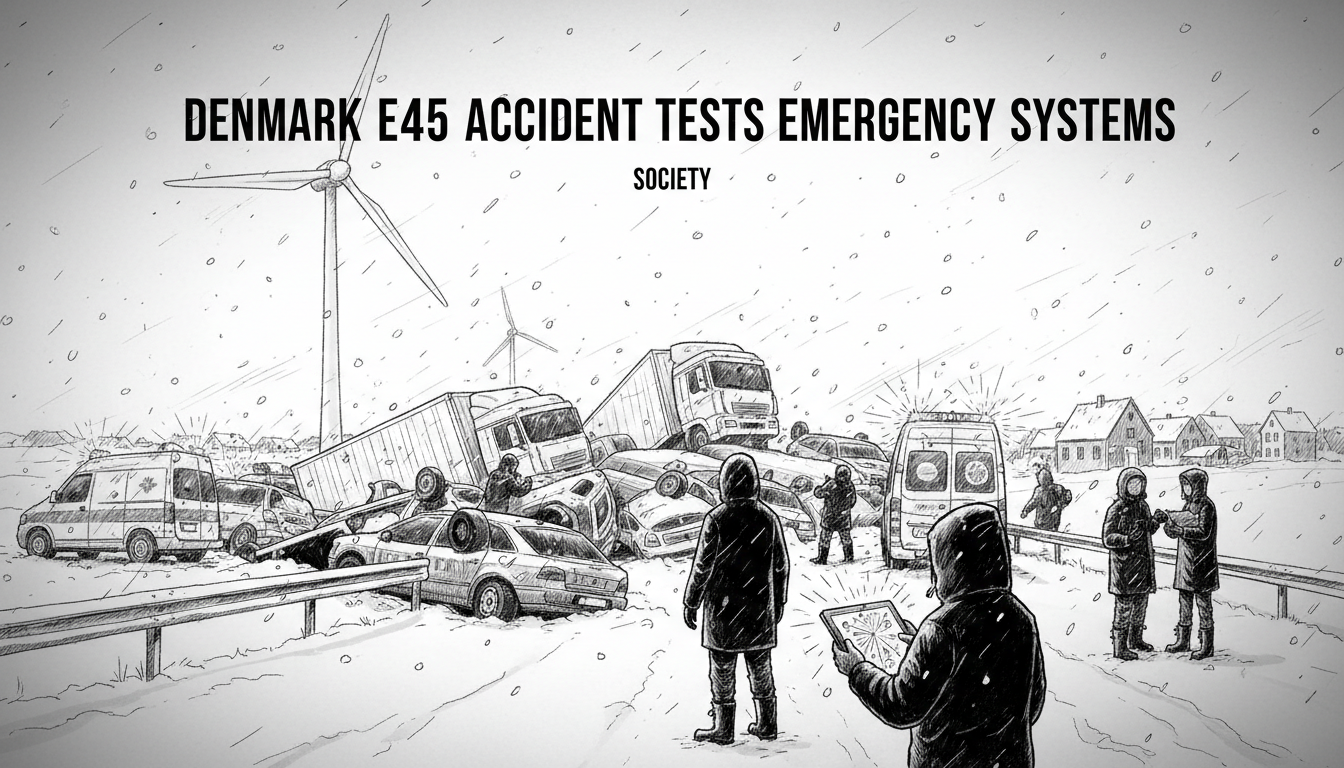
Denmark's E45 motorway saw traffic halted near Aalborg Thursday evening after an accident at the Humlebakken exit. The incident, reported by the national Road Directorate at 7:15 PM, temporarily blocked a key southern exit from one of the country’s busiest transport corridors. Emergency services including police and rescue units responded to the scene. By 7:40 PM, authorities confirmed the exit was closed, though they later adjusted the status to permit careful passage. This localized disruption on a major artery offers a routine case study in Denmark’s integrated emergency and traffic management protocols.
Such incidents, while often minor, immediately test the seamless coordination between municipal responders and national agencies. The Road Directorate's rapid public updates via traffic systems are a standard first step. Local police in the North Jutland region then assume control on the ground. This division of responsibility—national information and local response—is a hallmark of the Danish model. It relies on clear communication channels established long before any collision occurs.
A Well-Rehearsed Response Mechanism
The handling of the Humlebakken incident followed a well-established playbook. Denmark invests significantly in road safety and incident management, viewing efficient traffic flow as crucial for both commerce and daily life. The E45, part of a major European route, is particularly vital. Accidents on its exits, where speeds change and lanes merge, are a persistent focus for traffic engineers. ‘Our systems are designed for immediate notification and graded response,’ a traffic analyst with knowledge of Danish infrastructure explained. ‘The goal is minimizing disruption while ensuring safety.’
This process is not unique. It mirrors the structured, rule-based approach seen in other areas of Danish public administration. The efficiency expected from welfare services or municipal planning is also demanded of emergency coordination. There is a societal expectation that systems will function, and information will be clear. Thursday’s event, resulting only in a cautionary advisory, represents the system working as intended. A more serious crash would have activated a broader cascade of healthcare and support services.
Infrastructure and the Everyday Social Contract
Scrutinizing these events reveals more than traffic protocols. It touches on the unspoken contract between the Danish state and its residents. Reliable infrastructure is a cornerstone of the welfare society. It enables predictable commutes, efficient business logistics, and overall societal trust. When an exit closes, the system's transparency in reporting and managing the closure reinforces public confidence. Drivers receive the information needed to reroute, understanding the reason for the delay.
This transparency is a cultural priority. The immediate publication of incident details by the Road Directorate reflects a default toward open communication. In a broader sense, the integration of different response teams—police, rescue, road authorities—requires a high degree of professional trust and shared procedure. These are the same values underpinning successful integration and social policy: clear rules, coordinated actors, and transparent communication for the common good.
Beyond the Crash Barrier: A Societal Mirror
As a reporter focused on integration and society, I see parallels in these coordinated responses. The effective management of a public space like a motorway demands that all actors understand their role within a larger system. New residents learning to navigate Danish society encounter similar structures. From healthcare to housing, there are established pathways and responsible authorities. The clarity demonstrated in a traffic incident is the same clarity needed when accessing language classes or municipal services.
However, the system's smooth operation depends on everyone knowing the rules. A driver unfamiliar with Danish road signage or emergency protocols might react differently at a closed exit. This is a minor metaphor for larger challenges. Society’s infrastructure, both concrete and social, functions best when its operating principles are universally known and accepted. The efficiency witnessed on the E45 is the product of decades of shared societal development and consensus.
The Ripple Effects of Disruption
While this accident was resolved swiftly, it highlights potential vulnerabilities. The E45 is critical for regional connectivity. Prolonged closures can disrupt supply chains, delay workers, and impact businesses reliant on just-in-time logistics. The Aalborg municipality, as the fourth largest urban area in Denmark, is a significant economic hub. Its connection to the national motorway network is essential. Analysts consistently note that investment in road safety and alternative routing is an investment in economic resilience.
Furthermore, consistent traffic flow is an environmental issue. Congestion from accidents increases idling and emissions. Denmark’s broader social policies, which emphasize sustainability and green transitions, are thus indirectly linked to the reliability of its transport infrastructure. Efficient incident clearance is not just about convenience; it aligns with national environmental goals. This intersection of safety, economy, and environment is where modern infrastructure policy is forged.
A Return to Normal Flow
By late Thursday evening, the situation at Humlebakken returned to normal. The cautionary warning was lifted, and traffic resumed its usual patterns. The brief incident will become a small data point in annual road safety statistics. It will be logged, analyzed, and potentially used to inform future planning at that exit. This cyclical process of incident, response, analysis, and improvement is continuous. It reflects a pragmatic, learning-oriented approach to public management.
Denmark’s response to such everyday events showcases a deeply integrated operational culture. From the Road Directorate’s alert to the police securing the scene, the mechanism is refined. For the average Dane, this reliability is a mundane expectation. For an observer of society, it is a demonstration of institutional trust in action. The true test of any system is not when things are perfect, but when a minor crisis occurs. On a cool evening in North Jutland, the system performed its quiet, efficient duty. The question for the future is how such seamless integration can be applied to even more complex societal challenges, where the pathways are less clear than a motorway exit.