
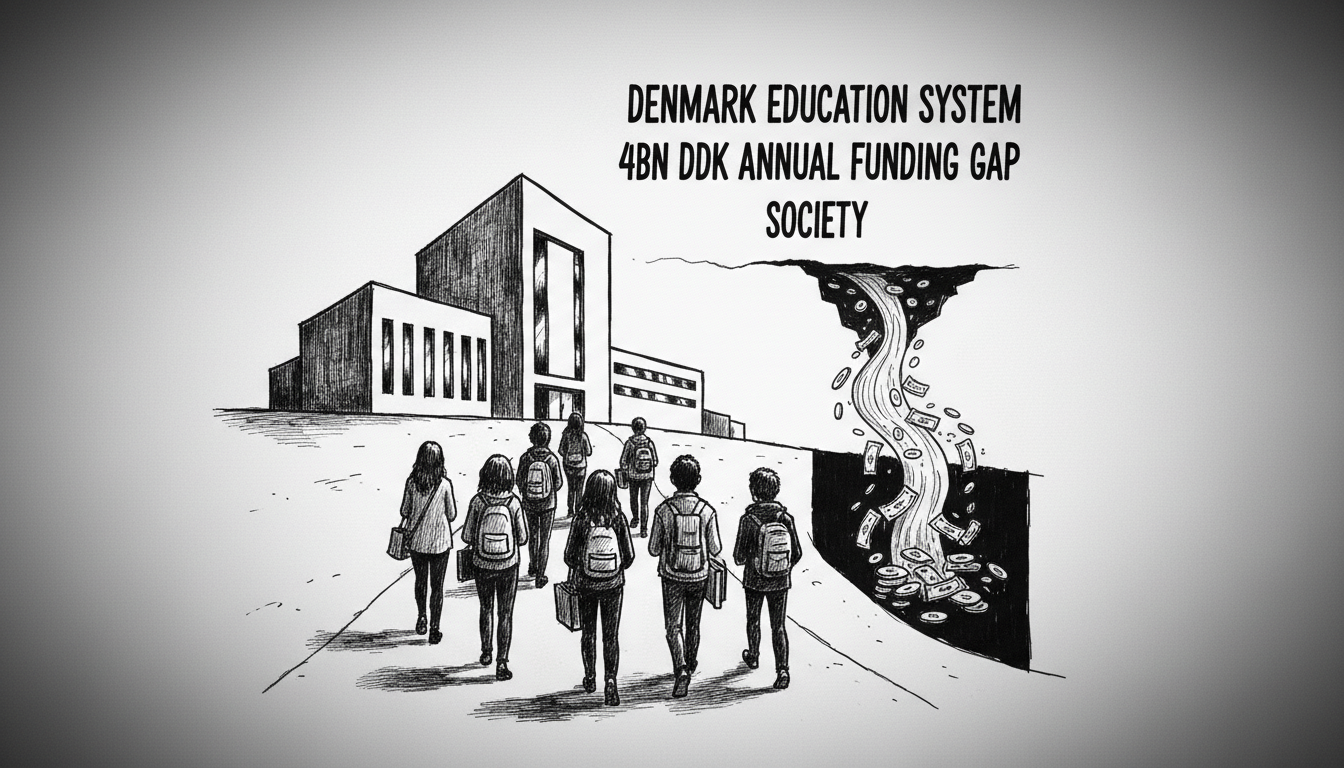
Denmark's flagship Folkeskole system requires an additional 4 billion Danish kroner annually just to keep pace with societal development, according to a stark new economic analysis. The findings, presented by prominent economist Professor Nina Smith, expose a growing financial chasm in the foundation of the Danish welfare state, with significant implications for the nation's future competitiveness and social cohesion.
"I am deeply concerned," stated Nina Smith, an economics professor, regarding the Danish primary school system's financial situation. Her analysis, commissioned by a trade publication and presented to the government, concludes that school funding has failed to track national prosperity. This comes after Minister for Children and Education, Mattias Tesfaye, recently expressed frustration in parliament that the Folkeskole had not shared in the nation's wealth growth. Professor Smith's investigation confirms the minister's unease with hard data.
The Economic Theory Behind the Shortfall
The core of the argument rests on an established economic principle known as Baumol's cost disease. This theory explains that costs in labor-intensive public sectors like education inherently rise faster than in more easily automated private industries. When wages increase across society or working hours decrease, the cost of providing the same level of public service climbs. Simply maintaining quality requires more investment. "The number in kroner per pupil is higher than before, but that figure doesn't say much about the real development," Smith asserts, emphasizing the need to account for this structural economic reality.
Smith compared the development in expenses for the Folkeskole with Denmark's GDP growth since 2007. Even after correcting for a declining student population, she found real spending per pupil has fallen by 6 percent. "If the Folkeskole were really keeping up, it should at least have the same share of GDP. We are nowhere near that," she explained. When isolating expenses for general classes—excluding special needs provision within mainstream schools—the lag is even more pronounced, reaching approximately a 10 percent real-terms shortfall over four years.
The Billion-Kroner Consequences
The cumulative effect is a deficit measured in the billions. "We are talking about an amount perhaps in the vicinity of 4 billion per year. So we are talking about many, many billions in arrears, which have built up over a long period of years," Smith stated. This financial gap has emerged as schools face escalating challenges, including supporting more children with psychological distress or requiring specialized educational support. The funding model, reliant on municipal budgets and state block grants, has not provided the necessary fiscal elasticity to meet these growing demands.
For a business and economy-focused audience, this represents a critical investment shortfall in Denmark's human capital pipeline. The Folkeskole is the primary institution shaping the future workforce. Chronic underfunding risks impacting educational outcomes, which directly correlate with long-term productivity, innovation capacity, and social mobility. In a knowledge-based economy, the quality of foundational education is as crucial as investment in roads or broadband.
Political Acknowledgement and the Path Forward
The issue has reached the highest levels of government. Minister Mattias Tesfaye's public comment that it frustrated him "like hell" that schools missed out on prosperity gains signaled political recognition of the problem. When presented with Professor Smith's calculations, the minister's office redirected inquiries to its spokesperson, Sara Emil Baaring, indicating the matter is under active political consideration. The ball is now firmly in the court of policymakers to translate concern into budgetary action.
The debate sits at the intersection of welfare policy and economic strategy. Economists frequently debate optimal public spending on education, balancing the need for adequate resources against efficient allocation. Smith's analysis, grounded in Baumol's law, argues the current allocation is structurally inefficient because it fails to account for the sector's inherent cost dynamics. The result is a system running an increasing deficit in quality and scope.
Broader Implications for Danish Society
This is not just a school budget issue; it's a societal investment question with trade implications. A well-educated population is Scandinavia's key export commodity—the foundation of its high-value industries in renewable energy, pharmaceuticals, and design. Stressing the system that creates that population poses a long-term economic risk. Furthermore, the Folkeskole's role in social integration and equality is a cornerstone of Denmark's stable business environment. Erosion of its capacity could have knock-on effects on social cohesion, potentially affecting everything from workforce stability to Denmark's international brand.
The 4 billion DKK figure provides a concrete target for discussion. It moves the debate from abstract concerns about quality to a specific fiscal challenge. Can the wealth generated by Denmark's strong economy, particularly in thriving sectors like renewables and tech, be effectively channeled to shore up its foundational institutions? The answer will define Denmark's competitive edge for decades to come. As Copenhagen and the Øresund region position themselves as green business hubs, the need for a robust, well-funded education system to supply talent is more acute than ever.
Professor Nina Smith's analysis serves as a clear economic warning siren. The funding gap for Danish primary education is a measurable, growing liability on the national balance sheet. Addressing it will require more than incremental adjustments; it demands a strategic recalibration of how Denmark invests its prosperity. The future skills of Denmark's workforce, and therefore its economic resilience, are being shaped in classrooms today. The question for ministers and mayors is whether those classrooms will have the resources needed to meet the moment.