
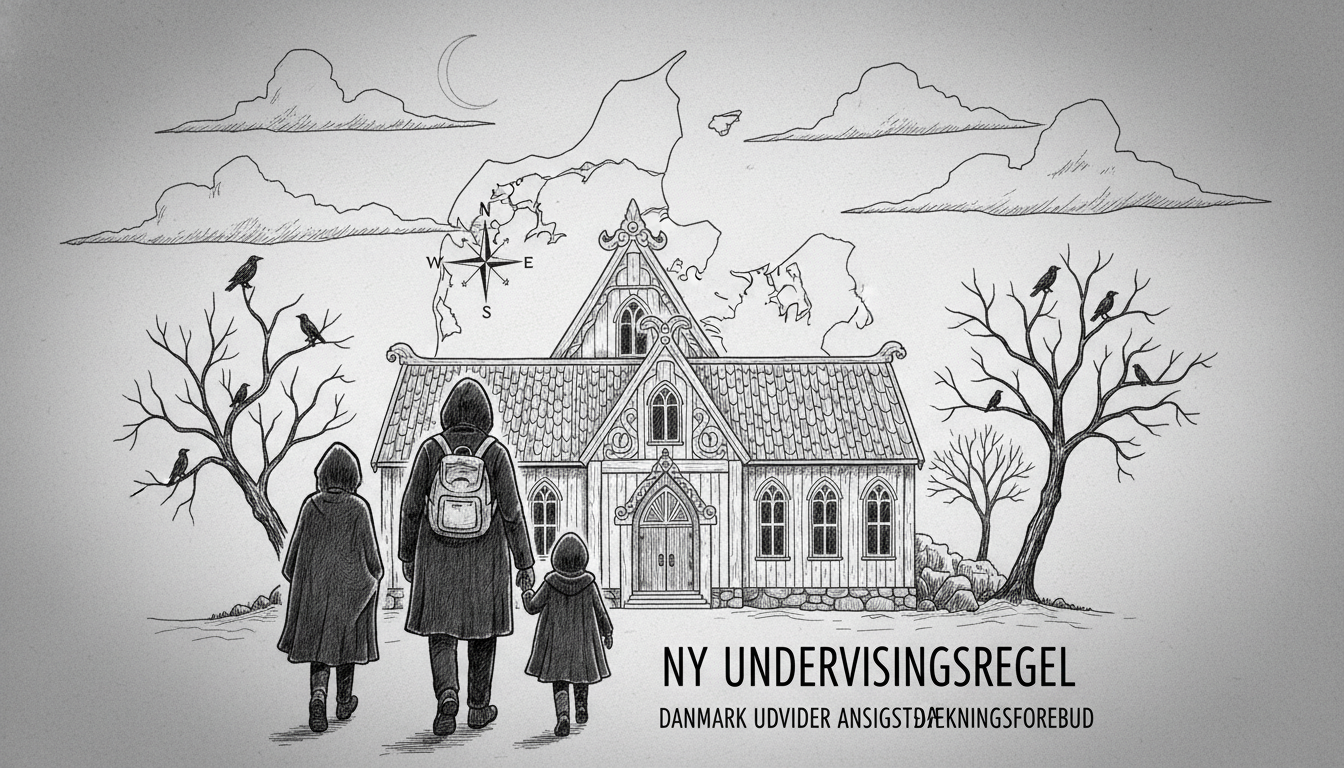
Denmark's government is proposing to extend its controversial ban on face coverings to include all educational institutions. The move would expand the existing 2018 law, which prohibits garments like the niqab and burqa in public spaces, into classrooms and university halls. This policy shift reignites a long-standing debate about religious freedom, integration, and the role of the state in regulating personal expression within Danish society.
For a small group of Muslim women in Denmark, the proposed change means a further narrowing of their public life. The original 2018 law, known as Law nr. 753, already restricted where they could wear religious face veils. Now, the government argues that full-face coverings are incompatible with the learning environment. "The face is central for communication, community, and education," a government spokesperson said in a statement announcing the proposal. "It is important that we can see each other in our educational institutions."
The Existing Law and Its Scope
The current ban, enacted in August 2018, applies to any garment that hides the face in public spaces. This includes the niqab and burqa, as well as balaclavas and masks used to conceal identity, with specific exemptions. Recognized purposes like wearing winter scarves in cold weather, using safety equipment, or participating in carnival celebrations are allowed. Enforcement is carried out by police, with fines starting at 1,000 Danish kroner for a first offense. The law was framed by its proponents as a necessary step for security and social cohesion, though critics immediately labeled it as targeting a specific religious minority.
Official estimates from a 2010 study suggested only about 200 women in Denmark wore the niqab, a number that is believed to have remained low. The practical impact of the original law, therefore, affected a tiny fraction of the population. Yet its symbolic weight in Denmark's ongoing integration debate has been immense. The proposed extension into educational settings shifts the focus from general public spaces to specific institutions central to social mobility and participation.
Integration Policy or Social Exclusion?
The government's rationale centers on integration and the conditions for effective learning. Ministers argue that open communication, which includes seeing facial expressions, is fundamental to the educational process and to building relationships within schools and universities. "We need to have an open and direct dialogue in our educational institutions," the Integration Minister stated, linking the proposal to broader efforts to ensure equal participation in Danish society.
However, sociologists and integration experts are deeply divided on the actual effects of such bans. Some community leaders in Copenhagen fear the expansion will further marginalize the very women it claims to help. "This does not promote integration; it pushes people away," said Aisha Hassan, a community organizer who works with immigrant women in Copenhagen's Norrebro district. "For a woman who chooses to wear the niqab, this law tells her she is not welcome to pursue an education in the same way as others. It limits her opportunities and tells her that her faith is incompatible with being a student in Denmark."
Other experts point to a potential conflict with international human rights conventions that protect freedom of religion. Legal scholars have consistently questioned whether blanket bans are a proportionate response, given the small number of women involved and the existence of less restrictive measures.
The Human Impact Behind the Policy
The debate often centers on abstract principles of integration and secularism, but the consequences are deeply personal. For women who wear the niqab, the existing ban has already reshaped daily routines, affecting trips to the supermarket, visits to public offices, and walks in the park. Extending this ban to educational institutions strikes at the heart of future opportunity. A university lecture hall or a vocational school classroom becomes a prohibited space, forcing a choice between religious practice and formal education.
Municipal social centers, which often serve as first points of contact for new residents, report that discussions about clothing and identity are a recurring theme. "We talk with women about many aspects of life in Denmark—language, work, family," said Karen Møller, a social advisor in Aarhus. "Laws like this become another barrier, another thing that makes them feel like outsiders. It can create distrust towards the very system meant to support them."
Proponents of the ban counter that it liberates women from patriarchal control, a perspective some feminist groups in Denmark support. They argue the state has a duty to intervene against oppressive cultural practices. Yet this viewpoint is contested by women who say they wear the niqab out of personal choice and devotion, not coercion.
A Broader Look at Danish Social Policy
This proposal does not exist in a vacuum. It fits into a decades-long trajectory of Danish immigration and integration policy, often characterized by strict requirements and a focus on cultural assimilation. From the controversial "ghetto laws" targeting certain residential areas to mandatory integration ceremonies and language tests, Denmark has pursued a model that demands clear adaptation to Danish norms.
The face covering ban, and its proposed expansion, is perhaps one of the most visually potent symbols of this approach. It legislates on the physical appearance of citizens in the public sphere, drawing a line on what the state considers acceptable for social interaction. The government's move suggests a continued belief that visible signs of religious difference, particularly from Islam, are obstacles to a cohesive society.
Critics argue this approach overlooks more substantive barriers to integration, such as labor market discrimination, access to housing, and social networks. They point to statistics on education and employment gaps for citizens of non-Western background as areas needing more urgent policy attention.
What Happens Next?
The legislative proposal will now undergo the standard parliamentary process, including committee reviews and debates. Given the current political composition, the bill is likely to pass. The discussion surrounding it, however, will continue long after any vote. It touches on fundamental questions about the limits of religious expression in a secular welfare state, the balance between individual freedom and collective values, and the best path to a society where everyone can participate.
Will expanding the ban create more open classrooms, as the government intends? Or will it simply close doors for a small group of women, making their path to education and integration more difficult? The answer depends on one's view of how Danish society is built. Is cohesion achieved by establishing clear, uniform rules for public behavior? Or is it built by creating a space where different identities and beliefs can coexist, even when they make some uncomfortable? The debate over a piece of cloth, it seems, is really a debate about the fabric of Denmark itself.