
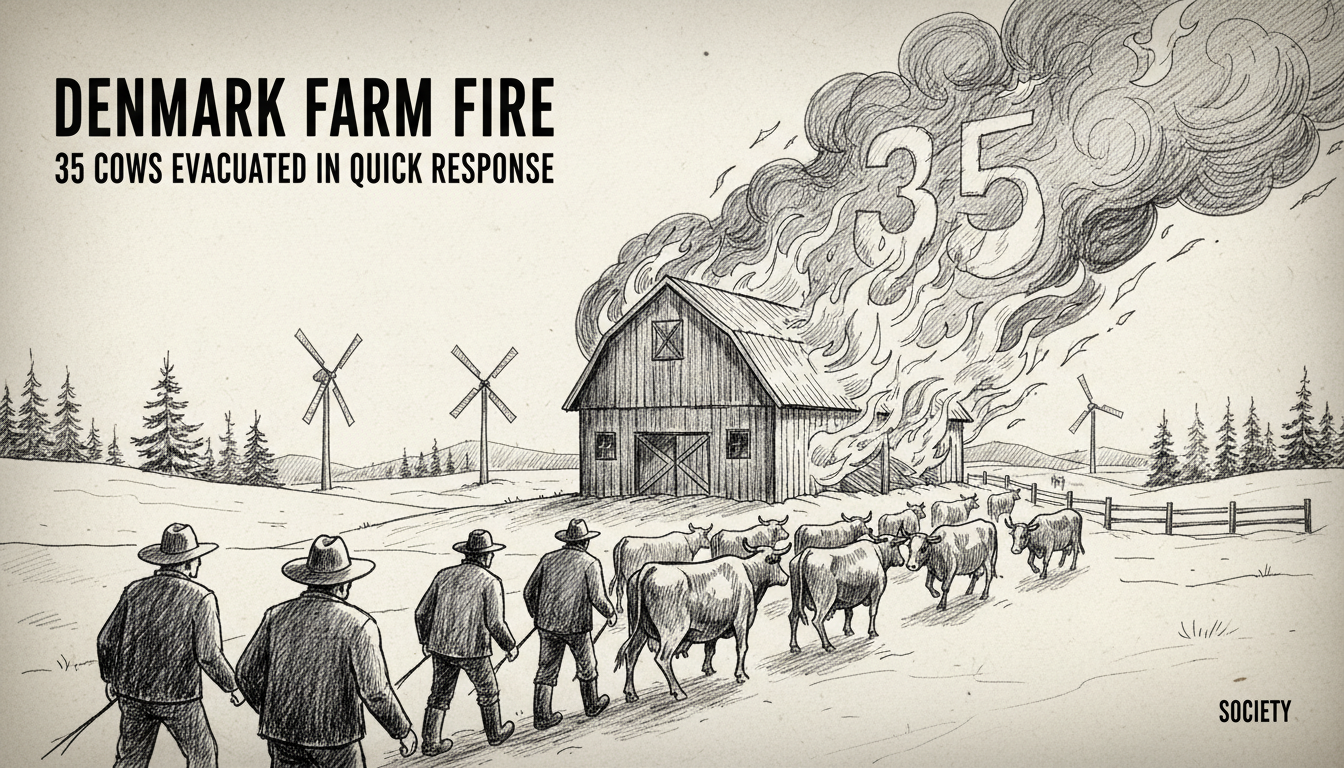
Denmark emergency services faced a busy Saturday afternoon as two separate fire alarms sent crews racing across North Jutland. The first call came at 5:24 PM for a building fire near Støvring. Just 17 minutes later, a second, more urgent alarm sounded: a farm fire with animals at risk in Handest, south of Hobro. For incident commander Per Hansen of Nordjyllands Beredskab, it became a test of coordination and community readiness.
A Tale of Two Alarms
The initial call from Støvring turned out to be a minor incident with a major lesson. A candle had melted onto a stove, producing significant smoke but causing no structural damage. "It just needed some airing out," Hansen noted, underscoring how quickly a common household item can trigger an emergency response. Before he could even reach that scene, the second alarm demanded his attention, shifting focus from a smoky kitchen to a potential agricultural disaster.
At the Handest farm, the situation was more serious. A fire had ignited in a technical room attached to a milk production facility. The immediate danger was not just to the building but to the 35 dairy cows housed nearby. Flammable materials in technical spaces, combined with the confined nature of livestock housing, create a high-risk scenario where minutes matter. The outcome, however, was a testament to preparedness.
Community Action Prevents Disaster
The successful evacuation of all 35 cows before firefighters arrived was the critical factor that averted tragedy. "There were a couple of quick-thinking guys on site who got control of the situation and evacuated the 35 cows," Hansen explained. This proactive action by farm personnel is exactly what fire safety experts highlight as essential in rural settings. Emergency services can have impressive response times, but the immediate actions of those on the ground are often what save lives and livelihoods.
Farm fires present unique challenges. Buildings often contain hay, feed, and machinery fluids that can fuel a blaze. Livestock cannot be easily moved and may panic, making evacuation complex. The fact that the farm workers managed to safely move 35 large animals demonstrates remarkable calm and efficiency under pressure. Hansen confirmed that due to this "good work," the animals and the main building were never in real danger.
The Anatomy of a Rural Emergency Response
Nordjyllands Beredskab, like other Danish emergency services, operates a coordinated system designed to handle multiple incidents across large, sometimes sparsely populated areas. The 17-minute gap between the two calls on a Saturday afternoon is a snapshot of their operational reality. These services must be prepared for anything, from a smoking candle to a full-scale barn fire, often with limited personnel covering vast districts.
The response protocol prioritizes calls where life is at risk, which is why the farm fire immediately took precedence. The technical room fire required assessment and repair. "Some things in the technical room need to be replaced before everything is up and running again," Hansen said, pointing to the practical aftermath of such incidents. For a working farm, downtime directly impacts business, making a swift and effective fire service response economically crucial as well as a matter of safety.
Expert Perspective on Prevention and Response
Fire safety professionals consistently stress a two-pronged approach for agricultural settings: prevention and prepared response. Technical rooms, which house electrical panels, heating systems, and machinery, are common points of ignition. Regular maintenance and clear safety protocols are the first line of defense. The second line is the human element—training farm workers in basic fire suppression and animal evacuation procedures.
"Early detection and rapid initial response are absolutely key on a farm," says a fire safety consultant familiar with Danish agricultural practices, who asked not to be named as they are not directly involved in this case. "The distance to the nearest fire station can be significant. Those first five minutes, handled by the people on site, determine whether you have a manageable incident or a catastrophic loss." This incident in Handest serves as a perfect case study of that principle in action.
The Bigger Picture for Danish Farms
While this event ended well, it highlights an ongoing concern for Denmark's agricultural sector. Farms are both homes and businesses, blending residential and industrial fire risks. According to data from the Danish Emergency Management Agency, responses to fires in agricultural buildings, while not the most frequent, often result in some of the most costly damages due to property value, equipment loss, and business interruption.
Many Danish municipalities and agricultural organizations run safety campaigns focusing on electrical safety, proper storage of flammable materials, and having clear evacuation plans for livestock. The investment in such preparedness pays off not only in saved animals and property but also in reduced strain on public emergency resources. A controlled, small-scale fire that is managed locally frees up crews for other life-threatening situations elsewhere in the region.
A Saturday Afternoon Resolved
By the end of that Saturday, Per Hansen and his team could stand down. In Støvring, a home was being aired out. In Handest, 35 cows were safely back in their barn, and repairs to the technical room were being organized. Two potential crises were downgraded to minor incidents. This outcome was not just luck. It was the result of a functional emergency service system and, more importantly, the decisive action of informed citizens.
The story of these two fires is less about drama and more about a system working as it should. It is a reminder that safety in rural communities is a shared responsibility. It relies on vigilant individuals preventing fires where possible, capable neighbors acting decisively when trouble starts, and professional responders being ready to roll when the alarm sounds. In the end, the most important statistic was not the 17 minutes between calls, but the number zero: zero animals hurt, zero people injured, and zero major buildings lost. In the business of emergency response, that is the only metric that truly counts.
Does the readiness of ordinary Danes to act in a crisis represent an unspoken pillar of the country's famed safety and welfare system? This quiet Saturday in North Jutland suggests it might.