
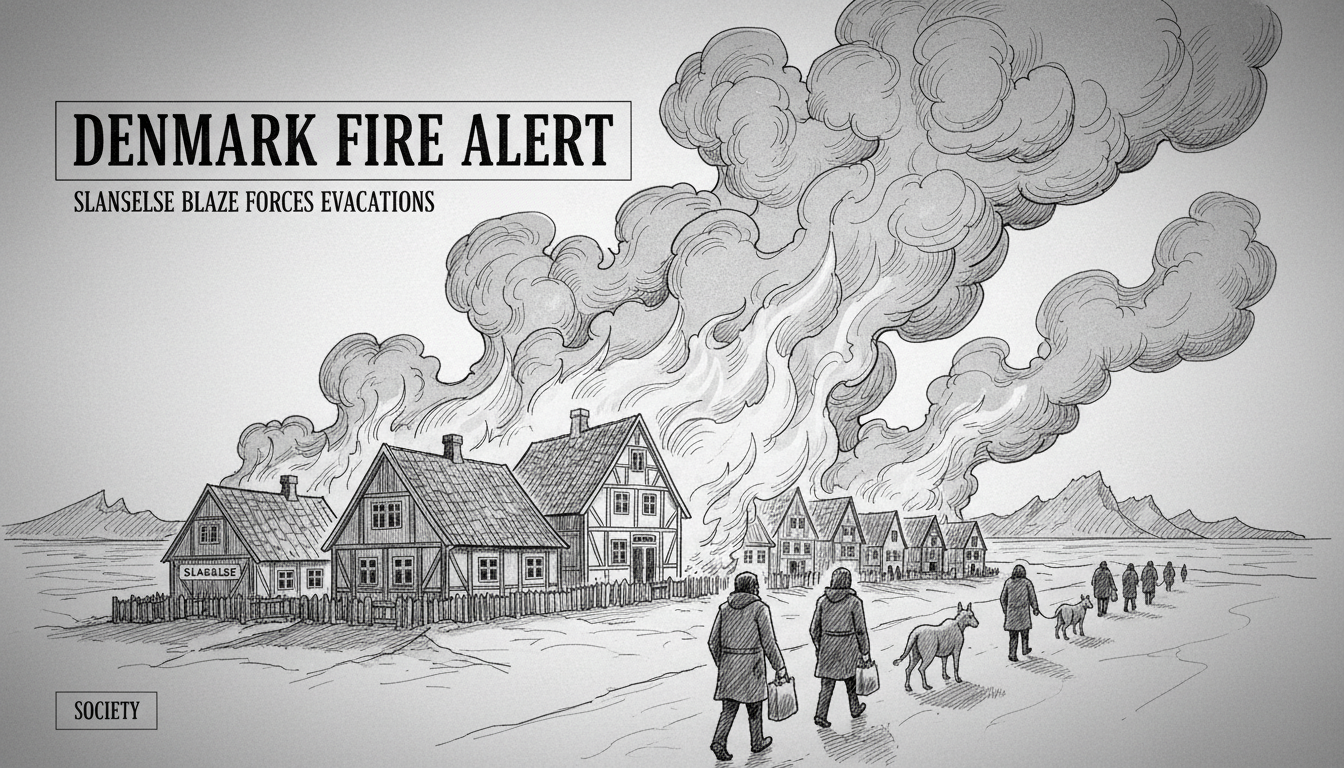
Denmark fire services are battling a major blaze in a central Slagelse building, prompting urgent public health warnings. Police have cordoned off large sections of the town center, including the entire Rådhuspladsen, after the fire broke out in a multi-story building on Smedegade Wednesday afternoon. Authorities are urging residents near Smedegade and Town Hall Square to stay indoors, close windows and doors, and shut off ventilation systems due to heavy, drifting smoke.
"The fire is developing heavy smoke, which is drifting out over the local area," Sydsjællands and Lolland-Falster Police stated on social media. Police supervisor Jannick Hallø confirmed the building houses a ground-floor pizzeria with residential apartments above. One resident has been evacuated, and ambulance personnel are examining another individual for potential smoke inhalation. Hallø stressed that no one is in life-threatening danger, but the emergency response has no estimated end time as crews work to contain the flames.
Emergency Response Escalates in Town Center
The incident began with a limited cordon around Smedegade and parts of Rådhuspladsen. By 5:40 PM, the police expanded the restricted zone to encompass the entire Town Hall Square and Skolegade from Ingemannsvej. This expansion reflects the operational scale required to manage the incident and protect public safety. The dense smoke plume, a significant hazard, is the primary driver for the indoor shelter advisory. Such directives are standard protocol when toxic combustion products threaten air quality in populated areas.
Emergency management experts note that coordinated police and fire brigade actions are critical in these scenarios. "The immediate priority is life safety, followed by incident stabilization," says a former Danish Emergency Management Agency consultant. "Cordon expansion is a dynamic process. It shows responders are assessing risk in real time, erring on the side of caution to keep people away from potential structural collapse or exposure." The presence of both commercial and residential spaces in the building adds complexity, requiring crews to account for both public and private occupancy.
Community Impact in a Historic Hub
Slagelse, a key commercial and educational center in western Zealand with roots stretching to the Viking Age, finds its core disrupted. Smedegade and Rådhuspladsen sit at the heart of the town's daily life. The closure of these areas halts foot traffic, affects local businesses beyond the immediate fire site, and creates a palpable disruption. For residents in nearby apartments, the warning to shut windows transforms their homes into a refuge from the external hazard, a waiting game dictated by the wind and the fire crews' progress.
The human impact, while physically limited to two individuals so far, carries an emotional weight. Being evacuated from one's home or treated for smoke inhalation are deeply personal crises unfolding within a larger public emergency. The police assurance that no lives are imminently at risk provides crucial public reassurance. It helps prevent panic and allows the operational response to proceed without the added pressure of rumour and fear spreading through the community.
Analyzing Public Safety Protocols
This incident showcases standard Danish emergency response protocols in action. The clear, sequential public communication—first an alert, then an expanded cordon notice, followed by detailed statements from an on-scene supervisor—aims to build public trust and compliance. The specific advice to shut off ventilation is a technically important detail, preventing smoke infiltration through building systems. Denmark's integrated emergency services, where police manage perimeter security and public communication while fire services tackle the hazard, are designed for this exact type of urban incident.
"The effectiveness of such responses often hinges on public adherence to instructions," the emergency consultant adds. "When people stay indoors and avoid the cordon, it keeps pathways clear for responders and reduces the number of potential casualties. It's a civic partnership during a crisis." The response also highlights the importance of municipal infrastructure; the ability to quickly seal off a town square requires pre-planned logistics and inter-agency coordination between police, fire, and municipal traffic authorities.
The Long Road to Normalcy
Even after the last flame is extinguished, the aftermath in Slagelse will unfold for days. Fire investigators will work to determine the blaze's origin and cause, a process that can take considerable time. Structural engineers must assess the damaged building's integrity before anyone can re-enter adjacent properties or the pizzeria and apartments themselves. For the evacuated resident and the person treated for smoke inhalation, the event may have lasting personal consequences, from displaced living arrangements to health follow-ups.
For the wider community, the sight of emergency vehicles in the town square and the smell of smoke serve as a stark reminder of urban vulnerability. It also demonstrates the system built to protect it. The incident, while contained, will likely prompt local reviews of fire safety compliance in mixed-use buildings and community preparedness information. As night falls on Slagelse, the focus remains on the firefighters' gruelling work, the police maintaining their cordon, and a community heeding advice to stay safe behind closed doors, waiting for the all-clear.
A Testament to Preparedness and Patience
As the operation continues without a set timeline, the Slagelse fire underscores a universal truth about emergency response: it is a marathon, not a sprint. The controlled, measured updates from authorities suggest a incident being managed methodically, not spiraling out of control. This balance between urgency and procedure is the hallmark of a tested system. For Denmark, a nation with stringent building and safety codes, such events test the real-world application of those standards. The true measure of success will be a final report showing all residents safe and the fire's impact limited to property damage—a outcome that appears within reach thanks to the rapid, coordinated action now underway.