
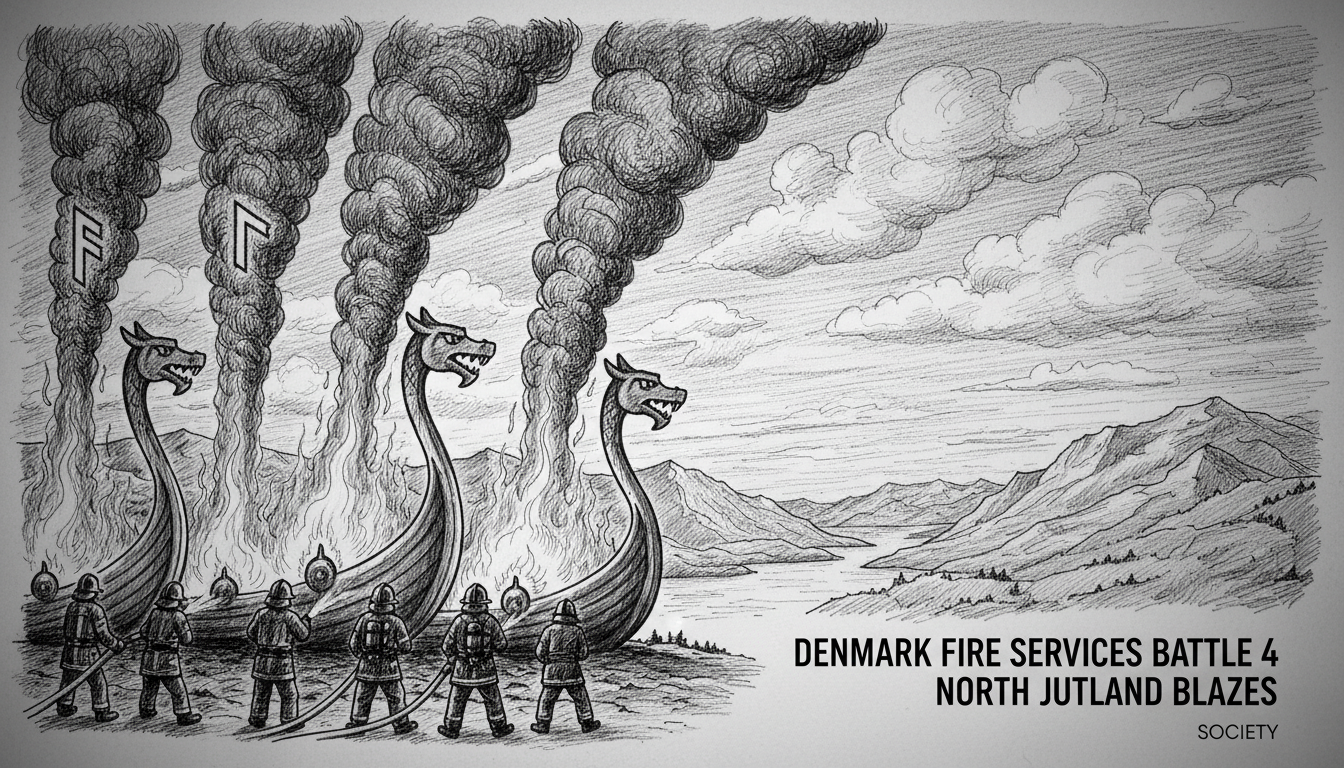
Denmark's North Jutland emergency services faced a demanding Monday evening, responding to four separate incidents across the region in a concentrated burst of activity. The Nordjyllands Beredskab was called to a building fire in Hørdum, smoke in a property in Agersted, a grass fire near Bulbjerg, and a rekindled blaze north of Fjerritslev. This multi-incident evening offers a snapshot of the diverse challenges faced by Denmark's municipal fire and rescue services, testing coordination and resource allocation across rural areas.
A Hectic Night Across the Countryside
The first call came just after 11 PM on Monday, reporting a fire in an apartment on Nyhåbsvej in Hørdum, near Snedsted. Firefighters dispatched three vehicles and seven personnel to the scene. Investigators later determined the cause was a short circuit in an electrical cabinet within the apartment. Fortunately, the incident was contained without significant damage to the building's structure. "There was presumably a short circuit in an electrical cabinet, but no damage occurred to the fixed property," a duty officer with the Midt- and Vestjylland Police confirmed on Tuesday morning. This swift resolution prevented what could have been a serious residential fire.
Simultaneously, other teams were mobilizing. In Agersted, near Dronninglund, reports of smoke in a building required the deployment of smoke divers—specially trained firefighters equipped to operate in zero-visibility, toxic environments. Their precise intervention was crucial to identify the source and prevent a full-scale fire. Meanwhile, near the coastal cliff of Bulbjerg, a different threat emerged: an open-area fire consuming dry grass and thick bramble bushes dangerously close to a wooded area. These types of fires, especially after dry periods, pose a significant risk of rapid spread to forested land.
The Lingering Threat of Dormant Flames
Adding to the evening's workload, crews were also called north of Fjerritslev for an efterslukning—an "after-extinguishing" operation. This term refers to the critical and often overlooked task of ensuring a previously extinguished fire is completely out. In this case, a fire from the previous week had rekindled, a common hazard with deep-seated blazes in peat, compost, or dense vegetation. Such callbacks highlight the persistent nature of some fires and the sustained resource commitment they demand from local brigades, often stretching over days.
This cluster of incidents, while resolved without major injury or catastrophic damage, underscores the operational reality for Denmark's decentralized emergency response. The system relies on a network of municipal beredskab, often cooperating across municipality borders, especially in less densely populated regions like North Jutland. A simultaneous surge in calls can test this network, requiring efficient prioritization and potential mutual aid. Analysts note that evenings with multiple incidents, though not uncommon, provide real-world stress tests for response protocols and resource deployment.
Strain and Resilience in the Welfare System
From my perspective, covering Danish society and its public systems, an evening like this reveals the quiet resilience embedded in local governance. The Danish welfare model extends beyond healthcare and education to include public safety, maintained through local tax funding and municipal management. The efficiency of the response in Hørdum, where a potential disaster was averted, reflects well-maintained local services. However, it also prompts questions about capacity in rural districts where stations may be staffed by part-time or volunteer responders, and where longer travel times are a factor.
Experts in emergency management point to several factors at play. Preventative public awareness campaigns about electrical safety, proper disposal of flammable materials, and regulations on open fires are the first line of defense. The grass fire near Bulbjerg, for instance, aligns with broader concerns raised by climate analysts. Drier, warmer conditions in the Nordic region are extending the risk period for vegetation fires, a challenge that requires adaptation in fire service preparedness and public advisories.
The Human Element Behind the Alarms
Behind the official reports of "three vehicles and seven brandfolk" are individuals leaving their homes, meals, and families to respond to community emergencies. This human element is the backbone of the system, particularly outside major cities. The professional assessment that prevented the Hørdum apartment fire from spreading, the skilled entry of smoke divers in Agersted, and the tedious work of damping down a rekindled fire—all speak to a culture of trained, responsive public service. It is a practical manifestation of the social contract, often invisible until the sirens sound.
While Denmark's fire statistics generally show a downward trend in building fires, thanks to improved regulations and materials, the nature of the threats is evolving. Incidents like these four demonstrate the variety: modern electrical faults, classic structural smoke, climate-influenced wildland fires, and persistent smoldering blazes. Each type demands specific training and equipment, placing a comprehensive knowledge and resource burden on local departments.
A System Tested, A Standard Upheld
The Monday night series in North Jutland ended as a successful, if busy, operational footnote. No lives were lost, and major property damage was avoided. Yet, it serves as a useful case study. It illustrates the interconnectedness of public safety with environmental conditions and infrastructure maintenance. It shows a system designed for reliability being called upon to perform exactly as intended, across multiple fronts. For residents, it is a reminder of the services their taxes fund, operating in the background. For the municipalities and the beredskab, it is a validation of planning and training, and perhaps a prompt to review resource models for nights when the call volume spikes unexpectedly.
The true test of any emergency service is not just its response to a single catastrophe, but its ability to manage concurrent, lower-level incidents that collectively demand significant effort. By that measure, the Nordjyllands Beredskab's Monday shift passed efficiently. The events, scattered across the map from Dronninglund to Bulbjerg, affirm that the safety net, woven at the municipal level, holds firm even when stretched. It is a fundamental, non-negotiable pillar of the Danish societal model, working exactly as it should when the alarms ring out across the Jutland heath.