
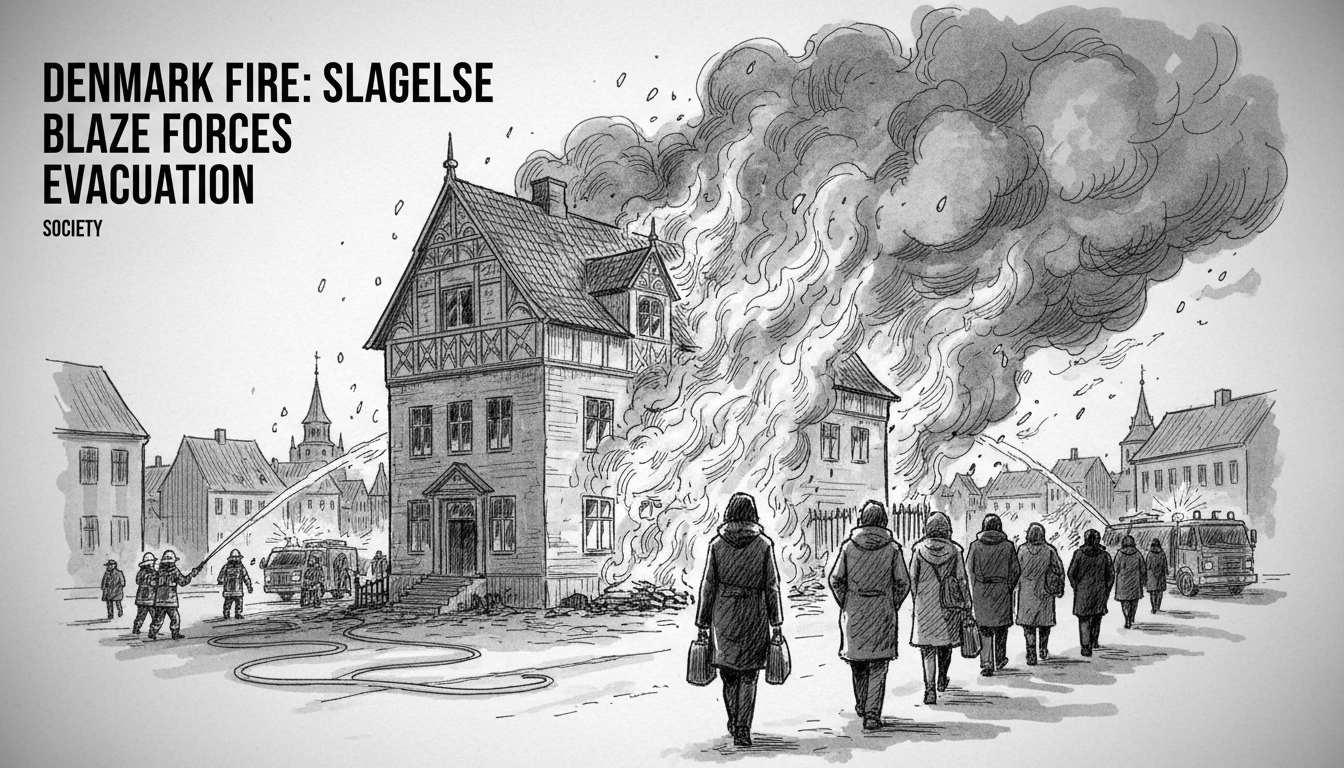
Denmark fire services are battling a significant building fire in the town of Slagelse, forcing evacuations and a major emergency response. Thick smoke billowed from a building on Smedegade Wednesday afternoon, prompting police to urgently warn residents to stay indoors, close windows, and shut off ventilation systems. The incident highlights the rapid coordination required between municipal fire services and police during urban emergencies.
A Rapidly Escalating Emergency
Initial reports described a fire in a mixed-use building containing a ground-floor pizzeria with residential apartments above. Police from the South Zealand and Lolland-Falster unit arrived quickly, establishing an initial cordon around Smedegade and parts of the adjacent Town Hall Square (Rådhuspladsen). As the fire developed, the situation intensified. "The fire is producing heavy smoke, which is drifting out over the local area," the police district stated on social media, issuing the critical public health warning.
By 5:40 PM, authorities expanded the safety perimeter significantly. The cordon grew to encompass the entire Town Hall Square and Skolegade from Ingemannsvej. Police spokesperson Jannick Hallø confirmed the ongoing efforts. "They are working to gain control over the fire, which is producing heavy smoke. We urge people to stay away from the cordoned areas," he said. The expansion indicated the fire's severity and the unpredictable nature of smoke drift in a built-up urban center.
Evacuation and Medical Response
Emergency crews successfully evacuated one resident from the affected building. Another individual received medical attention on-site from ambulance personnel for potential smoke inhalation, a common and dangerous risk in structural fires. Hallø provided a crucial update on their condition, stating that no one was in immediate life-threatening danger. This outcome, while serious, points to the effectiveness of the initial emergency response in a populated area.
Smoke inhalation remains a primary cause of fire-related injuries and fatalities, even when flames are contained. Experts consistently stress that toxic fumes from burning modern materials can overcome people far more quickly than the fire itself. The police directive for nearby residents to seal their homes was a standard but vital procedure to prevent secondary casualties across the neighborhood.
The Challenge of Urban Firefighting
Fighting a fire in a mixed-use, multi-story building presents distinct challenges for Denmark's emergency services. The combination of commercial and residential spaces complicates firefighting tactics, as construction materials, ventilation systems, and occupancy patterns differ. The presence of a commercial kitchen in the pizzeria, with potential grease and gas lines, adds another layer of risk that firefighters must assess upon arrival.
Danish fire brigades, integrated within the municipal rescue services (Beredskab), train extensively for such scenarios. Their response is coordinated with police, who manage crowd control, traffic, and public communications, allowing fire crews to focus on suppression and rescue. The lack of a clear timeline for resolving the Slagelse incident, as noted by police, is not unusual. Containing a fully developed structural fire, ensuring it is completely extinguished, and making the area safe for investigators can take many hours.
Community Impact in a Historic Town
The fire occurred in Slagelse, a key town in western Zealand with a history stretching back to the Viking Age. Today, it functions as a modern commercial and educational hub for the region. An incident like this in a central area near the Town Hall Square disrupts the core of community life. Local businesses faced immediate disruption due to cordons, and residents were confined to their homes during the emergency response.
Events such as this test the resilience of local infrastructure and social cohesion. While the direct damage was contained to one building, the indirect effects—from economic disruption to the anxiety caused by heavy smoke and emergency sirens—ripple through the community. The response also demonstrates the reliance on clear, authoritative communication from authorities to prevent panic and ensure public compliance with safety orders.
Analysis: Preparedness in the Danish System
This incident serves as a live test of Denmark's integrated emergency management protocols. The Danish model relies on clear division of labor: fire services handle the technical rescue and suppression, while police secure the perimeter and communicate with the public. The immediate issuance of specific instructions—close windows, stay indoors—shows a pre-planned public information strategy for environmental contamination events.
From an integration and social policy perspective, emergencies do not discriminate. They affect everyone in the vicinity, regardless of background, highlighting the universal importance of robust public safety systems. A well-functioning welfare state depends on citizens' trust that authorities can protect them during crises. The efficient evacuation and medical response in Slagelse, aiming to prevent loss of life, is a fundamental service citizens expect from their municipality and state.
Looking Ahead: Investigation and Recovery
The immediate priority remains fully extinguishing the fire and ensuring the structural safety of the affected and adjacent buildings. Once the site is secure, the investigative phase will begin. Danish fire investigators will work to determine the origin and cause of the blaze, a process that can take considerable time. Their findings are crucial for potential insurance claims, future safety regulations, and providing answers to the displaced residents and business owners.
For the evacuated individual and those living nearby, the recovery process starts once the smoke clears. Municipal social services often play a role in providing temporary housing and support for those displaced by such events. The incident is a stark reminder of how quickly normal life can be upended, and how society's structures, from emergency services to social safety nets, are designed to catch people when it happens.
The Slagelse fire, while contained, prompts broader reflection. How prepared are our densely built towns for such emergencies? Are public warnings effective enough? This event, thankfully without fatal casualties, offers a case study in response efficacy and the quiet, constant work of maintaining public safety in communities across Denmark.