
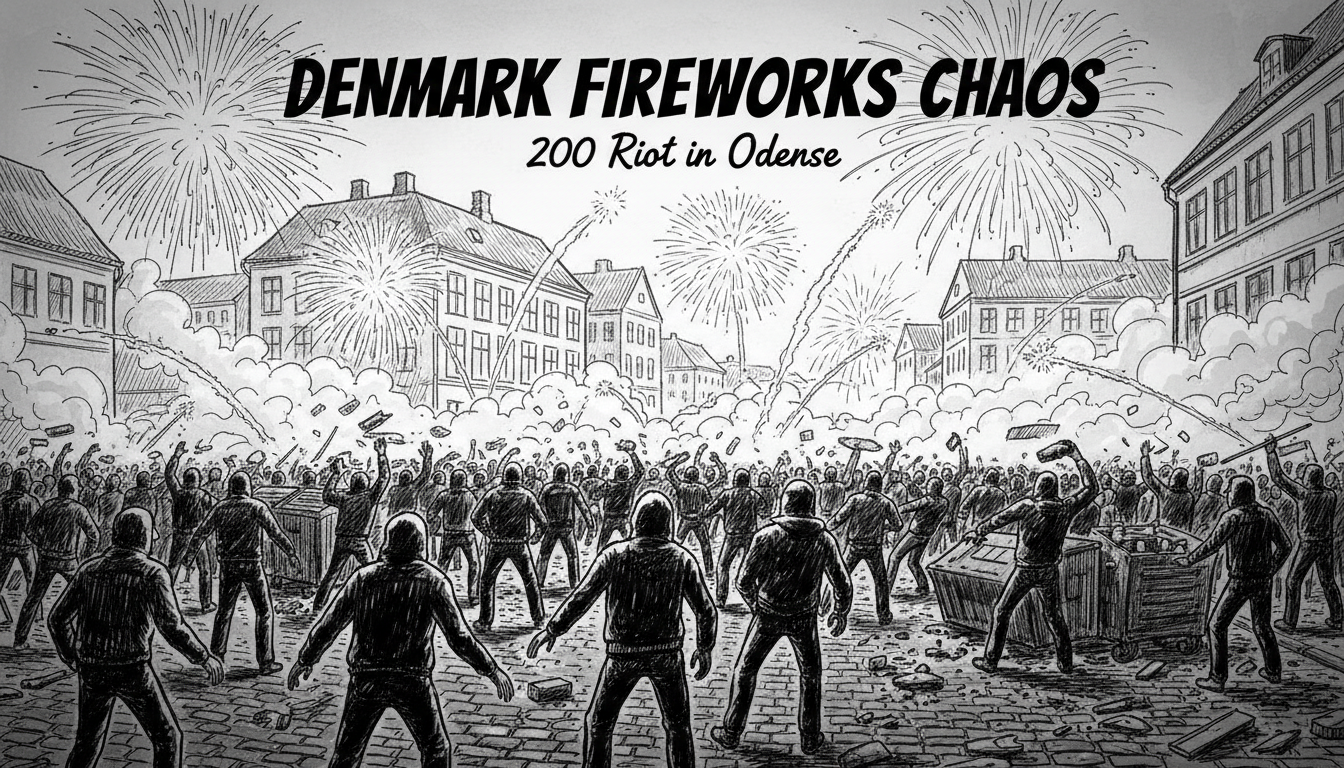
Denmark's New Year's Eve celebrations turned violent in Odense, where police condemned a 'foolish, reprehensible, and downright stupid' fireworks riot. Up to 200 people, including masked individuals, turned the city center into a warzone overnight Wednesday. Participants launched rockets and illegal fireworks at citizens, windows, and directly at police officers, who responded with batons and dogs to control the crowd. The scenes in Denmark's third-largest city represent a severe escalation of annual tensions surrounding pyrotechnics and public order.
A Night of Pyrotechnic Violence
Fyns Politi, the police force for the Funen region, described a coordinated and aggressive confrontation. 'It is foolish, reprehensible, and downright stupid behavior that we have witnessed,' a police spokesperson said in a strong statement following the events. The incident was not spontaneous revelry but a targeted attack. Fireworks became projectiles aimed at people and property, creating dangerous conditions far beyond typical holiday mischief. This direct assault on public servants and the community marks a troubling new threshold in Denmark's ongoing struggle with festive period violence.
Danish law permits fireworks use only during a limited window around New Year's Eve, strictly regulating their sale and possession. The weapons used in Odense, however, fell outside these legal boundaries. 'The use of illegal fireworks, especially in this manner, shows a complete disregard for the safety of others and the law,' the police statement continued. The event forces a difficult question for Danish society: how do traditional celebrations coexist with modern public safety and social cohesion?
The Annual Challenge of Enforcement
Policing New Year's Eve presents a consistent logistical and tactical challenge for Danish authorities. Large, dispersed crowds and the widespread use of explosives create a volatile environment. 'Events like Odense show the fine line officers walk between facilitating celebration and preventing criminality,' says Lars Jensen, a former police commissioner and current security analyst. 'When fireworks are deliberately used as weapons, it transforms a public order situation into a potentially life-threatening one. The police response with batons and dogs indicates they perceived a direct threat to life.'
This incident is not isolated but part of a recurring pattern across Danish cities during the holiday period. Emergency services are routinely stretched thin responding to fireworks-related injuries and vandalism. Hospitals prepare for an influx of hand and eye injuries each year. The Odense riot, however, shifts the focus from accidental harm to intentional violence, complicating the traditional policy approach. Municipalities and social centers often run information campaigns about safe fireworks use, but these messages fail to reach those intent on causing disruption.
Searching for Roots in Social Fabric
Beyond policing, sociologists point to deeper social currents. 'When you see masked individuals and coordinated action, it points to something more than just high spirits,' notes Dr. Anette Fisker, a sociologist at the University of Southern Denmark who studies youth and community dynamics. 'It can be an expression of alienation, a challenge to authority, or a quest for notoriety within certain groups. The fireworks provide both a dramatic tool and a symbolic rejection of regulated society.'
These explosions in the night may also illuminate quieter fissures in Danish society. While Denmark boasts a robust welfare system and high social trust, events like these suggest pockets of disaffection, particularly among young people. Integration policies and community engagement efforts in cities like Copenhagen and Odense aim to build bridges, but a violent minority can overshadow broader success. The challenge for social policy is to address root causes without legitimizing criminal behavior or stigmatizing entire communities.
The Policy Crossroads: Tradition vs. Safety
The Odense riot places Denmark's fireworks tradition at a policy crossroads. Other Nordic nations have taken stricter approaches. Norway, for instance, allows only professional fireworks displays in many municipalities, banning private use altogether. In Denmark, the cultural attachment to personal fireworks remains strong for many, seen as an essential part of hygge and celebration. Yet the annual toll of injuries, property damage, and now organized violence strengthens the argument for reform.
Potential solutions exist on a spectrum. Some advocate for a complete ban on private sales, moving to licensed public displays only. Others propose stricter licensing for buyers, increased penalties for illegal imports, or designated supervised zones for use. 'The debate is no longer just about noise or litter,' says political commentator Magnus Thorup. 'It is about whether an individual's right to celebrate with fireworks outweighs the community's right to safety and peace. Odense shows the cost can be unacceptably high.' Municipal governments may soon demand more tools to regulate sales and use within their boundaries.
A Community Reckoning
The aftermath in Odense involves more than police reports. Shop owners will assess damaged windows, residents will process fear, and community leaders will seek answers. Local politicians must balance outrage with constructive solutions. 'This violence does not represent our city,' said Odense's mayor in a separate statement. 'We are a community that resolves differences through dialogue, not rockets.' The incident tests the Danish model of social cohesion, where high trust and collective responsibility are fundamental principles.
For Fyns Politi, the investigation continues. Identifying masked individuals from a chaotic nighttime scene is difficult, but the force has pledged to pursue all leads. The legal consequences for participants could be severe, involving charges for violence against officials, possession of illegal explosives, and public disorder. The judicial response will be closely watched as a signal of how seriously the state treats this new form of holiday violence.
Can the Tradition Survive?
Denmark now faces a defining moment for its New Year's tradition. The Odense riot exposes the dark potential of unchecked pyrotechnic culture. As police clean up the debris and the community recovers, a national conversation is inevitable. Can Denmark preserve the joyful, sparkling heart of its celebration while surgically removing the capacity for weaponized chaos? The answer will require honest reflection from citizens, creativity from policymakers, and a shared commitment to safety. The alternative is more nights where the only light comes from explosions aimed at people, and the sound of celebration is replaced by the sirens of emergency response.