
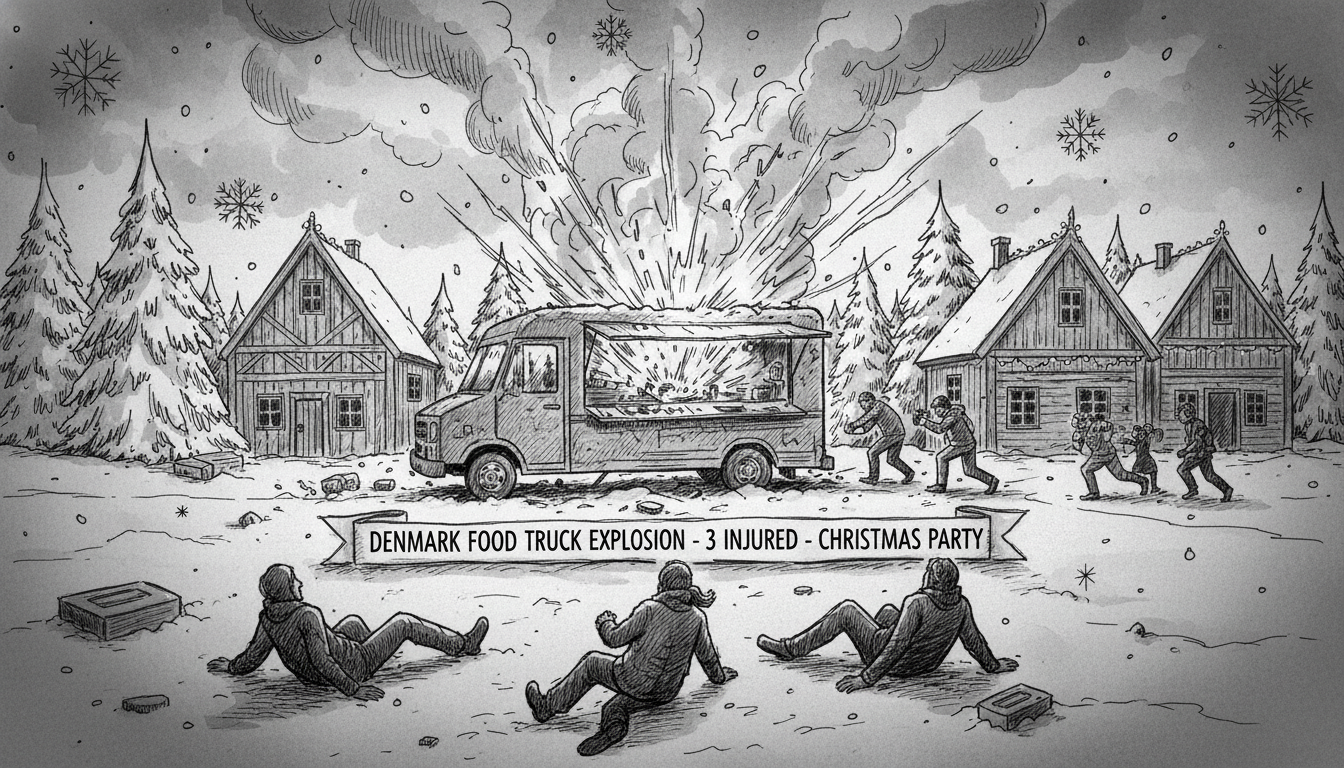
Denmark food truck explosion at a Skærbæk Christmas party sent three people to hospital with burns Saturday night. The blast occurred around 9 PM at a sports hall in Frifelt, where approximately 300 people were celebrating a festive julefrokost. Police say a partygoer lit a cigarette near a leaking gas cylinder connected to a food truck parked outside, triggering a fireball that destroyed the vehicle and injured two women and a man.
Emergency services, including police and the South Jutland Fire and Rescue Service, remained on scene until nearly midnight. All three injured individuals were transported to a hospital emergency room for treatment of their burns. Authorities confirm none were in critical condition immediately following the incident. The explosion abruptly ended a quintessential Danish holiday tradition, turning a night of celebration into one of shock and emergency response.
A Festive Gathering Turns Chaotic
The julefrokost, or Christmas lunch, is a cornerstone of Danish social life in December. Companies, clubs, and communities gather for a long, merry meal featuring traditional dishes, schnapps, and singing. The event in Frifelt was such a gathering, a community celebration inside a local sports hall. The festive atmosphere was shattered by a loud explosion that witnesses described as sudden and terrifying. The source was a food truck, a popular feature at modern events, stationed just outside the hall's entrance to serve guests.
Initial investigations point to a tragic sequence of mundane events. A gas cylinder supplying the truck's cooking equipment developed a leak. Natural gas, which is heavier than air, pooled in a confined area. When an attendee nearby lit a cigarette, the ignition source met the combustible gas, resulting in a rapid explosion and subsequent fire. This immediate cause, however, raises broader questions about operational safety protocols for mobile food vendors at crowded events.
The Rising Popularity and Hidden Risks of Food Trucks
Food trucks have surged in popularity across Denmark over the past decade. They represent culinary entrepreneurship, offering everything from gourmet burgers to Asian fusion at markets, festivals, and private parties like this Christmas event. Their mobility and variety have made them a welcome addition to the Danish food scene. Yet, this incident highlights the inherent risks of combining pressurized gas systems, high-heat cooking, and public spaces.
Safety regulations for these mobile kitchens involve a patchwork of oversight. National guidelines from the Danish Safety Technology Authority exist regarding gas installation and pressure equipment. However, daily inspection and enforcement often fall to local municipalities, which grant the operating permits. A food truck must typically demonstrate safe gas connections, proper fire extinguishers, and adequate ventilation. The critical question following the Skærbæk explosion is whether these protocols were followed, maintained, and respected on the night of the party.
“An accident like this is always a chain of failures,” said Lars Bjørn, a former fire safety inspector consulted for this article. “It starts with a mechanical failure—the leak. But it requires a human factor—the ignition source—and often a procedural failure, like the cylinder being placed or stored incorrectly, or a lack of clear safety zones. At a busy party, those zones can easily be ignored.”
Examining Safety Protocols for Event Vendors
The incident forces a scrutiny of responsibility at private events. When a company or community group hires a food truck, who is ultimately responsible for ensuring its safe operation? Is it the vendor, the event organizer, or the owner of the venue? In this case, the sports hall association likely rented the space. The party organizers hired the caterer. This diffusion of responsibility can sometimes lead to safety checks falling through the gaps.
Experts stress several non-negotiable rules for gas safety at events. Gas cylinders should be secured upright and protected from damage. Hoses and regulators must be regularly inspected for wear. A strict no-smoking zone, clearly marked, should be enforced around any gas equipment. Furthermore, vendors should conduct a simple leak check with soapy water on connections at the start of each service. These measures are basic but vital.
“We see this in many contexts, from construction sites to festivals,” Bjørn added. “Complacency is the enemy of safety. A cylinder that has been fine for months can develop a fault. That’s why the routines are so important. This wasn’t a complex industrial accident. It was a preventable failure in a everyday setting, which makes it so jarring.”
The Human Cost Beyond the Burns
While the physical injuries to the three individuals are the most immediate concern, the psychological impact of such a traumatic event can be widespread. Attending a Christmas party is an act of trust in one’s community and the safety of the environment. A sudden explosion violates that trust profoundly. For the 300 attendees, many of whom likely witnessed the flash and the aftermath, the memory of this julefrokost will be forever altered.
Community leaders in Frifelt now face the task of supporting those affected. In Denmark’s close-knit local societies, such an event reverberates through schools, workplaces, and family networks. The Danish welfare system, known for its robust social safety net, will provide the medical care needed. However, the informal community support—checking in on neighbors, offering help—becomes equally crucial in the days and weeks that follow a shared trauma.
Police have concluded their initial on-scene investigation, noting the likely cause. A formal report will be filed, and whether any further legal or regulatory action is taken depends on the findings regarding potential negligence. The food truck business involved now faces not only the total loss of its vehicle but a serious examination of its practices.
A Sobering Reminder During the Festive Season
This explosion serves as a stark, sobering reminder during Denmark’s most festive month. It underscores that risk management is not just for industrial workplaces but for all communal gatherings. For event organizers, it is a call to rigorously vet vendors and insist on seeing safety certifications. For food truck operators, it is a urgent warning to never cut corners on maintenance and safety checks. For the public, it is a lesson in remaining aware of one’s surroundings, even in a celebratory mood.
The julefrokost will go on across Denmark, as it should. But perhaps now, event planners will glance twice at the food truck’s setup. Vendors will double-check their gas lines with renewed vigilance. And guests might think twice before lighting a cigarette near any service vehicle. The tragedy in Skærbæk was a freak accident, but it emerged from a chain of ordinary oversights. Breaking that chain is a responsibility shared by everyone involved in bringing people together to celebrate.