
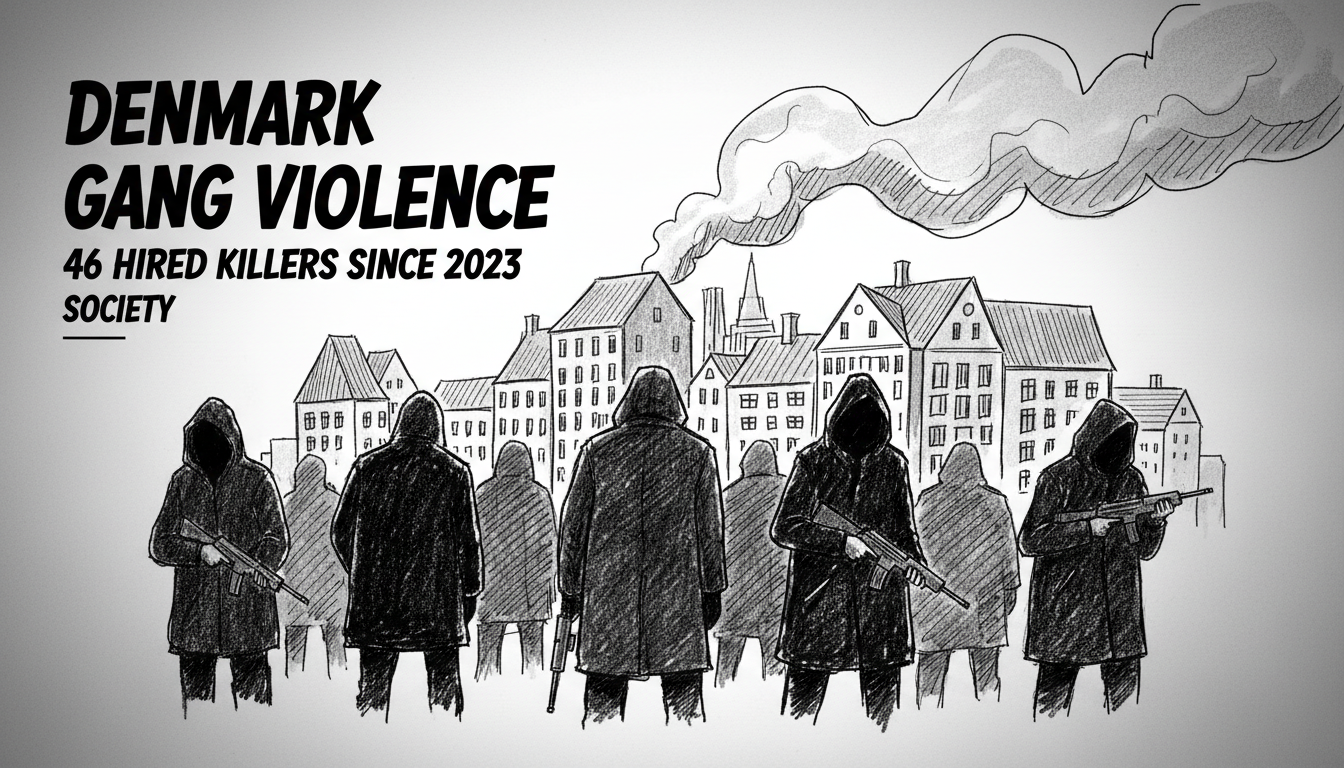
Denmark's criminal underworld is outsourcing violence to a shocking new demographic: children. A former gang member who participated in kidnappings and mutilation says current methods are too brutal even for him. At least 46 people, predominantly teenagers recruited from Sweden, have been involved in or en route to commit contract killings in Denmark since late 2023. This marks a dangerous evolution in organized crime that is alarming veterans and authorities alike.
A Veteran's Horror at New Brutality
He kidnapped a man, drove him to a forest, and told him to dig his own grave. For decades, he operated in the criminal underworld as part of a cross-border drug network. Today, he is anonymized for his safety, referred to here as ‘The Veteran’. He is horrified by what his old world has become. "What we did was completely extreme," he said. "But you can't even compare it to what's happening now. It's even more callous." The Veteran identifies the outsourcing of violence to minors as the core of this new brutality. These young recruits, often called 'torpedoes', are dispatched to commit murders while their handlers pull strings from the shadows.
"These are small children, 13, 14, 15, and 16 years old, who are sent from Sweden," The Veteran explained. "They get some message. You have to show up and get some money for a bus ticket or something, and then you go to Copenhagen, and they send a picture of someone. Boom, you go in and shoot him." The phenomenon has spread rapidly. A new mapping based on extensive material from court cases and investigations in Denmark and Sweden confirms the scale. The Veteran notes these youths often have no insight into how to kill. "Some may have never held a gun before. It's completely callous in my eyes."
The Erosion of Criminal 'Rules'
The brutality is not limited to the age of the perpetrators. The Veteran describes a fundamental shift in the underworld's code, where violence now extends far beyond direct rivals. "They shoot family members, they even take people further out on the periphery, friends of those who are to be punished," he said. "It's completely insane. That was completely out of the question back when I was in the environment." This expansion of targets creates a wider circle of fear and retaliation, destabilizing communities and making policing more complex. It represents a breakdown of former, albeit violent, norms that once contained conflicts within specific criminal circles.
This tactic serves a clear strategic purpose for crime bosses. By using disposable, inexperienced youth from another country, the actual organizers insulate themselves from direct involvement. The logistical chain—recruitment in Sweden, travel to Denmark, execution of the act—creates layers of deniability. If caught, the torpedo often knows little about who hired them or why. This cross-border element complicates jurisdiction and investigation for Danish and Swedish police, requiring unprecedented levels of cooperation.
A Cross-Border Crisis in Recruitment
The recruitment pipeline from Sweden points to deep-seated social vulnerabilities. Last year, 93 children under 15 were suspected in murder cases in Sweden. The Swedish government has proposed lowering the criminal age of responsibility in response. Experts point to factors like social marginalization, lack of opportunity in segregated neighborhoods, and the powerful lure of quick money and status offered by criminal networks. These groups exploit young people at a critical stage, offering a twisted sense of purpose and belonging.
For Danish communities, particularly in Copenhagen, the impact is direct and terrifying. Violence becomes more random and unpredictable as hired youths, unfamiliar with local dynamics, carry out attacks. This outsourcing model makes traditional gang policing, often focused on known rivalries and territories, less effective. The threat is imported, transient, and harder to track. It turns city streets into potential battlegrounds for conflicts the young perpetrators themselves may not understand.
Policy Responses and Social Foundations
Denmark has long combated gang violence with a dual strategy of enforcement and prevention. Police have specialized gang units, and legislation has been strengthened to tackle organized crime. The social policy aspect is crucial, focusing on early intervention in vulnerable housing areas, mentorship programs, and creating educational and employment pathways away from crime. The Danish welfare model, with its strong social safety net, is theoretically a protective factor. However, this new trend suggests those systems are being bypassed by cross-border recruitment targeting youth before Danish social services can engage.
Copenhagen's integration and social policy experts stress that the solution cannot be purely Danish. "This is a Scandinavian crisis," said a community leader from Nørrebro, who asked not to be named due to safety concerns. "The gangs operate across borders, so our prevention must too. We need to share data, strategies, and social programs with Swedish municipalities. A child recruited in Malmö is a potential victim on our streets." The challenge is integrating robust cross-border law enforcement with equally coordinated social welfare initiatives that address root causes in both countries.
The Human Cost of Calculated Chaos
The real cost is measured in shattered lives on all sides. The victims and their families suffer unimaginable loss, often from violence that feels arbitrary. The young perpetrators, themselves victims of exploitation, face decades in prison, permanent trauma, or death. Their futures are sacrificed for the profit and power of unseen bosses. The Veteran’s perspective is a stark reminder of how far the boundaries have been pushed. When someone who has committed grave violence is alarmed by new methods, society must take note.
The evolution towards younger, foreign-born hitmen represents a calculated corporatization of violence. It is efficient, deniable, and brutally effective for criminal organizations. For Danish society, it demands a reevaluation of whether current legal frameworks and social policies are equipped for a borderless criminal economy. The question now is whether Danish and Swedish authorities can build a cooperative response as agile and transnational as the threat they face. The safety of both nations' citizens may depend on it.