
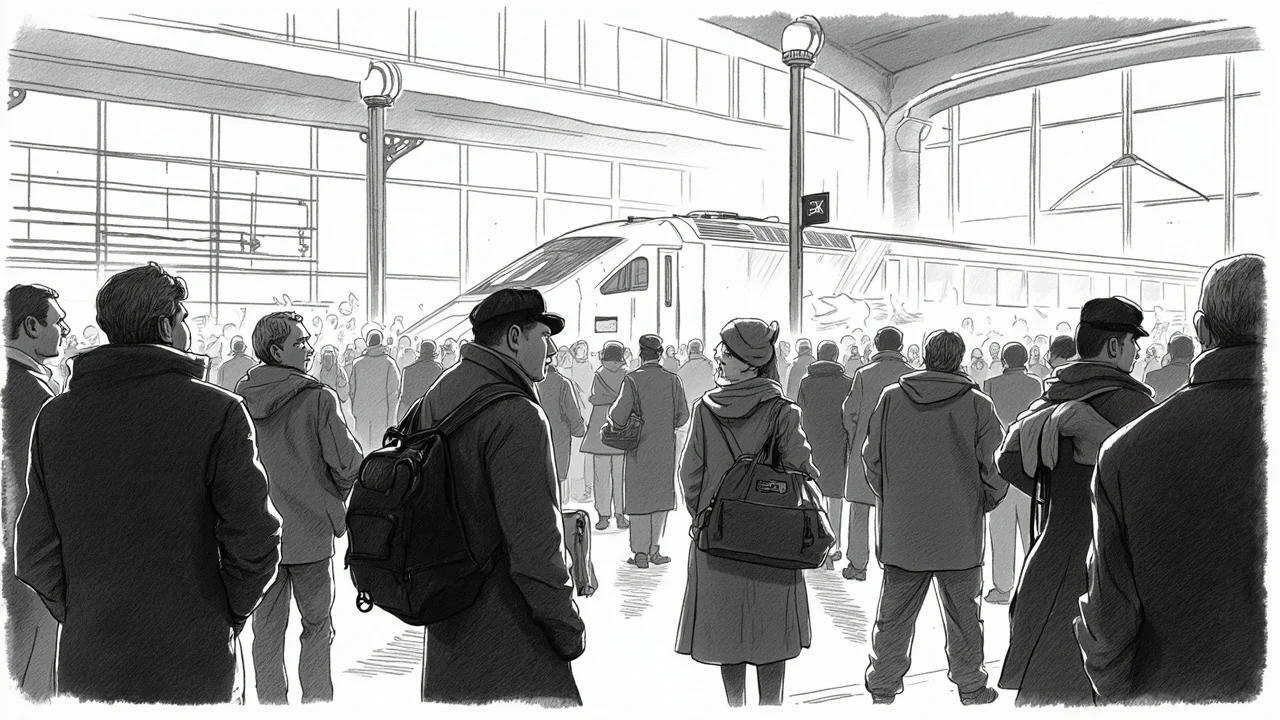
Denmark's national railway operator DSB cancelled all train services between Copenhagen and Hamburg on Saturday due to severe winter conditions. The cancellations, caused by snow, frost, and drifting snow, mark the second major disruption on the crucial international corridor in three days, leaving hundreds of passengers stranded and exposing the vulnerability of cross-border infrastructure to extreme weather.
DSB announced the blanket cancellation on its website, stating Deutsche Bahn had suspended all services in both directions. The only partial relief came from three scheduled departures from Copenhagen to Padborg, the Danish border town, with connecting bus services arranged from Padborg to Flensburg in Germany. This stopgap measure offered a fragmented and slow alternative for essential travel. The situation mirrored Thursday's chaos, when all but one departure on the route were also axed due to similar winter hazards.
A Critical Artery Severed
The Copenhagen-Hamburg railway is more than just a transport link; it is a vital economic and social conduit connecting Scandinavia to continental Europe. For daily commuters, business travelers, tourists, and freight, this line represents the backbone of the Femern Belt region's integration. Its repeated failure this week highlights a significant challenge for the Danish and German transport authorities. The cancellations disrupt complex travel itineraries, with knock-on effects for connections to Berlin, Amsterdam, and beyond, stranding people at stations like Copenhagen's Central or Hamburg's Hauptbahnhof.
Passengers received minimal notice, forced to scramble for last-minute alternatives. The replacement bus service from Padborg to Flensburg, while necessary, adds hours to a journey that normally takes under five hours by direct train. For families traveling with children or individuals with mobility issues, this presents a particular hardship. The financial and logistical toll on affected passengers is considerable, with questions arising about compensation and the adequacy of contingency planning for a known seasonal threat.
Systemic Stress in Winter
This incident is not an isolated anomaly but part of a recurring pattern that tests the resilience of Denmark's much-vaunted public transport system. While Danish domestic rail networks have protocols for snow and ice, international coordination with Deutsche Bahn introduces another layer of complexity. The decision to cancel all services suggests a precautionary approach, likely rooted in safety concerns over signaling, points freezing, or reduced visibility for drivers. However, it also prompts scrutiny of whether infrastructure investment and winter preparedness are sufficient for a main international route.
Analysts point to a broader tension within the Danish welfare model, which prizes reliable public services. When a core service fails repeatedly, it challenges public trust. The Danish approach to social policy often involves building robust systems to ensure predictability and equality of access. A major transport failure like this feels dissonant in that context, creating a gap between expectation and reality. It raises the question: should a system designed for high reliability have more resilient fallbacks for its most important international connections?
The Human Cost of Cancellation
Behind the official announcements are countless personal stories of disruption. A student missing a crucial family event, a businessperson failing to make a key meeting, a tourist seeing a meticulously planned holiday unravel. The social centers and waiting areas of Copenhagen's main station become temporary shelters for the stranded, a visible manifestation of the breakdown. For those reliant on affordable rail travel over flights, the cancellation removes their primary option, forcing expensive last-minute purchases or simply cancelling plans altogether.
This human impact is the immediate consequence of infrastructure vulnerability. In a society that values mobility and connectivity, such interruptions are more than inconveniences; they are fractures in the social and economic fabric. The situation is particularly acute for residents in the border region of Southern Jutland, for whom the train is a lifeline to larger urban centers for work, healthcare, and education. Their integration into a broader regional economy is momentarily paused by the weather.
Looking for Solutions on the Line
The repeated disruptions this week will inevitably lead to calls for review from passenger associations and political figures. Key questions will focus on coordination between DSB and Deutsche Bahn, the threshold for full cancellation versus managed delays, and the scalability of replacement bus services. Is the current protocol the only safe option, or can improved technology or more aggressive pre-emptive maintenance keep the line open?
Investment in winter-resilient infrastructure, while costly, may be necessary to safeguard a route of such strategic importance, especially with the future Fehmarn Belt fixed link promising even greater integration. The incident serves as a stress test, revealing where the system's weaknesses lie. For Danish transport policy, the goal is clear: to align the reliability of international corridors with the high standards expected of domestic services. Achieving that requires binational commitment and a recognition that in an interconnected region, transport policy is also social and economic policy.
As the snow eventually melts and normal service resumes, the memory of this weekend's cancellations will linger. It underscores a simple truth: even in a highly organized society, nature retains the power to disrupt. The measure of the system's strength will be found not in never failing, but in how quickly and effectively it learns, adapts, and prepares for the next winter storm. For now, passengers are left with a lesson in patience and the hope that their future journeys will be less dependent on the whims of the weather.