
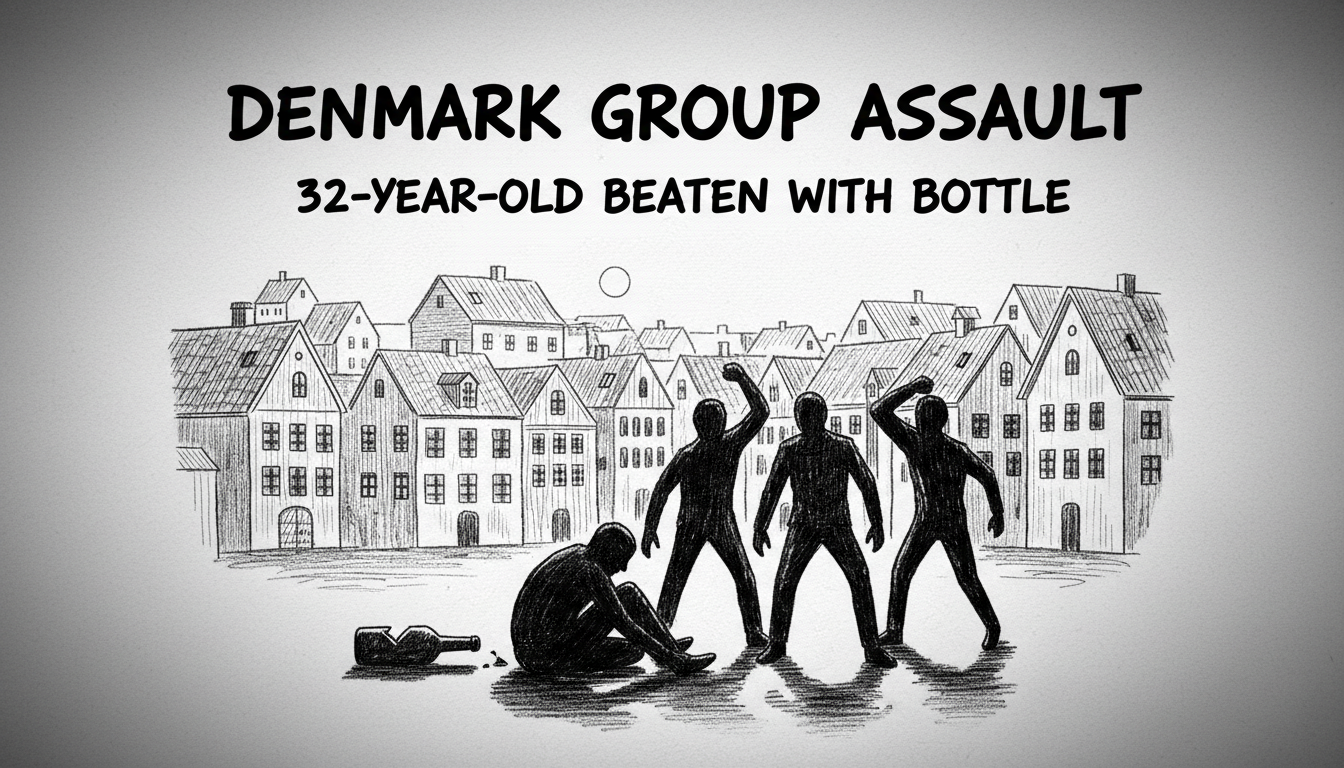
Denmark crime news centers on a brutal group assault in Herning, where a 32-year-old man was beaten by a crowd of 10 to 12 people. The attack occurred late Thursday evening on Vestergade, leaving the victim severely injured but not in life-threatening condition. Police describe the incident as a serious case requiring extensive investigation, with no arrests made yet.
A Violent Night in Herning
Around 11:30 PM, police in Herning received a report of a disturbance on Vestergade. Officers arrived to find a 32-year-old man who had been violently assaulted by a large group. "He was held down and received a lot of blows. Among other things, he was hit with a bottle," said Thomas Hald, the duty officer for Central and West Jutland Police. The victim was left badly beaten, a fact that elevates the case to the more serious end of the spectrum for local law enforcement. The motive remains unclear, transforming the quiet street into a crime scene that now demands significant police resources.
This incident disrupts the typical narrative of safety in Danish provincial towns. Herning, known for its concert hall and textile history, is not a frequent headline for violent street crime. The randomness and brutality of the attack, involving a weapon and overwhelming numbers, generate particular alarm. It forces a community to question the security of its public spaces after dark.
The Context of Crime in Denmark
Denmark maintains a reputation for low violent crime rates compared to international standards. Statistics from the Danish Ministry of Justice consistently show that the risk of being exposed to violence is relatively small. Yet, cases like this one reveal the persistent, unsettling reality of assaults, particularly linked to nightlife and group dynamics. They represent the challenging, frontline work for police districts across the country.
Criminologists often point to alcohol consumption, social conflicts, and group mentality as key factors in such spontaneous group violence. "When a large group targets an individual, the dynamics shift," explains a Danish criminologist who studies urban conflict. "Individual accountability diffuses, and aggression can escalate quickly, especially with the presence of weapons like bottles or other readily available objects." These incidents, while statistically less common than petty theft, have a profound impact on the public's sense of safety.
Police strategies in Denmark increasingly focus on visible presence in urban centers and nightlife districts to deter such acts. The immediate response in Herning followed standard protocol, but the failure to apprehend suspects on-site highlights the difficulty of policing fast-moving, large-group offenses. The investigation now turns to witness statements, potential CCTV footage from Vestergade, and forensic evidence.
The Investigation and Community Impact
The Central and West Jutland Police have launched a full investigation. Duty Officer Thomas Hald confirmed the case requires major investigative work, indicating a complex scene with many potential witnesses or participants to identify. The search is on for 10 to 12 individuals who disappeared into the night, leaving a man injured and a community searching for answers. No description of the perpetrators has been released, suggesting police are in the early evidence-gathering stages.
For the municipality of Herning, the attack is a jarring event. Local social services and victim support organizations often step in following such traumatic events, offering counseling and assistance to those affected. While major cities like Copenhagen and Aarhus see more frequent public discourse on street safety, an assault of this nature in a smaller city resonates deeply. It shatters the assumption that serious violence is confined to metropolitan areas.
Community policing models, where officers build relationships within neighborhoods, are tested by these incidents. They rely on public cooperation, which investigators will now need to piece together the events leading to the assault. The police appeal for information will be a critical next step, hoping someone from the community comes forward with details.
A Personal Reflection on Safety and Society
Reporting on crime in Denmark often involves balancing statistical reassurance with the raw human impact of single events. The numbers say one thing; the experience of a man held down and beaten by a dozen people says another. As a reporter focused on Danish society and integration, I see how incidents like this feed into broader anxieties about social cohesion and public order, even in towns far from integration debates.
There is a tangible fear that stems from random, group violence. It feels different from a bar fight or a personal dispute. It suggests a pack mentality where violence is not a means to an end but the activity itself. For the victim, the physical wounds may heal, but the psychological trauma of being overpowered by a crowd can linger for years. The Danish welfare system, with its strong healthcare and social support networks, will be tasked with that longer-term recovery.
Furthermore, these events put pressure on the Danish police force. They are expected to maintain the country's high safety standards with visible patrols and rapid response, while also conducting complex investigations that may involve tracking large groups of individuals. Resources are always a topic of political discussion, especially in regional districts covering vast areas.
Looking Ahead: Justice and Prevention
The path forward for this case hinges on the police investigation. Will CCTV footage provide clear identities? Will witnesses from the group or the surrounding area provide statements? The answers will determine if arrests are possible. Danish law prescribes significant penalties for grievous bodily harm, particularly when carried out by multiple assailants or with the use of a weapon.
Preventatively, the conversation may turn to nightlife safety and urban design. Are lighting and surveillance adequate in areas like Vestergade? What is the role of bar and restaurant staff in identifying and de-escalating tensions before they spill onto the street? These are practical questions local authorities and business owners will consider.
Ultimately, this assault in Herning is a stark reminder. No society, regardless of its overall peacefulness, is immune to moments of brutal violence. It tests the responsiveness of institutions, the resilience of the community, and the foundational sense of trust that allows people to walk their streets at night. The coming days will reveal whether the perpetrators can be found and held accountable, offering some measure of justice for the 32-year-old victim and the town of Herning.