
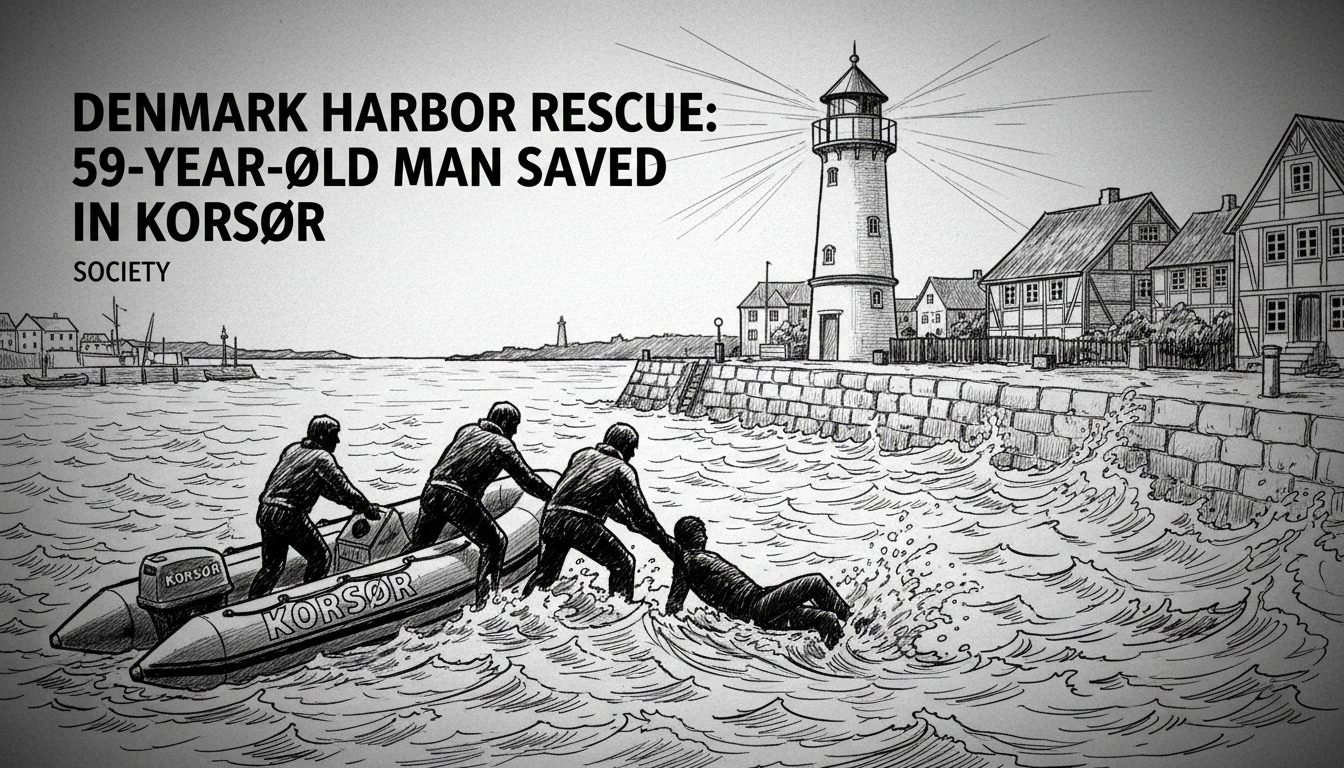
Denmark harbor rescue teams pulled a 59-year-old man from the cold waters of Korsør harbor early Sunday morning. The incident at Havnearkaderne highlights the ever-present dangers of Denmark's coastal communities and the swift response required to prevent tragedy. Police received the emergency call at 6:44 AM, launching a rapid operation that successfully retrieved the severely hypothermic man and transported him to Slagelse Hospital for urgent care.
According to Kasper Skotte, the duty officer for South Zealand and Lolland-Falster Police, the man's plunge into the harbor appears to be a result of his own carelessness. The exact circumstances leading to the fall remain unclear as investigations continue. This early-morning rescue underscores a critical, often overlooked aspect of public safety in a nation defined by its relationship with the sea.
A Swift Response in the Early Hours
The police report details a precise timeline, beginning with the 6:44 AM alert. Emergency services, including harbor patrol and medical teams, mobilized immediately. The location, Havnearkaderne, is a known docking area in Korsør, presenting specific challenges for rescuers. Cold water immersion, especially in the early morning hours, drastically reduces survival time and necessitates a rapid extraction.
"When the emergency services got him up, he was very hypothermic," Skotte stated, emphasizing the immediate medical threat. Hypothermia sets in quickly in Danish waters, even in late summer, impairing motor function and leading to cardiac arrest. The man's transport to Slagelse Hospital, the central medical facility for Region Zealand, followed standard protocol for severe temperature-related trauma.
The Perils of the Harbor Front
Korsør's identity is inextricably linked to the water. For centuries, it served as the vital ferry crossing point over the Great Belt, connecting Zealand to Funen. While the iconic bridge now handles most traffic, the harbor remains active with commercial and leisure vessels. This incident is a stark reminder that working waterfronts, while picturesque, are inherently hazardous environments.
Slippery surfaces, uneven lighting, and sudden changes in weather can turn a casual stroll into an emergency. Police suspicion of "egen uforsigtighed" or "own carelessness" points to a common, tragic theme in such accidents. A momentary lapse in attention, potentially compounded by other factors, can have immediate, life-altering consequences. It serves as a public safety reminder for all coastal towns.
The Science of Cold Water Rescue
Expert context reveals why this rescue was particularly critical. Search and rescue operations in harbor settings are complex. Water visibility is often poor, hiding submerged obstacles. The cold shock response can cause involuntary gasping and hyperventilation, leading to drowning within minutes. Specialized training and equipment are essential for responders navigating these risks.
"The first priority is always getting the person out of the water as fast as possible," explains a veteran Danish coastal rescue instructor who asked not to be named. "Every second counts when dealing with hypothermia. The successful outcome in Korsør likely depended on a combination of a fast witness report, efficient coordination between police and rescue units, and skilled medical intervention on the scene." The rapid hospital transfer was the next crucial link in the survival chain.
Community Safety and Municipal Responsibility
This event shifts focus to the broader framework of public safety infrastructure in Danish municipalities. Slagelse Municipality, which governs Korsør, is responsible for maintaining safe public spaces along its coastline. This includes adequate lighting, secure railings, and clear signage in high-risk areas like Havnearkaderne. While individual responsibility is paramount, the municipal duty of care is a constant subject of evaluation after any accident.
Danish welfare principles extend to preventative safety measures. Do current protocols around harbor fronts balance open public access with necessary risk mitigation? Following such incidents, local councils often review safety audits. The question becomes whether environmental design can further reduce the potential for human error, a key consideration in Denmark's proactive social policy approach to accident prevention.
A Narrow Escape and Broader Reflections
The rescued man's condition upon arrival at Slagelse Hospital indicated a serious medical event. Treatment for severe hypothermia involves careful, controlled rewarming to avoid dangerous complications like afterdrop, where cold blood from the extremities returns to the core. His prognosis, while undisclosed, hinges on the speed of the initial response and the quality of hospital care.
This incident, while ending in a rescue, invites quiet reflection on vulnerability. It occurred not during a storm, but on a Sunday morning. It did not involve a ship, but the harbor's edge. These details make it relatable and unsettling. They remind us that danger in Denmark's beautiful maritime settings is often mundane and proximity-based. The community's safety net—from the alert citizen to the police, rescuers, and hospital staff—was tested and held firm.
The Unanswered Questions and Moving Forward
As the man recovers, several questions linger. What was the precise sequence of events leading to the fall? Are there lessons for harbor safety in Korsør and similar towns? How can public awareness of cold-water risks be improved? The police's preliminary assessment points to an accidental slip, a theory that will be solidified as the man is able to provide his own account.
For now, the story remains one of successful intervention. It showcases the efficiency of Denmark's integrated emergency response system, where police, rescue services, and healthcare providers coordinate seamlessly across Region Zealand. It is also a human story of a life hanging in the balance at dawn, saved by a chain of swift actions. As the community in Korsør goes about its week, the silent harbor walls hold the memory of a morning when vigilance and professionalism averted a far sadder headline.