
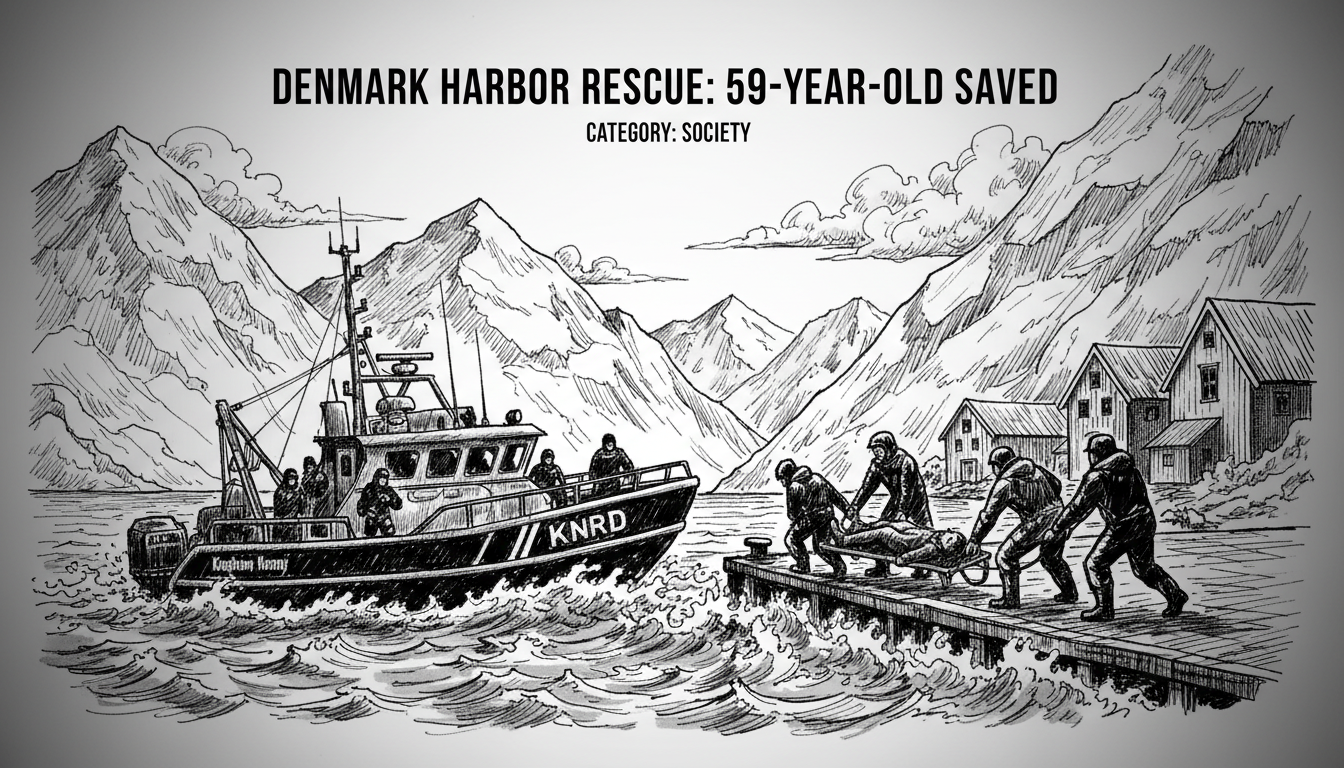
Denmark emergency services pulled a 59-year-old man from Korsør harbor at 6:44 AM on Sunday. Police responded to a report of a person in the water near the Havnearkaderne area. The man was severely hypothermic when rescued and rushed to Slagelse Sygehus for treatment. Initial police assessment suggests the incident resulted from his own carelessness. As a reporter focused on Danish society, I see such events as moments to examine our communal safety nets.
The Morning Call to Action
Police in the Sydsjælland and Lolland-Falster district received the alert just before dawn. Vagtchef Kasper Skotte confirmed the man's age and the location. Rescue teams worked quickly to retrieve him from the cold Belt Strait waters. The operation highlights the precision of Denmark's regional emergency response systems. Every minute counted in preventing a tragic outcome.
This incident occurred in a working harbor area. Such environments pose inherent risks, especially during early hours. The police have not indicated any suspicion of foul play. Their focus remains on understanding the precise circumstances. Investigations in these cases typically involve checking for witnesses or surveillance footage.
Korsør: A Community Defined by Water
Korsør is a historic ferry port town in Slagelse Municipality. It sits on the Great Belt strait, connecting Zealand and Funen. The town's identity is intertwined with maritime activity. For decades, it was a vital ferry crossing point. Now, it is overshadowed by the Great Belt Bridge, a key national infrastructure piece.
The harbor where the man was found is part of this living history. It is a place of transit, work, and sometimes solitude. Waterfront safety is a constant concern for Danish coastal municipalities. Slagelse Municipality, like others, implements regulations for public areas near water. Yet, accidents can still happen in an instant.
From an integration perspective, ports often symbolize connection and transition. They are gateways for people and goods. Ensuring safety in these spaces is a shared social responsibility. It reflects how Denmark manages public spaces for everyone's benefit.
The Anatomy of a Harbor Rescue
When a person falls into Danish waters, a coordinated machine springs to life. Police, ambulance services, and sometimes the coastal guard are mobilized. The goal is swift extraction and medical stabilization. Hypothermia is a primary threat, as it was for this man. Cold water shock can incapacitate even strong swimmers within minutes.
Kasper Skotte's statement points to 'egen uforsigtighed' or own carelessness. This is a common preliminary finding in such cases. It underscores a need for personal vigilance near water. Danish authorities often launch public awareness campaigns about waterfront risks, especially in summer. However, this incident serves as a cold-weather reminder.
Data on harbor accidents in Denmark is not centrally aggregated in public reports. Yet, local rescue services respond to dozens of water-related incidents annually. Each case is a potential tragedy averted or a life lost. They prompt reviews of safety signage and barrier adequacy.
The Human Cost and Community Fabric
The rescued man's current condition is not publicly known. His experience, however, resonates beyond the hospital ward. For a community like Korsør, such an event is a shared moment of concern. It tests the strength of local support networks and emergency preparedness.
In Danish social policy, health and safety are pillars of the welfare system. A single accident triggers multiple responses: medical care, police inquiry, and possibly follow-up by municipal social services. If the man is a resident, his recovery may involve community health nurses or social workers. This integrated approach aims to address both immediate and longer-term needs.
As a journalist, I consider how individual vulnerability intersects with public infrastructure. Was the man a local fisherman, a worker, or a visitor? While his identity is private, his situation raises universal questions. How do we protect individuals in moments of personal crisis? Are our public spaces designed with enough safeguards?
Prevention in the Danish Context
Danish municipalities have extensive authority over local public safety. Slagelse Municipality, responsible for Korsør, likely reviews incident reports to identify patterns. Potential actions include installing better lighting, adding railings, or increasing patrols in harbor areas. Community social centers also play a role in outreach, educating residents about risks.
Integration policy often emphasizes participation and safety for all residents, regardless of background. Ensuring that waterfronts are safe for everyone—long-time locals and newcomers alike—is part of that mission. Clear signage in multiple languages and community safety workshops could be tools.
The Great Belt Bridge stands as a symbol of modern Danish engineering and connectivity. Yet, the older harbor beneath it requires ongoing attention. Balancing historic charm with contemporary safety standards is a challenge for many Danish towns.
This rescue was a success for the emergency responders. But it should also be a catalyst for reflection. How many similar near-misses occur before a fatality? Proactive investment in safety measures is cheaper than the human cost of an accident.
A Moment of Collective Breath
The man pulled from Korsør harbor will hopefully recover fully. His story is a brief headline, but its implications ripple outward. It reminds us that Danish society's strength is tested in quiet, early-morning emergencies. The response systems worked this time. The question for community leaders is how to make sure they never need to.